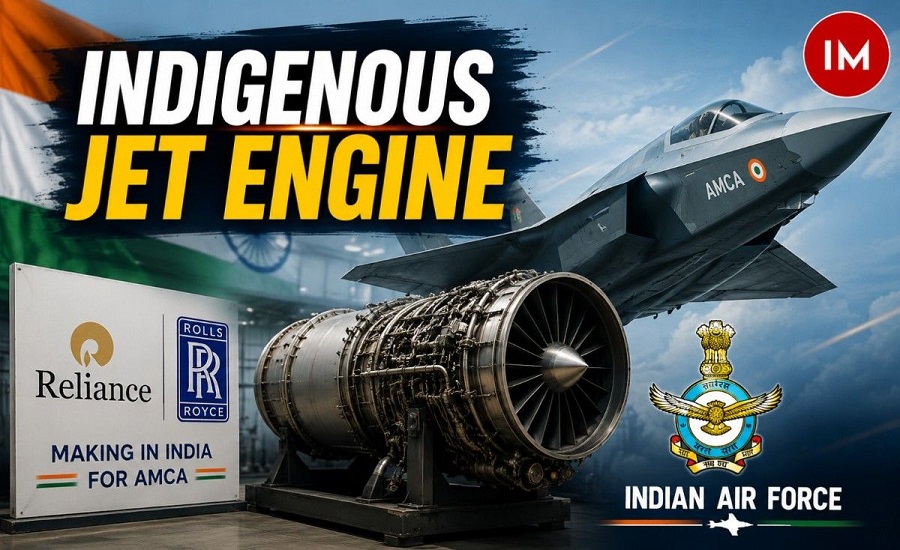
New Delhi: Rolls-Royce AMCA Engine proposal has emerged as a major contender in India’s quest for an indigenous fighter jet powerplant. The British aerospace giant, in partnership with Reliance Industries, has outlined plans for a 120kN-class engine for the Advanced Medium Combat Aircraft (AMCA), with a future upgrade path that could boost output to 145kN wet thrust. The proposal highlights technology transfer, Indian intellectual property ownership, and long-term self-reliance in advanced aero-engine technology.
Rolls-Royce And Reliance Offer Indigenous AMCA Fighter Engine
Rolls-Royce and Reliance Industries announced their strategic intent in August 2026 to jointly develop and manufacture a sovereign combat engine for India’s AMCA programme.
The partnership aims to combine Rolls-Royce’s engine expertise with Reliance’s industrial and manufacturing capabilities. Both companies are also exploring the creation of a dedicated Aerospace Gas Turbine Complex in India.
Dedicated Aerospace Hub Planned In India
The proposed facility would support the complete engine lifecycle. This includes design, development, testing, production, maintenance, and long-term operational support for future Indian aerospace programmes.
What Is Rolls-Royce Offering For AMCA Fighter Engine
According to reports, the initial proposal focuses on a 120kN thrust-class engine suitable for future AMCA variants. The engine’s core is expected to generate around 73kN dry thrust. However, the design is being planned with future scalability in mind.
Future Upgrade To 145kN Wet Thrust
One of the most significant aspects of the proposal is its growth potential. Rolls-Royce has reportedly designed the engine architecture so that the dry thrust core can be enhanced in the future. This could eventually support an engine capable of producing up to 145kN wet thrust for more advanced fighter aircraft requirements.
Why 145kN Engine Matters
A higher-thrust engine would allow future AMCA variants to carry heavier payloads and more fuel. It would also improve acceleration, range, and overall combat performance while supporting advanced mission systems and next-generation air combat requirements.
AMCA Fighter Engine: India To Retain Intellectual Property Rights
A key feature of the Rolls-Royce proposal is the emphasis on Indian ownership. Rolls-Royce has repeatedly highlighted its willingness to support indigenous development and sovereign capability for India. Reports indicate that India could retain full intellectual property rights over the engine developed under the programme.
Strategic Importance For India
Control over intellectual property would allow India to upgrade, modify, and adapt the engine for future programmes without depending on external approvals. This is considered a critical objective under India’s Atmanirbhar Bharat and defence self-reliance initiatives.
AMCA Needs A Powerful Indigenous Engine
The AMCA is India’s fifth-generation stealth fighter aircraft programme. While early AMCA Mk1 aircraft are expected to use GE F414 engines, future versions will require a more powerful engine in the 110-130kN class and beyond. Developing such an engine domestically remains one of India’s most important aerospace goals.
Lessons From The Kaveri Programme
India has pursued indigenous fighter engine technology for decades through the Kaveri engine project. Although the programme generated valuable experience, it did not achieve the performance needed for frontline fighter aircraft. This makes the AMCA engine project particularly important for India’s future aerospace ambitions.
Competition With Safran Intensifies
Rolls-Royce is not the only company seeking a role in the AMCA engine programme. French aerospace company Safran has also proposed a partnership with India’s Gas Turbine Research Establishment (GTRE) for developing a next-generation fighter engine with significant technology transfer.
The final decision will likely depend on technology transfer commitments, intellectual property arrangements, development timelines, cost, and long-term strategic benefits for India.
What Happens Next
Government evaluations and discussions on the AMCA engine programme are continuing. If approved, Rolls-Royce’s roadmap reportedly targets engine core testing by 2030, first flight testing around 2034, and full-scale production by 2036.
Read also: Can TEJAS And AMCA Fill India’s Fighter Squadron Gap? New Study Raises Questions
FAQs
The proposal involves Rolls-Royce and Reliance Industries jointly developing an indigenous combat engine for India’s AMCA stealth fighter programme, starting with a 120kN-class engine.
Yes. Reports indicate the engine architecture is designed with a future upgrade path that could increase performance to approximately 145kN wet thrust.
Full intellectual property rights would allow India to independently modify, upgrade, and manufacture future versions of the engine without relying on foreign approvals.