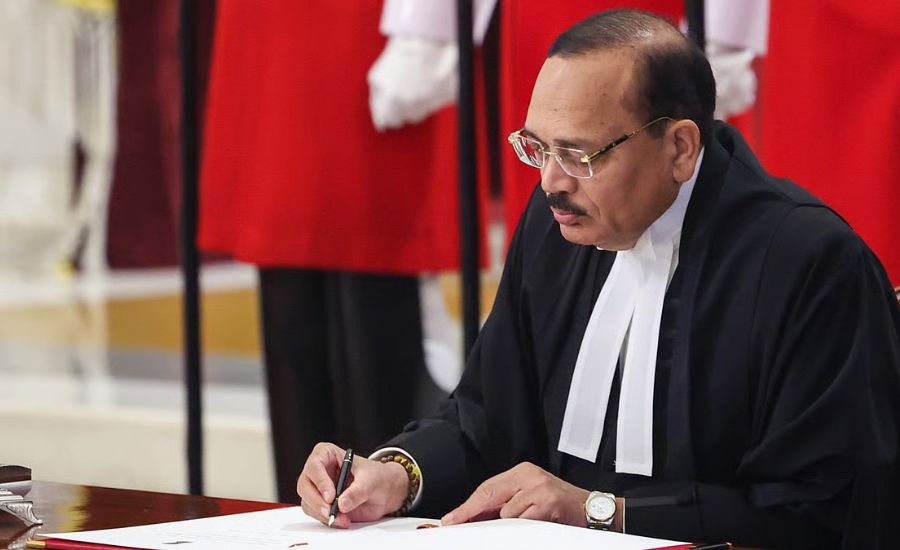
New Delhi: Climate displaced people must receive a separate legal status as the climate crisis creates new challenges that existing refugee and migration laws were never designed to address, Chief Justice of India Surya Kant said. Speaking at the High-Level Commonwealth Policy Dialogue on Climate Justice in London, the CJI warned that climate change will test long-standing legal frameworks and require courts, lawmakers, and educational institutions to adapt to a rapidly changing world.
CJI Surya Kant Calls For Recognition Of Climate Displaced People
Chief Justice Surya Kant said that people forced to leave their homes because of environmental degradation deserve a legal identity of their own.
Read also: Bar Council of India Reforms Plea: Key Demands Against Chairman Manan Kumar Mishra
According to him, existing refugee and migration laws do not adequately cover people displaced by climate-related events and environmental decline. As a result, many affected communities remain caught between legal categories that were never created for their situation.
Climate Change Is Challenging Traditional Legal Systems
The CJI emphasized that the climate crisis is pushing the boundaries of legal systems around the world. He noted that judges and legal institutions must ensure that laws remain clear and effective, especially for vulnerable communities that face the greatest risks from climate change.
Climate Justice Must Protect The Most Vulnerable
Speaking at the Commonwealth event organized by the Commonwealth Secretariat and the Commonwealth Legal Education Association (CLEA), CJI Surya Kant highlighted that climate vulnerability is not equally distributed. He said that communities dependent on natural resources often suffer first and most severely from climate-related disasters.
These include fishing communities, farmers, and rural populations whose livelihoods depend directly on land and water resources.
Climate Displaced People: Climate Impacts Go Beyond Environmental Damage
The Chief Justice explained that climate-related losses are not limited to environmental harm. When families lose land, water, or crops due to climate events, the impact affects their income, dignity, social equality, and long-term security.
Climate Displaced People: CJI Raises Concerns Over Global Energy Transition
CJI Surya Kant also spoke about the challenges developing nations face during the transition to clean energy. He pointed out that industrialized countries spent more than two centuries building their economies through coal and oil, while developing nations are now being asked to shift rapidly to renewable energy within a much shorter period.
Need For A Fair And Balanced Transition
The Chief Justice stressed that climate policies should consider the different economic realities of countries. He called for a fair distribution of responsibilities and burdens arising from the global transition to cleaner energy systems.
Courts Will Play A Bigger Role In Climate Displaced People Disputes
According to the CJI, judges increasingly face difficult decisions that require balancing development needs with environmental protection. He said courts must understand not only what the law says but also the real-world conditions in which laws operate. This approach is becoming increasingly important as climate-related litigation grows across jurisdictions.
Environmental Protection And Development Can Coexist
The Chief Justice rejected the idea that environmental protection and economic development are always opposing goals. He cited judicial interventions where courts allowed essential public projects to proceed while also ordering environmental safeguards and compensatory measures.
Experts Needed In Climate Litigation
CJI Surya Kant said environmental disputes are becoming more scientific and technically complex. Because of this, courts need ongoing support from scientists, environmental experts, economists, and policy specialists rather than relying solely on legal professionals.
National Green Tribunal Model Highlighted
The Chief Justice referred to the National Green Tribunal (NGT) as an example where judicial and technical experts work together. He suggested that environmental adjudication benefits when scientific expertise becomes part of the decision-making process.
Climate Displaced People: Law Schools Must Adapt To Climate Challenges
The CJI said legal education must evolve to meet future climate challenges. He urged law schools to give greater attention to climate and environmental law through practical learning, interdisciplinary research, and engagement with real-world environmental disputes.
Climate Law Should Become A Mainstream Subject
According to the Chief Justice, environmental law can no longer remain a niche subject studied by only a small group of students. As climate disputes become more frequent and technically demanding, future lawyers will require deeper knowledge of environmental and climate governance.
Read also: Chief Justice of India Surya Kant Responds Strongly After Fake Caste Comment Spreads Online
FAQs
He argued that developed nations took centuries to build their economies using fossil fuels, while developing countries are now expected to transition to clean energy much more quickly, creating fairness concerns.
CJI Surya Kant said that people displaced by climate change and environmental degradation deserve a separate legal status because current refugee and migration laws do not adequately address their situation.
He believes climate disputes are becoming more scientific and complex, making it necessary for future lawyers and judges to receive stronger education in environmental and climate law.