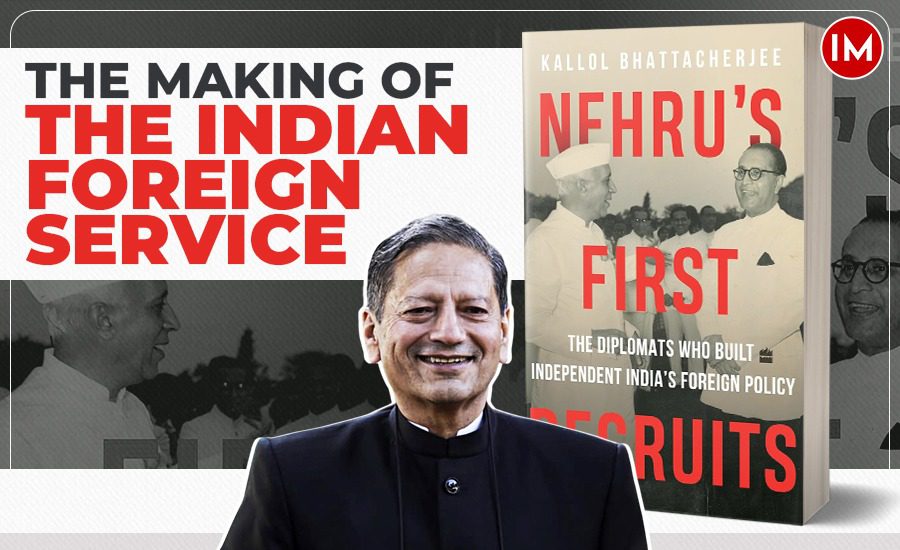
If Sardar Patel is the patron saint of the IAS, with respect to the diplomatic corps,the same sobriquet has to be applied for Nehru. For the record, while the first batch of the IAS was recruited even before Independence, the first formal recruitment to the IFS took place a year later, through the common civil services examination conducted by the Federal (now Union) Public Service Commission. From the correspondence between the undersecretaries in the External Affairs and the Home Ministry, the tensions between these two stalwarts on how the recruitment should be made comes to the fore – for while the Home department was very firm that but for certain exceptions, the general norm for recruitment had to be followed in the case of the IFS as well. However, we know from the memoirs of civil servants of that era that Nehru would personally interview the toppers of the Civil services exam to check the suitability of those whom he felt should represent India abroad. All this, and much more, comes to light in Kallol Bhattacharjee’s excellent book ‘Nehru’s First Recruits: The Diplomats Who Built Independent India’s Foreign Policy’ published by Harper Collins last year.
Of course the predecessor service to both the IAS and the IFS was the ICS, and the senior most member of the ICS Sir Girja Shankar Bajpai was actually designated as Secretary General. But this book, is not just about those who entered the Foreign service through the ICS and the IFS route – it is also about patricians, princes, journalists, poets, stenographers, INA members and radio announcers who were often asked to take up positions in different parts of the world to meet the extraordinary situation that emerged at the end of the Second World War. Bhattacherjee has reconstructed these stories after a series of interactions with the principal proponents, and in some cases their family members besides secondary research on the contemporary political and cultural climes of the times. The actions of these individuals set the context of India’s engagement with many of these countries, as in the case of Indonesia.
Thus P.R.S Mani, an intrepid journalist who became an embedded war correspondent with the PR Directorate of Indian Army was taken as a PoW in the battle of Surabaya where as part of the Allied troops, the Indian soldiers were conflicted in their mandate to crush the Indonesian freedom fighters vis a vis their support for the liberation of the country. After the War, he quit the military, rejoined the Free Press Journal and went back to Indonesia where he earned the friendship of the leading lights of the freedom movement, including Ahmed Soekarno, whose Balinese Hindu mother had raised him in a cultural milieu where Mahabharata was the text which marked his growing up years. It was at Mani’s suggestion that the two newly liberated Asian giants started a unique barter under which Indonesia supplied rice to India– reciprocated in kind by offering textiles and medicines. Of course as we are all aware, Soekarno was the Chief Guest at the first Republic Day parade in India on 26th January, 1950, and earlier this year, the honour was again extended to President Prabowo Subianto on the 76th Republic Day celebrations at New Delhi.
The other media personnel who joined the Foreign service included Ranbir Singh, Ascharaj Ram Sethi, Samuell Verghese, Fredrick Kamath, Uma Shankar Bajpai and Purshottam Lal Bhandari. By this time, regular recruitment to the IFS, and secondments from the ICS began to form the nucleus of the newly created service, the bare details of which were published as a classified document ‘History of Services of Officers of the Indian Foreign service (branches A & B) in 1958. The ICS men who dominated the foreign policy space included Y.D. Gundevia, C.S. Jha, Rajeshwar Dayal, T.N. Kaul, and Kewal Singh — all of whom became foreign secretaries before the IFS took over the South Block (the headquarters of the MEA). MK Rasgotra, of the 1952 batch, took over as the first direct recruit foreign secretary in 1982
Bhattacherjee then takes up the extraordinary careers of some of these exceptional officers – starting with Brijesh Mishra of the 1951 batch who became the most trusted
aide to Vajpayee and India’s most powerful NSA ever for he concurrently held the position of the Principal Secretary to the Prime Minister as well. These first generation diplomats included J.N. Dixit–who also became the NSA, C.B. Muthamma, the first female recruit as also Mira Sinha-Bhattacharjea and Mira Ishardas Malik the first female recruit posted to China, Eric Gonsalves who organized the first successful evacuation of Indians from Burma (Now Myanmar), A.P. Venaktesawaran, Kamtekar besides K. Natwar Singh, Romesh Bhandari, both of whom joined the Congress party as active politicians. The discrimination and bias faced by the women officers has been examined at length by the sociologist Patricia Uberoi.
Let me share some words about some of them – especially Dileep Shankarrao Kamtekar, the topper of the 1952 batch, and also the father of Indiver, my friend and batchmate from the CHS at JNU whom Bhattacherjee interviewed at length for this book. Kamtekar was the only outsider in his batch – for the other four- Venaktesawaran, K.S. Bajpai, Uma Shankar and Jagdish Chand Ajmani – all had an ICS connection. No wonder then that this chapter is called ‘The outsider becomes an Insider’. Indiver has also shared the memories of the IFS families growing up together at the IFS hostel at KG Marg, especially the blackouts and bunkers during the 1971 war with Pakistan which led to the birthing of Bangladesh.
The author of Madhushala and the great Hindi poet from Nehru’s constituency, Allahabad, was none other than Harivansh Rai Bachchan (now known for being the father of Amitabh Bachchan). He was also inducted into the Ministry to promote Hindi, and the term ‘Videsh Mantralaya’ was coined by him. Bachchan and Nehru had a major difference of opinion about how Hindi should evolve. For Nehru, Hindi and Urdu were both ‘Hindustani’, but Bacchan disagreed. While Urdu, Arabic and Farsi words could be used in Hindi, it was not a creole.
The man who shares the cover page with Nehru also has a very interesting tryst with history, for not only did he set the protocol about protocol, but had started his career in public life as the secretary to M.A. Jinnah, who was the pole opposite to whatever Indian foreign policy stood for. Baig and his better half Tara were responsible for the reception, culinary layout and the cultural programs on the occasion of the first ever visit of Soviet leaders Khrushchev and Bulganin to India in 1955. Unlike Stalin, Khrushchev was far more positively inclined towards India, and in fact visited Srinagar and declared – much to the chagrin of Pakistan – that Jammu and Kashmir was an integral part of India. Educated in England, Baig started his professional career as a young lieutenant with the 16th Light Cavalry in 1916. While commanding his unit at Jhansi in 1927, he met with all the Nehru’s, except Jawaharlal who had gone to the USSR to mark the tenth anniversary of their Revolution. Later he worked for the Tatas, as well as Jinnah’s secretary and then the Director of the National War Front – to mobilize opinion against the Nazi threat. At the eve of Independence, Nehru chose him to become India’s Consul General at Panjim in the (then) Portuguese colony of Goa, where he had the singular honour of flying the Tricolour at the Consulate in the large colonial structure on Altinho Hill.
The book ends with a counter intuitive interpretation about Dronacharya’s insistence on getting Eklavya to cut his thumb as a tribute (Guru Dakshina) to him from the Sambhava Parv of the Mahabharat. The cruelty of Drona was also a sign of his remarkable, single minded quest for revenge and strategic insight where nothing except victory for his cause mattered. He was determined that in the event of a challenge to the Kuru kingdom, no king including Drupad should have the ability to hire a commander as competent as him. This then is the ethic and the realpolitik of a nation state which wants to extend its strategic reach in the extended neighborhood. Whether or not Nehru agreed with this is not disclosed, but his first recruits certainly did.