For decades, food security in India has been viewed primarily through the prism of crop production. Policy discussions have consequently focused on irrigation, seeds, yields, storage and crop markets. These interventions remain essential. But for a small farmer, food security is not determined by the harvest alone. It also depends on whether the household can withstand a failed monsoon, a medical emergency, a fall in commodity prices or the long interval between two cropping seasons.
Small and marginal farmers account for 86.2 per cent of India’s operational holdings but operate only about 47 per cent of its cultivated area. This structural reality requires us to look beyond crop productivity alone. Food security must rest upon livelihood security: diverse income sources, productive household assets and institutions that give small producers greater stability and bargaining power. Goat rearing can play a pivotal role in this transition.
A Small Asset with Strategic Value
India had approximately 148.88 million goats under the 2019 20th Livestock Census, an increase of about 10 per cent over the previous census. The scale is significant, yet the contribution of goats to household resilience is still not adequately reflected in mainstream conversations about food security.
For rural families, goats can serve simultaneously as productive assets, sources of periodic income and stores of value. They generally require less space and initial investment than larger livestock, making them comparatively accessible to small, marginal and land-poor households.
A family can begin with a few animals and expand its herd gradually. The sale of animals, milk or other products can supplement crop income and provide cash for school fees, healthcare, farm inputs and household expenses. This is why goats are often described in rural India as a chalta-phirta ATM, literally a “walking ATM”, or a living bank account. They convert biological growth into liquidity and can be sold when a household most needs cash.
This does not mean goat rearing is without cost or risk. Feed, housing, healthcare and labour must all be considered. But with the right support, goats can add an economic layer to the household rather than leaving it entirely dependent on one crop or agricultural season.
Also Read – Sardar Patel’s Steel Frame: Are We Strengthening Institutions or Ourselves?
A Buffer Against Climate and Market Shocks
Climate variability is making crop-dependent livelihoods increasingly precarious. Erratic rainfall, drought, unseasonal weather and pest outbreaks can sharply reduce production. Even when the harvest is good, falling commodity prices may erode farm income.
Livelihood diversification distributes this risk. When crops underperform, livestock can preserve household liquidity. When crop prices fall, the sale of an animal can help maintain essential consumption and reduce distress borrowing. Goat rearing should therefore not be viewed as a substitute for cultivation. It is a complementary activity that can make farming households more resilient.
The importance of this wider livestock economy is already visible nationally. At constant prices, livestock’s share of agricultural and allied-sector gross value added increased from 24.32 per cent in 2014–15 to 30.47 per cent in 2021–22. India’s rural economy clearly extends beyond crops. Our understanding of food security must do the same.
Women as Owners, Not Unrecognised Workers
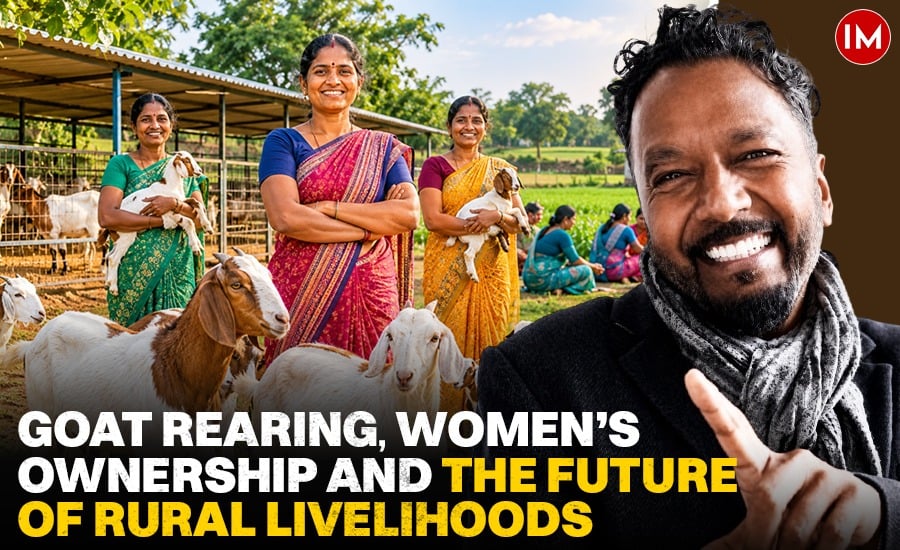
Goat-based livelihoods have particular relevance for rural women. Women frequently undertake feeding, cleaning, healthcare and daily animal management, yet their labour does not always translate into ownership, control over income or decision-making authority.
The ICAR-Central Institute for Women in Agriculture identifies goat farming as important for employment, household nutrition and the livelihood security of small and marginal farm women. It also identifies poor-quality feed, disease, inadequate management knowledge and women’s limited access to services, markets and formal information as significant constraints. A well-designed livestock programme must therefore go beyond counting women as beneficiaries. Women should be recognised as owners of livestock assets, members and leaders of producer institutions, trained animal-health workers and rural entrepreneurs. Payments should reach their accounts, while training, credit and market information should reflect their responsibilities and circumstances.
When women gain ownership and control over productive assets, goat rearing can become a pathway to income, stronger household decision-making and greater economic independence.
Animals Alone Do Not Create Livelihoods
One of the most important lessons for livestock policy is that distributing animals is not the same as building an enterprise. A goat without vaccination, preventive healthcare, reliable fodder, appropriate breeding services, insurance and market access remains a vulnerable asset. The loss of even one animal can impose a serious financial setback on a low-income household.
These gaps cannot be addressed by individual farmers acting alone. Livestock clusters, self-help groups, cooperatives and producer organisations can aggregate demand for veterinary care, finance, feed and training. They can organise vaccination schedules, breeding records and local animal-health services while helping farmers obtain better price information and negotiate collectively with buyers.
This is also where the farmer must be treated as a strategic partner rather than a passive beneficiary. Farmers contribute labour, knowledge, local networks and stewardship of land and animals. Public agencies can provide infrastructure, veterinary systems and an enabling policy environment. Responsible private enterprises can contribute finance, technology, training and market access. But communities must remain central to planning, ownership and value sharing.
The National Livestock Mission recognises several elements of this ecosystem. Its revised framework focuses on entrepreneurship, breed improvement, feed and fodder development, stronger value chains and connecting unorganised producers with organised markets. It also provides for the participation of individuals, self-help groups and farmer producer organisations in livestock enterprise development.
Beyond the Crop
The future of food security lies beyond the crop because rural vulnerability is never solely a production problem. It emerges when families lack diverse incomes, productive assets, protection for those assets, access to finance and a fair route to markets.
A goat may appear to be a modest asset. Connected to preventive veterinary care, fodder security, women’s ownership, collective institutions, affordable finance and transparent markets, it can become the foundation of a more resilient household economy.
India does not need to choose between crops and livestock. It needs integrated rural livelihood systems in which the two reinforce each other. By recognising goat rearing as an accessible diversification strategy, we can help small and marginal farmers not only survive the next shock, but build the productive capacity and confidence to move beyond it.
Also Read – Rahul Navin: The Tax Expert Who Rose to Lead India’s Enforcement Directorate