In the forest-fringe villages of Gaya, hunger, poverty and forest degradation were never separate problems. They were connected to the same households.
When families had little income, the forest became a source of fuelwood, food and sometimes even illegal crops. Protecting the forest, therefore, meant addressing the economic needs of the people living around it.
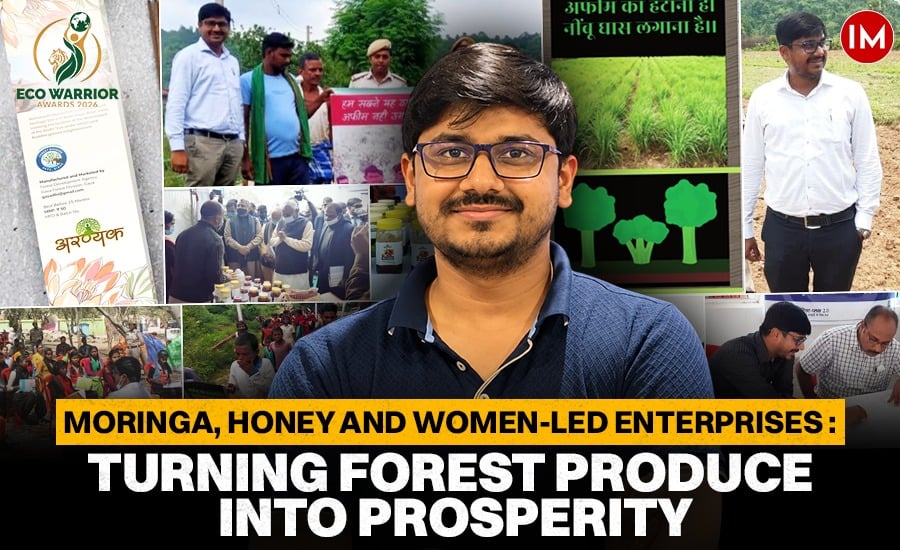
This was the challenge Abhishek Kumar, Indian Forest Service (2016 batch, Bihar cadre), took up when he served as Divisional Forest Officer, Gaya Forest Division, covering Gaya and Jehanabad districts, from February 2019 to January 2022. He is currently Director, Directorate of Horticulture, Department of Agriculture, Government of Bihar, Patna.
His approach was to make conservation directly beneficial to local communities through agroforestry, forest-based enterprises, women-led businesses and community ecotourism.
WHEN CONSERVATION AND LIVELIHOODS COLLIDED
Bihar has only about 7.27 per cent of its geographical area under notified forests, much lower than the national average. Gaya’s dry deciduous forests spread across rocky landscapes such as Barabar, Dungeshwari, Barachatti and the Gautam Buddha Wildlife Sanctuary.
The pressure on these forests was high.
Gaya and Jehanabad were also among India’s priority districts for food security and nutrition. Many forest-fringe families had no stable source of cash income. Some depended on selling fuelwood, while illicit poppy cultivation had also taken root in parts of Gaya.
At its peak, poppy cultivation in Gaya covered more than 1,300 hectares, including around 300 hectares inside the Gautam Buddha Wildlife Sanctuary.
Raids and enforcement could destroy the crop, but the problem returned.
In 2019, women from eight villages involved in poppy cultivation approached the Forest Administration seeking alternatives.
That became a turning point.
“A forest officer can destroy an illegal crop in a day. Only a better alternative can stop it from returning the next season,” Abhishek Kumar said.
MORINGA: FROM A COMMON TREE TO A COMMUNITY ENTERPRISE
The answer was found in a plant already growing across the landscape — moringa, or sahjan.
People already used its pods and branches. But its leaves had little commercial value locally.
The Forest Department began looking at moringa not simply as a plantation activity but as a complete value chain. The plan covered planting material, leaf supply, processing, branding and buyers.
In 2020, moringa plantation was launched with seedlings distributed to members of Eco-Development Committees. For the 2021 season, around one lakh saplings were raised at Barabar nursery and another two lakh in other forest nurseries.
More than two lakh seedlings were eventually provided to communities for planting on their own land through different programmes.
JEEViKA self-help groups were brought into the process. Two women were given nurseries under the Mukhyamantri Niji Paudhshala Yojana to raise 40,000 moringa plants.
Moringa was planted in backyards, field bunds, fallow land and other suitable spaces.
FROM LEAVES TO ‘ARANYAK’
The next challenge was processing.
At the Barabar Hills forest nursery, the Forest Department facilitated land, a building and a shed for a moringa value-addition centre. With technical support from Forest-PLUS 2.0 and field partner PRERANA, a solar dryer capable of handling 300 kg of leaves a day was installed.
A pulveriser converted dried leaves into powder.
The Bhainkh Eco-Development Committee became part of the process, from plucking to packing. Another processing centre was later taken up at Gehlaur village.
The product was branded ‘Aranyak’, meaning “of the forest”, and launched commercially in January 2021 at Kalrav, Bihar’s first state bird festival.
The moringa powder sold at about ₹400 per kg and reached outlets including Patna Zoo, Aranya Bhawan and Bihar Khadi Mall.
The brand later expanded to include wild honey, wild-ber pickle and other forest-linked products.
WHEN THE GOVERNMENT BECAME THE BUYER
For a new community enterprise, producing the product was only half the challenge. It needed a reliable market.
The Forest Department worked to connect Aranyak with the Integrated Child Development Services (ICDS) programme.
In September 2021, a high-level decision was taken to introduce moringa powder in around 2,000 selected Anganwadi centres in Gaya and Jehanabad. Children aged three to six years were to receive 2.5 grams of moringa powder twice a week, mixed into nutritious food.
By March 2022, the product had been introduced into the supplementary nutrition programme.
“A community enterprise rarely dies for want of machines. It dies for want of a buyer. ICDS gave Gaya’s forest communities their first big buyer,” Abhishek Kumar said.
The initiative also attracted CSR support. ₹14 lakh was mobilised from Axis Bank for moringa plantation, while ICICI Foundation partnered for a five-year programme aimed at planting five lakh moringa trees across about 500 acres, benefiting around 5,000 households in 100 villages.
WOMEN AT THE CENTRE
Women became important participants in the model.
They were trained in beekeeping, sewing, moringa, lemongrass and mahua-based products. Village-level processing units were established for lemongrass oil, honey, moringa powder and mahua tilkut.
At Dungeshwari, 26 women came forward to make incense sticks from flowers collected from temples. The Forest Department facilitated land and infrastructure for the enterprise.
Two JEEViKA women also managed moringa nurseries, turning them into suppliers rather than only beneficiaries.
For landless families, the model included plantations on forest and panchayat land, allowing them to earn from collecting and selling leaves.
CONSERVATION THROUGH LIVELIHOODS
The approach extended beyond moringa.
In Barachatti, villagers were trained in beekeeping as an alternative to illicit poppy cultivation. Wild ber was collected and processed into pickle. Temple flowers became raw material for incense. Sabai grass was promoted for craft and soil protection.
Community-based ecotourism was also introduced at Barabar and Dungeshwari Hills, with protective infrastructure and local participation planned alongside visitor facilities.
During his tenure, more than 6,500 hectares of degraded forest land were brought under community-based watershed and restoration works through 138 forest committees.
For Abhishek Kumar, the lesson from Gaya was clear: conservation becomes stronger when communities benefit directly from protecting the landscape.
The model connected forests, farmers, women, government schemes, CSR partners, NGOs and markets.
It replaced a cycle of dependence and forest pressure with one built around local enterprise.
As he puts it, “The forest must earn from what it renews — leaves, flowers, honey, a visitor’s curiosity — never from what it loses.”
That became the central idea behind Gaya’s conservation journey: protect the forest by making its people partners in its future.
Also Read – 25 YEARS. ONE VISION. DEVELOPMENT