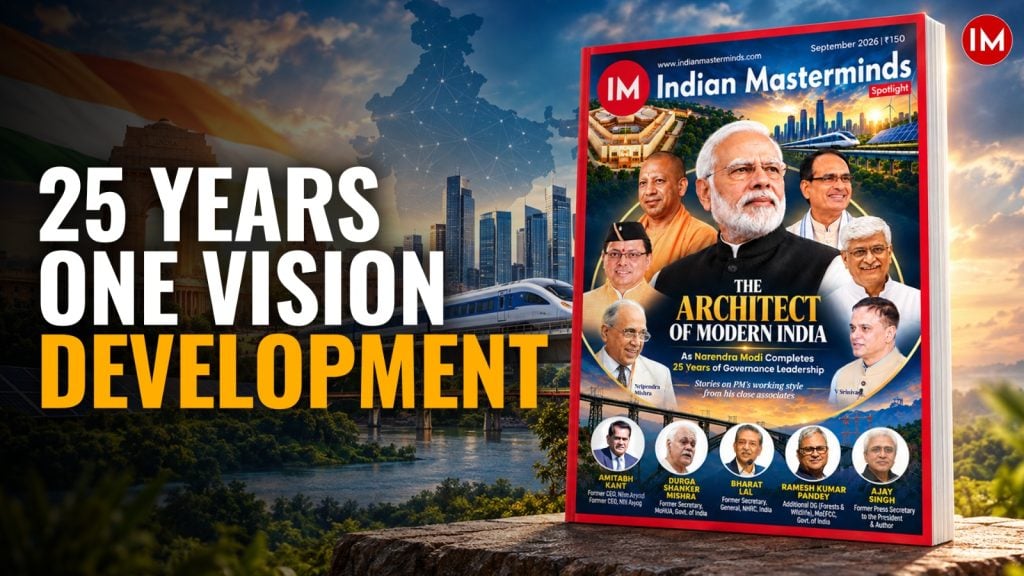
Twenty-five years at the helm of government is more than a political milestone. It is long enough for ideas to become institutions, experiments to become policy, policies to become programmes and programmes to begin reshaping the lives of millions.
On October 7, 2001, Narendra Modi took oath as the Chief Minister of Gujarat. Twenty-five years later, he stands at the threshold of completing a quarter century as the head of a government—first in a state and subsequently at the national level.
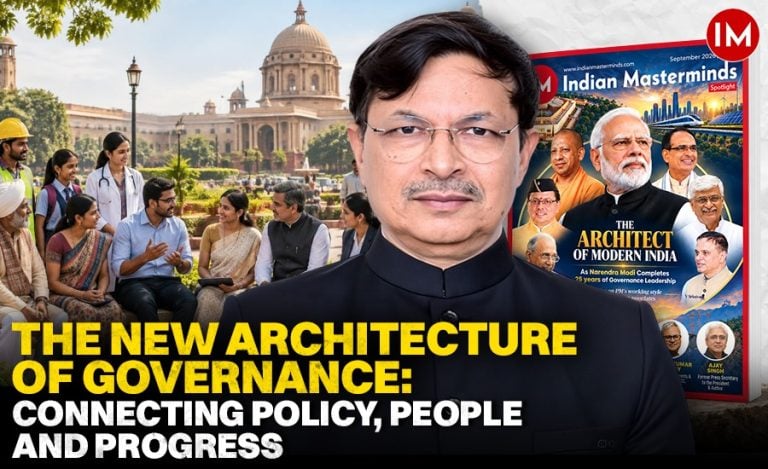
For Indian Masterminds Spotlight, a publication that looks at India through the prism of governance, administration and the people who make the State work, this is an occasion not simply to celebrate a milestone, but to examine a phenomenon.
What has defined the Modi approach to governance? What explains its emphasis on scale, technology, delivery and long-term objectives? How has a style of administration that took shape in Gujarat evolved after moving to the national stage? And what do those who have worked with him, observed him closely or studied his political and administrative journey make of it?
These are some of the questions that this special issue seeks to explore.
Also Read – From Conflict to Coexistence: How An IFS officer Used AI, Drones and Communities To Protect Elephants
The Journey
A quarter century in government cannot be understood merely by looking at the years spent in constitutional office. The roots of the leadership style go much deeper.
One of the most revealing pieces in this issue when by Union Minister for Agriculture, Rural Development and Farmers welfare Shri Shivraj Singh Chauhan, is based on nearly three decades of personal association with Narendra Modi. The article, takes readers behind the public persona and into the habits of the administrator.
There is, for instance, the recollection of a modest room in Delhi in the early 1990s, where a young Narendra Modi would spend hours working on a desktop computer at a time when computers were hardly commonplace in political organisations. Then there is the memorable 1998 episode when he asked party workers how many had an email ID—a question that produced laughter because the technology itself was still unfamiliar to most of them.
These may appear to be small stories. In retrospect, however, they acquire significance because they point towards a recurring characteristic: an instinct to look ahead.
The same article recounts a much later encounter involving Amrit Sarovars. After viewing an exhibition, Modi did not stop at the broad objective of the programme. He wanted to know how much water a particular pond could actually hold and whether its depth would make fish farming viable.
It is an unusually revealing administrative instinct. The question is not merely What is the scheme? but Will it work?
Another anecdote from the same article concerns the Pravasi Bharatiya Divas in Indore in 2023. After being told that the event had gone well, Modi asked whether there was a mechanism to collect feedback. He already knew of problems with seating, overcrowding and the experience of some delegates.
The larger lesson emerging from these recollections is that governance, in this approach, does not end with implementation. It requires feedback, scrutiny and correction.
Readers will find these stories in the original Indian Masterminds Spotlight article, where they acquire their full context and personal texture. We have brought them into this editorial because they illuminate something larger—the administrative habits behind the larger governance story.
Something Problems
If there is one theme that runs through several contributions in this issue, it is the transition from managing problems to attempting to solve them at scale.
Water provides perhaps the clearest example. The article written by former Mission Director of Jal Jiwan Mission Shri Bharat Lal mentions, when Modi became Chief Minister in 2001, Gujarat was dealing with recurring drought, water scarcity and the aftermath of a devastating earthquake. The subsequent emphasis on water management, infrastructure and long-term planning became an important part of the state’s development experience.
That philosophy later found a national expression through drinking water, irrigation, conservation and water-security initiatives.
The issue’s contributions on water, rural development, agriculture and public administration examine different aspects of this transformation.
Jan Bhagidari
Another thread running through the Modi years is the attempt to change the relationship between government and citizen.
Government, in this formulation, cannot do everything by itself. Sanitation requires behavioural change. Water conservation requires community participation. Environmental protection needs citizens to become stakeholders. Tourism depends not only on infrastructure but on local communities, hospitality and civic behaviour.
Hence the emphasis on Jan Bhagidari. This is also where the ideas of Seva, Antyodaya and Rashtra Pratham intersect.
Accounts of several contributors suggest that the Modi model is not only about creating schemes, but also about creating a narrative around those schemes—one that seeks to make citizens participants rather than passive beneficiaries.
Development and Heritage
There is another dimension that makes the current phase of the journey distinctive: the attempt to combine modern development with civilisational inheritance.
Vikas Bhi, Virasat Bhi provides a useful lens through which to understand this approach.
The renewal of important cultural and pilgrimage sites, the greater emphasis on heritage tourism and the effort to bring India’s cultural assets into the mainstream of development policy represent an understanding that economic modernisation and cultural confidence need not be competing objectives.
The contributions on tourism, culture, forests and wildlife in this issue explore this wider idea of India—an India that seeks simultaneously to modernise, conserve and rediscover.
Many Voices
This special issue deliberately brings together very different voices.
Uttar Pradesh Chief Minister Yogi Adityanath offers political perspectives shaped by his own experiences of governance.
Senior administrators and policymakers such as V. Srinivas, Amitabh Kant, Bharat Lal and Durga Shankar Mishra bring the institutional perspective of people who have worked within the machinery of government.
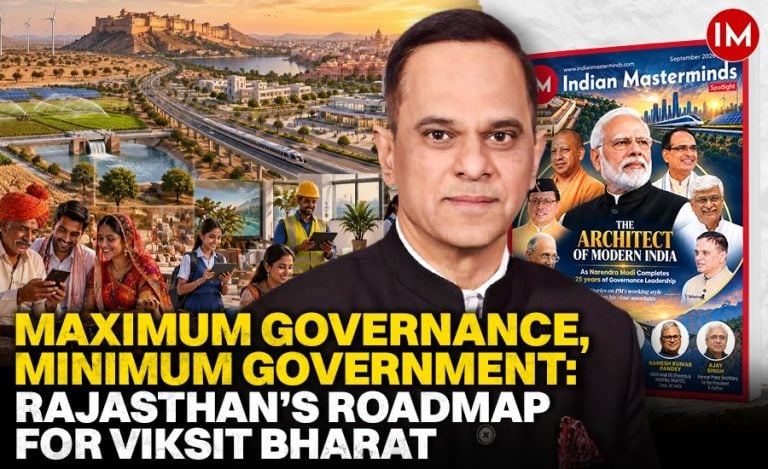
Ramesh Kumar Pandey brings the perspective of forests, wildlife and environmental governance, while author Ajay Singh examines the government transformation through the prism of mythological tales
Eachb piece sees a different part of the picture. And that is precisely the purpose of this issue.
A quarter century of governance cannot—and should not—be reduced to a single narrative. It must be viewed through multiple lenses: political leadership, administration, technology, social welfare, environment, culture, agriculture and India’s changing place in the world.
The stories, recollections and assessments published in these pages offer those different lenses. Looking Back. Looking Ahead.
Twenty-five years provide enough distance to examine a leadership journey with some perspective, but they also lead inevitably to the future. That is ultimately why Indian Masterminds chose to mark this milestone through the voices assembled in this special issue.
Not simply to recount twenty-five years. But to understand them. Not merely to look at the leader. But to examine the leadership. Not just to revisit the past. But to ask what this quarter century of governance has set in motion for the India of the future.
Twenty-five years. One extraordinary journey. And a vision that continues to evolve.
Also Read – Dr. Priyanka Gahlot: She Faced a Man-Eating Leopard, Protected Gir’s Lions and Made Saline Land Bloom