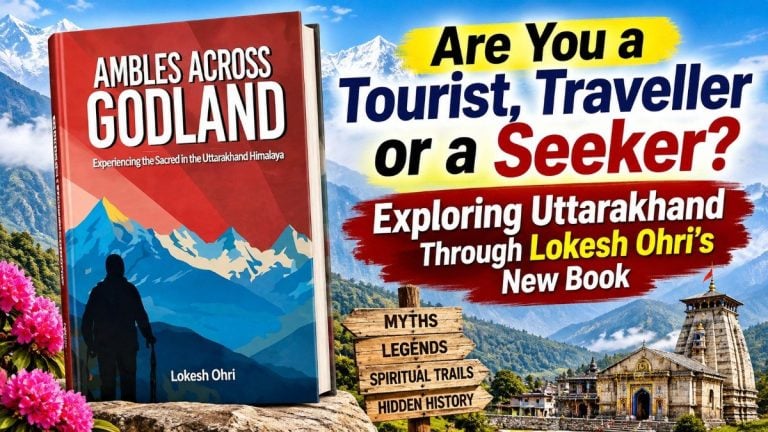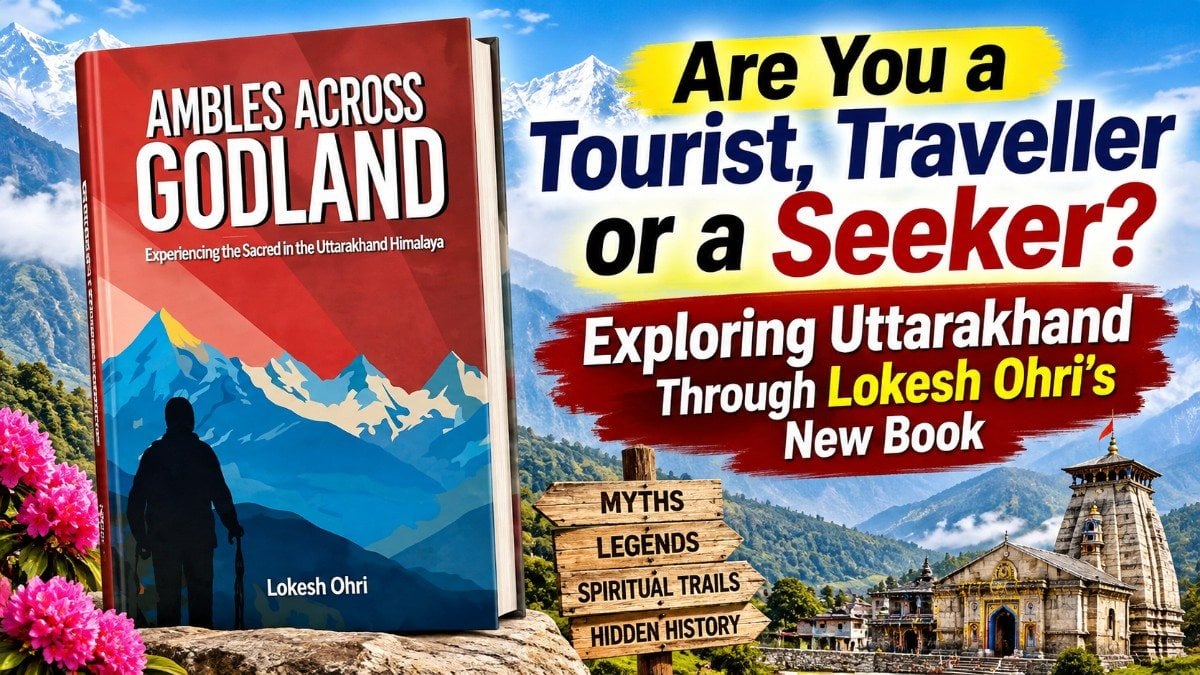
Are we tourists, or travellers, or seekers? How do we interpret each of those words and ourselves within them? For Lokesh Ohri, a “Laata” who brings people along on his walks through Dehradun and Uttarakhand, the answer is clear: every tourist can shed “ego-tourism” through travel, and each of us can transform into seekers — if we remain open to sauntering rather than speeding along saint-terre, to slowing down and observing life as it takes shape around us.
“Truth is a pathless land,” is the J. Krishnamurthy quote which begins this new book by Dr Ohri. There are many trails in the Uttarakhand Himalayas which we tread subsequently. Mythologies which continue to animate them include closely-held traditions of Shiva and Shakti. Alongside temples to the sun god and mountain daughters are monuments to individuals and incidents from the Mahabharat. Pandukeshwar is named for the spot where Pandu is said to have performed severe penance for having accidentally killed a sage — penance that would prove fruitless in undoing the curse levied upon him which would eventually unfold in war. Many locals believe themselves to be directly descended from the Pandavas; some in the Jaunsar-Bawar region claim Kaurava lineage. A temple to Karna in the Dyora village pays tribute to that eldest Pandava brother too, since truths are complex and pathless.
In one legend about the Bandarpoonch mountain, Bhima encounters a monkey whose tail is blocking his route to acquiring parijat flowers for Draupadi. The monkey refuses to move its tail and Bhima is shocked to find that his own strength cannot accomplish the task either — until he realises that the monkey is Hanuman. Another tale about Hanuman’s tail suggests that he extinguished its Lankan flame in the icy waters of the Yamuna. From the Ramayana is the story of Hanuman picking up the Dunagiri mountain in his quest to locate the Sanjeevani, but without permission from the goddess Nanda Devi; thus anyone who worships him here is sure to incur Her wrath. This is after all the Goddess associated with the Skeleton Lake at Roopkund, where the remains of 38 bodies have recently been dated back to around 1200 years in a genetic study which suggests that while some of the dead had South Asian genetics, others appear closely related to Greeks currently living in Crete.
Many of the spirits which possess Uttarakhandi locals derive from Hindu cosmology, but there are also acharies: nymph forest fairies who spirit away handsome young men from alpine grasslands and attack false pilgrims. These forest fairies link to forest goddesses like Hariyali Devi, and speak to a tradition of human reverence for the natural world. The rich flora of these mountains range from the rare Brahmakamal to the spring-heralding buraansh and the Himalayan Oak (baanj) cloud forests which date to the Pleistocene Age. There is also mention in this book of herbal aushadhis like sulfadi, ghingara and bhang. Wildlife includes the Common Owl Moth along with the Bearded Vulture and the Crested Serpent Eagle and Barking Deer kakar.
The Himalayas stand sentinel to semi-nomadic Jads with dual Hindu and Buddhist identities and Marcha traders moving with their herds from Tibetan plateau to the Terai lowlands; elderly pilgrims whose faith illuminates their progress through freezing cold; WH Auden’s younger brother John and Sir Stephen Spender’s younger brother Michael, both in love with the same woman and the same mountain range. Ashoka’s edict in Kalsi with its Pali inscription, still intact today, makes mention of Greek kings as well as the Chola and Pandya empires of South India. Several Chand and Katyuri rulers established Himalayan kingdoms, and it is from their garh fortresses that Garhwal gets its name. In Ramoligarh, thousands of people gather once every three years to play their instruments in memory of Krishna playing his flute. Rani Karnavati from the Parmar dynasty is immortalised as ‘Nak Kati Rani’, and there is also Frederick ‘Pahadi’ Wilson, known as the Raja of Harsil (an area which takes its name from Hari Sila as Rock of the Gods).
Uttarkashi was previously called Barahat – Big Market – and Tehri’s name is derived from the “tri-three” sins of thought (manasa), words (vacha) and deeds (karmana) to be washed away. Haridwar in ancient texts was referred to as Mayapuri, and was known for the Maya Devi temple which is no longer particularly significant today. Charan Chalo Marg Gobind is what Sikh sites of pilgrimage – including the Sri Guru Ram Rai Darbar Sahib dera from which Dehradun is said to have gotten its name – remind us. Sabir Piya’s Sufi shrine in the village of Kaliyar with its ancient cluster fig tree is a lesson in patience too. And there are the Panch Prayag river confluences as well as the Panch Kedar temples of Shiva, and the Char Dham understood as essence: Kedarnath’s austerity versus the bhogabhumi of Badrinath.
We learn that the Pahadi Rajput style which characterises the Garhwal School of painting traces back to Sulaiman Shikoh’s exile in Srinagar, which is famous for the Sri Yantra inscribed on one of its large boulders. There is a silver Sri Yantra at Kalimath in Rudraprayag as well, with a shrine built over it, where Kali is believed to have entered the netherworld. And the Sri Yantra signifying Sati in the Chandrabadni siddha peeth requires a cloth canopy to be tied over it each year by a priest who must remain blindfolded during this task.
From the rock art in Almora caves to the Pindar river valley ruled by nine snake goddesses who visit from their naaglok when drummers awaken them or when they are invoked by the conch shells of the Bainoli village pujaris, there is plenty about Kumaon too — Gori Ganga, Byans valley with its maitri fairies, Meetha Reetha Sahib, the Chipla Jaat festival of the Rung community, Pithoragarh fort built by Piru Gosain, Leprosy Ashram in Chandak, ancient naulas for water harvesting, baal mithai and singori, stalactites and stalgamites…. The Drikung Kagyu Monastery in Kasar Devi attracted Buddhist scholars like Robert Thurman, whose daughter Uma — named here — would grow up to be a Hollywood star, and the twelve churches in Ranikhet stand testament to the various faiths which have bloomed here.
“The first false step, says Akha, was that you forgot to look within…” To walk the pace of prayer without shortcut or distraction is to have communion with the sacred self. But there is also an element of safety to this archetypal source of reconnecting with nature and ourselves — how many women are able to loiter alone on roads without unwanted attention, to bask in the sunshine of a rock upon a hill without fear of repercussion, to pause or revel fully in divinity without calculating worst-case scenarios if that moment of grace happens to be in public?
The distinction between tourists and travellers — and seekers — is increasingly urgent. Pilgrimage entails walking, the repetitive task of placing one foot after another, often on difficult terrain, at nature’s pace of prayer, to eventually catch a glimpse of the sacred destination. Every “khand” or rock in our Devbhoomi holds “uttar” answers — but then, as this fascinating and thought-provoking book reminds us: “Of what use are answers when questions themselves cease to exist?”