Diversity in Unity, or Unity in Diversity
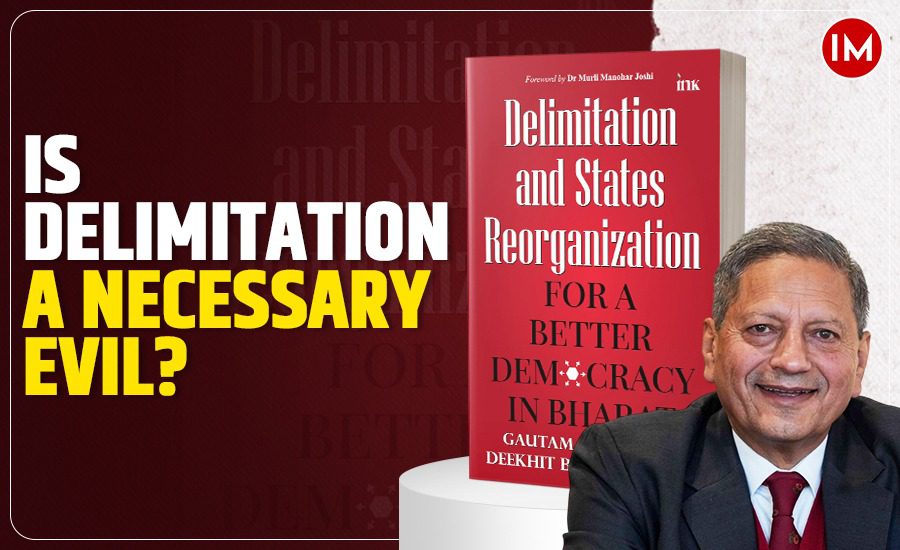
Delimitation and States Reorganization: For a Better Democracy in Bharat by Gautam R. Desiraju (who earlier authored Bharat 2.0) and Deekhit Bhattacharya could not have come at a better time. Earlier this week, all the Dravidian parties and the INC rallied together behind the Tamil Nadu CM, M.K. Stalin, in asking for another thirty-year extension of the existing delimitation. My generation of readers (born in the first two decades of Independence) may recall that the current dispensation had been forced upon the country in 1976 as part of the 42nd Constitutional Amendment during the Emergency years. This will, for sure, lead to an emotional and politically charged North versus South debate, in which the ‘Bimaru’ states will be accused of a disproportionately higher share of India’s population bulge—an idea propagated by demographers like Ashish Bose, who received official patronage from then-Prime Minister Indira Gandhi. However, recent research by Ravi Mishra has challenged the Ashish Bose hypothesis by taking census data over the long durée—from the first census of 1871 to projected figures of 2021.
But the core argument of Desiraju and Bhattacharya is different. They suggest that while the transition of civilizational Bharat into the nation-state of India, after a hiatus of several centuries, began on August 15, 1947, with the Tiranga replacing the Union Jack on the ramparts of the Red Fort, the basic architecture of governance continued to be that of the British Raj and the Mughal Empire. Thus, the reorganization of the nine provinces of British India and 562 princely states under the Dominion of India into the Part A, B, C, and D states of the Republic of Bharat on January 26, 1950, was more in the nature of ‘rearranging the deck chairs on the Titanic.’ This was followed by the reorganization of states in 1956, in which the SRC report accepted the linguistic principle as ‘one,’ but not the ‘sole’ factor. In fact, the recommendations included the continuation of the bilingual states of Bombay and Punjab, besides the multilingual state of Assam. The authors are critical of the way the SRC recommendations were tweaked for political expediency. They aver that the Westminster style of parliamentary democracy, superscribed on the Westphalian model for the creation of linguistic states within the Union of India, eroded the feeling of Bhartiyata and led to sub-optimality in the use of national resources.
They reject the notion of federalism, which is rooted in the Roman idea of varied peoples pooling together to select political powers as ‘fœderatis.’ In the Indian context, the multiple principalities were all aligned to a common cultural and spiritual heritage within the sacred geography of Jambudwip, as described in Pauranik and Vedic lore. This geography more or less corresponds to the Indian subcontinent, comprising present-day Afghanistan, Pakistan, India, Bangladesh, Nepal, Bhutan, Sri Lanka, and the islands in the Indian Ocean. The authors contend that this identification never really ceased, but an artificial construct of a ‘supra-state’ was imposed by the Mughals, who wanted to centralize revenue collection and enforce law and order backed by military force. The authors point out that while Sher Shah Suri governed his empire through 66 shiqqs, with an exception for frontier regions like Bengal, where a few shiqqs were grouped together for military supervision and revenue collection. States of the size we understand today came into being with Akbar’s regime. However, this centralization of the subcontinent into fifteen ‘subahs’ under Akbar was difficult to administer, and Jahangir and Shah Jahan started the process of excising Odisha from Bengal, Sindh from Multan, Kashmir and Kandahar from Kabul, and Bidar from Ahmednagar. By the time the Mughal Empire reached its zenith, India had twenty-seven states. These were ‘arbitrary divisions’ carved across India to secure different objectives in different parts of the country—in the south and the northwest, they were essentially for military dominance, while in the Ganga basin, the objective was revenue maximization.
The authors also point out two major fault lines of our democratic process: the differential value of each individual vote and the asymmetry among states that constitute the Union of India. They point out that ‘one person, one vote’ does not, ipso facto, translate into ‘each vote, same value,’ as the value of a vote in Kerala is 1.8 times that of a voter in Rajasthan. With eighty seats in the Lok Sabha, Uttar Pradesh exercises unparalleled heft in the political economy of the country. The freeze on delimitation from 1976 has aggravated both these issues. However, the authors contend that if, after the next census, a delimitation exercise is undertaken, India should be reorganized into 75 states, which roughly correspond to the principalities and republics at the time of Mahabharat.
The war at Kurukshetra saw the participation of eighteen armies (akshauhinis), each consisting of 21,870 chariots, 21,870 elephants, 65,610 horses, and 109,350 foot soldiers, making a total of 218,700 warriors in each akshauhini. Eleven of these were on the Kuru side and seven on the Pandavas’. These came from over one hundred autonomous units, which competed, collaborated, merged, and demerged based on strategic or matrimonial alliances, or broke up due to internal strife, succession politics, and the leadership profile of their rulers. Based on the records of the Mahabharat, the authors have drawn up a map with the proposed seventy-five states of Bharat, each with an approximate population of two crores—starting with Gilgit in the north to Lakshadweep in the Arabian Sea, which is part of the Hind Mahasagar (Indian Ocean). While it is not really possible to spell out all the seventy-five units in this review, let me highlight that the authors propose that Bengal could be reorganized as Mallabhum, Gauda, and Kamtapur, with Kharagpur, Kolkata, and Cooch Behar as their respective capitals. They also propose that Darjeeling and Sikkim be brought together as Indrakil, with Gangtok as the state capital.
Let me mention here that a similar exercise was attempted by political scientist and parliamentarian Rasheeduddin Khan, who first articulated his views on cooperative federalism in a special issue of Seminar (Issue 64) in 1973. However, Khan argued that every region of India had unique social, cultural, historical, linguistic, economic, and political characteristics that the polity had to recognize. However, this is where the crucial difference lies: is it diversity in unity, or unity in diversity?
The authors contend that fresh delimitation is also an opportunity to reorganize the Republic of Bharat de novo, ensuring that the value of each vote and the power of each state in the Union replicate, to the extent possible, the provisions of Article 81(2). Even if Desiraju’s call for restructuring Bharat into seventy-five states may seem far-fetched, there is substantial merit in his argument. It is certainly an issue that needs to be pondered over and discussed at length if we want our democracy to be as deep, effective, meaningful, and civilizational as we envision it to be!