In the arid heart of Rajasthan, where water scarcity is a year-round reality, Salumbar district has carved out an inspiring story of resilience and innovation. Under the leadership of District Collector Jasmeet Singh Sandhu, a team of dedicated officials and community members has transformed Salumbar into a model of water sufficiency. Through the ambitious ‘Catch the Rain’ and ‘Jal Sanchay’ campaigns, the district embarked on an all-encompassing mission to harvest every drop of rainwater, reduce water wastage, and ensure long-term sustainability for water resources.
TURNING RAINWATER INTO A LIFELINE
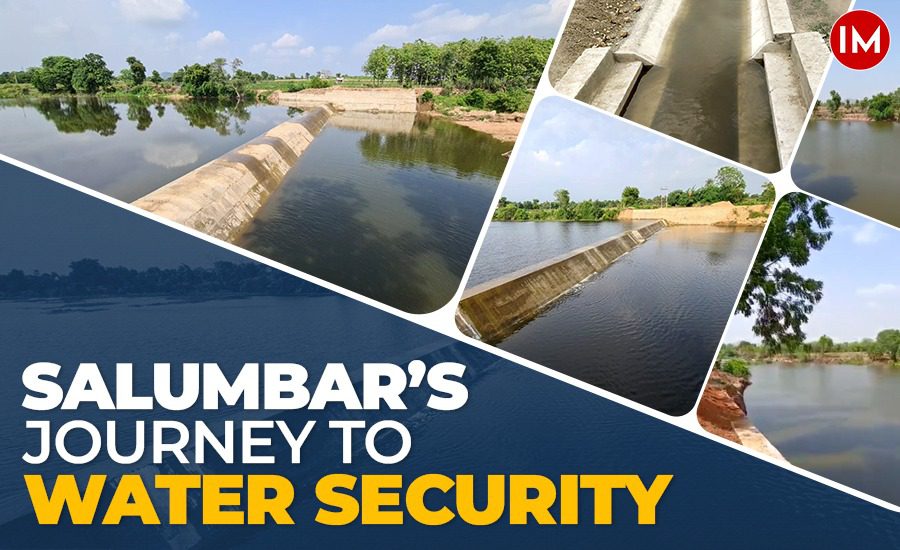
The ‘Catch the Rain’ campaign is not just a slogan for the people of Salumbar but a lifeline. “The goal was to create self-sustaining water-harvesting structures,” Mr. Sandhu explained to Indian Masterminds. “We wanted to ensure that water resources could serve multiple villages without the need for massive reservoirs.” In 2022-23 alone, 1,531 water conservation projects were sanctioned and implemented, focusing on creating structures such as anicuts, mini percolation tanks (MPTs), and reservoirs.
These efforts were backed by timely support from programs like MGNREGA, the Pradhan Mantri Krishi Sinchayee Yojana (PMKSY), Atal Bhujal Yojana, and the Integrated Watershed Management Programme. The result? A significant boost in surface water availability and a much-needed respite from the endless struggle for water in dry spells.
REVITALIZING THE JAISAMAND LAKE
One of the most remarkable achievements of Salumbar’s water initiative is the redirection of surplus water to Jaisamand Lake, Asia’s second-largest artificial lake. The lake, with a full capacity of 14,650 mcft, has been revived as a central reservoir, storing rainwater from numerous sources for use during lean periods. Sandhu notes, “The lake serves as a lifeline for both human and animal populations, and now, with proper water management, it’s able to support the district year-round.”
COLLABORATIVE PLANNING
The foundation of Salumbar’s water strategy lies in its collaborative planning approach. Each project was reviewed by Gram Sabhas and approved in consultation with elected representatives, government departments, NGOs, and the Water Resources Department, ensuring both transparency and accountability. “We involved everyone from the grassroots level,” Sandhu says. “We wanted them to understand the gravity of the situation and the importance of conserving every drop of water.”
Not only were water-harvesting structures built, but they were also integrated with the Jal Jeevan Mission to provide long-term water sources for village households. Local techniques and methodologies were leveraged to create solutions that were both efficient and sustainable.
A FIGHT AGAINST WATER MISUSE
A major hurdle in Salumbar’s journey was the lack of awareness about water conservation and the ongoing misuse of resources. To address this, the district administration launched an extensive campaign, reaching people through social media, local newspapers, community radio, and traditional performances like nukkad nataks and kathputli shows. The message was clear: “Every drop matters.”
In addition, a “Jal Shapath” pledge was administered, binding communities to use water judiciously. Rooftop water-harvesting structures became mandatory for urban societies, and farmers were encouraged to build farm ponds. “We had to make them realize that water is a precious commodity, not an endless resource,” Sandhu asserts.
WOMEN AS THE PILLARS OF WATER CONSERVATION
Women’s self-help groups played an instrumental role in ensuring water conservation efforts reached every household. Empowered with the responsibility of managing water supply, these groups fostered a sense of ownership and accountability. “Women have been the silent warriors of this initiative,” Sandhu remarks. “Their involvement has strengthened our cause and helped us achieve water sufficiency.”
The inclusion of women’s groups was a game-changer for the district, leading to better water management and contributing to positive health outcomes. Women now lead awareness efforts, encouraging others to value water as an asset for their communities’ futures.
SUSTAINING SALUMBAR’S SUCCESS
The success of Salumbar’s water initiatives has set a precedent for other regions facing similar challenges. With 15 dams, Jaisamand Lake, and 1,531 new water-harvesting sites, the district has achieved an enviable level of water sufficiency. Sandhu and his team have ensured that these solutions are replicable and sustainable, using local techniques that can easily be adapted in other drought-prone areas.
Through public-private partnerships, transparency in execution, and deep-rooted community engagement, Salumbar has turned water scarcity into a manageable issue. The district’s approach to water conservation is now seen as a scalable model for other parts of Rajasthan, and perhaps beyond, where water scarcity looms large.
A BLUEPRINT FOR THE FUTURE
Salumbar’s journey is far from over, but the district has made remarkable strides toward a water-secure future. With continued vigilance and support from all stakeholders, it aims to sustain this progress and inspire other regions. Sandhu is optimistic: “What we have accomplished in Salumbar is a testament to what can be achieved through collective effort. Our approach is replicable, and with the right partnerships, it can bring water security to even the driest areas.”
Salumbar’s transformation is not just a success story; it’s a blueprint for sustainable water management in water-scarce regions. It stands as a reminder that with the right strategies, resources, and community involvement, even the most daunting challenges can be overcome.