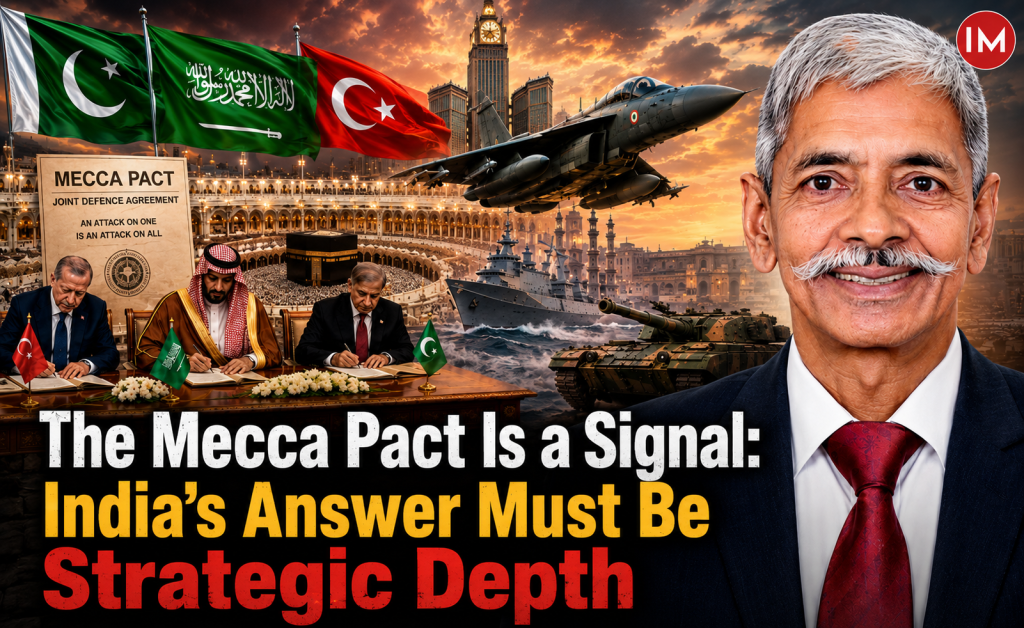
The Mecca Joint Defence Agreement signed by Saudi Arabia, Türkiye and Pakistan on 7 August has added a new layer to an already unsettled West Asian security environment. Its core provision is clear: an armed attack on one of the three will be regarded as an attack on all. The first high-level meeting under the agreement is taking place in Istanbul today, bringing foreign and defence ministers and military chiefs together to work through its mechanisms.
Should India be alarmed?
No.
Should India be attentive?
Absolutely.
The more important question is different: Has India’s diplomatic reach kept pace with the military and technological capability it has spent the last decade building? That is where the real strategic test begins.
Capability has moved. Has statecraft moved with it?
India today possesses a very different defence profile from the one it had a decade ago. Domestic defence production reached a record ₹1.78 lakh crore in 2025-26. Defence exports touched ₹38,424 crore, with Indian systems and components reaching more than 80 countries. The private sector is also becoming a larger part of the defence ecosystem.
These numbers matter. But numbers alone do not create national power. A missile gives reach. A satellite gives awareness. A fighter gives air power. A warship gives presence. Diplomacy determines what happens before any of those capabilities have to be used.
Also Read – Two Chairmen, Two Exits, One Governance Question: Who Really Exercises Power?
This is the distinction India must now internalise. For years, the discussion around Atmanirbharta was understandably centred on reducing import dependence. That phase is no longer enough. The next phase has to be about converting indigenous capability into strategic influence.
In simple terms: from buyer to builder, and from builder to partner. That is a much harder transition.
The Mecca Pact should sharpen, not narrow, India’s thinking
The pact tells us something about the changing behaviour of middle powers. Countries are increasingly trying to build insurance policies around their own security interests. Saudi Arabia wants greater strategic room. Türkiye wants greater regional influence.
Pakistan wants strategic relevance beyond South Asia. India must understand this instinct because it is not very different from its own. India too has resisted being locked into a single strategic camp. Its relationships with the United States, France, Russia, Japan, Australia, the Gulf and Europe are not identical. They serve different purposes.
Partnerships must now produce capability
The India-France relationship, for example, has moved well beyond buying platforms. In February 2026, the two countries elevated their relationship to a Special Global Strategic Partnership and agreed to deepen co-design, co-development and co-production of advanced defence platforms and emerging technologies. Their cooperation now extends across air, naval and land systems, space, cyber and critical technologies.
That is the model worth studying.
Not because France should become India’s preferred partner for everything. It should not. But because the relationship demonstrates what a mature defence partnership can look like when procurement is connected to technology, industrial capacity, research and strategic autonomy.
India-Australia defence cooperation has developed around maritime security, logistics and information sharing. India’s relationship with Saudi Arabia itself has an established Strategic Partnership Council covering political, economic, security and military cooperation.
The pieces are already on the board. The next challenge is connecting them. The missing link is institutional. This is where the issue moves from defence to governance.
A country can sign twenty strategic partnerships. But if each ministry, service, agency and industry group works within its own silo, strategic advantage leaks away. A military professional recognises this immediately.
In operations, no commander asks the artillery, infantry, intelligence, logistics and communications elements to pursue separate wars. They work towards the same operational objective. National strategy needs the same discipline.
India needs stronger institutional integration between foreign policy, defence planning, intelligence, technology, industry and energy security. Why? Strategic preparedness has to begin before the crisis.
Diplomacy must become an instrument of deterrence
This is perhaps the most important doctrinal shift India needs. We have traditionally treated diplomacy as something that manages political relationships and defence as something that manages military threats.
The boundary has disappeared. A defence partnership can open access to technology. A technology partnership can strengthen industrial resilience. An industrial partnership can support diplomatic influence. And diplomatic influence can prevent a military problem from becoming a military crisis. That is deterrence in its broader form.
For India, the modern interpretation should be even wider: build enough relationships, resilience and capability that adversaries think twice before testing your interests.
India should not respond to every bloc with another bloc
This is where strategic maturity will matter. It needs a network of dependable relationships that can be activated when interests converge.
The Indian Ocean should remain central to this architecture. Maritime domain awareness needs greater depth. Defence-industrial partnerships should increasingly include supply-chain resilience. Space, cyber, drones, electronic warfare and artificial intelligence must become part of strategic diplomacy, not remain confined to specialist departments. And there is another opportunity.
India’s defence exports should increasingly be viewed as an instrument of foreign policy.
When an Indian defence system enters another country’s inventory, it creates training links, maintenance relationships, interoperability and long-term institutional familiarity. That is influence. A sale is commercial. A sustained defence relationship is strategic.
The boardroom lesson is equally important
There is a governance parallel here that India’s corporate sector will understand.
A company may have excellent assets and a strong balance sheet. Yet if its decision-making is slow, its risk systems fragmented and its succession planning weak, the underlying strength can quickly become irrelevant.
India’s defence transformation should therefore enter its next phase. Atmanirbharta cannot end at the factory gate. It must extend into technology, finance, supply chains, exports, diplomacy and strategic partnerships.
The objective should be clear: India must become difficult to coerce because it has alternatives. Alternatives to suppliers, technologies, partnerships , energy routes to diplomatic channels.
And, when required, the independent military capability to act. That is strategic autonomy with muscle behind it. The Mecca Pact does not diminish India’s position. But it does remind us that strategic space never remains vacant. If India is not shaping regional security conversations, others will shape them without India.
The answer, therefore, is not anxiety. Nor is it another round of diplomatic statements. It is institutional depth. It is faster decision-making. It is credible military capability backed by domestic industry.
It is partnerships that produce technology and access, not merely photographs and joint declarations. And it is diplomacy that arrives early enough to shape the outcome. India has travelled a considerable distance on capability. Its next strategic test is whether its diplomacy can move at the same speed.
The future will not belong simply to the strongest military. It will belong to the country that can connect military power, economic resilience, technology, diplomacy and governance into one coherent national strategy. India has the pieces. The task now is to make them work as one.
About The Author – Colonel M V Shashidhar (Retd) is a Defence & Strategic Affairs Expert, Certified Independent Director (IICA), ESG Advocate and Governance Thought Leader
Disclaimer—(The views and opinions expressed in this article are solely those of the author and do not necessarily reflect the views of Indian Masterminds. For feedback or queries, please write to [email protected].)
Also Read – Atmanirbharta 2.0: India’s Real Defence Test Begins After the Factory Gate