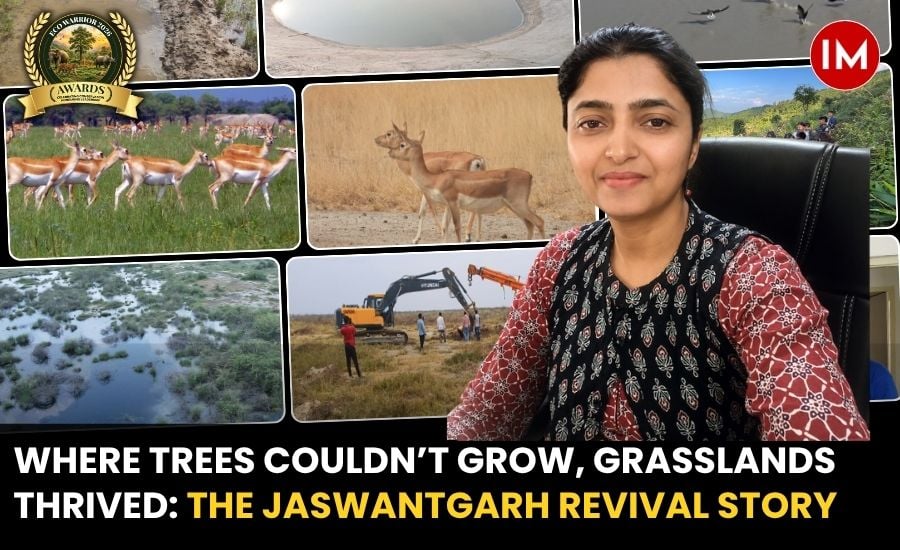
For years, the land at Jaswantgarh in Rajasthan’s Churu district looked like a place nature had forgotten.
It was low-lying and degraded. Dead cattle were scattered around. Garbage from the nearby municipality had accumulated. Dirty municipal water flowed into a local waterbody. The soil was poor, saline and almost devoid of organic matter. In summer, temperatures could touch 50°C. In winter, they could fall below zero.
Yet, this seemingly barren landscape had the potential to become something very different.
Between 2023 and 2024, the Forest Department began an ambitious experiment — to create a satellite sanctuary at Jaswantgarh and expand the ecological landscape around the famous Tal Chhapar Grassland.
The transformation was led during the tenure of Ms. Savita Dahiya, a 2013-batch Indian Forest Service officer of the Rajasthan cadre, when she was serving as Deputy Conservator of Forests (DCF), Churu. She is now serving in Barmer.
What emerged was more than a restoration project. It became an example of how degraded land can be converted into a functioning grassland ecosystem with scientific planning, sustained field work and community cooperation.
Also Read – How Ramsundar M Turned Rajgir Zoo Safari Into a Tech-Driven Wildlife Experience
WHEN TREES ARE NOT THE ANSWER
Grasslands are often misunderstood as empty land waiting to become forests.
But that is not always how nature works.
Some landscapes simply do not support dense forests because rainfall is too low, soil is too shallow or its chemistry is unsuitable for trees. In such places, grasses are not a temporary stage. They are the natural climax vegetation.
“We cannot have forests or trees everywhere. Every ecosystem has its own natural character, and grasslands have to be understood and protected as grasslands,” says Savita Dahiya.
Grasslands cover large parts of the world’s tropical and temperate regions. They support livestock, wildlife, birds, insects and countless smaller organisms. Their extensive root systems also help water infiltration and soil stability.
They can store substantial amounts of carbon in their soils. Their light-coloured vegetation reflects sunlight and can contribute to local cooling.
For communities dependent on livestock, grasslands are also an economic lifeline.
A FRAGILE LANDSCAPE AT TAL CHHAPAR
Tal Chhapar Sanctuary itself is a unique landscape.
Located on the edge of the Thar Desert, it receives barely around 30 cm of rainfall a year. It was once a private hunting reserve of the Maharaja of Bikaner before being declared a sanctuary in 1998.
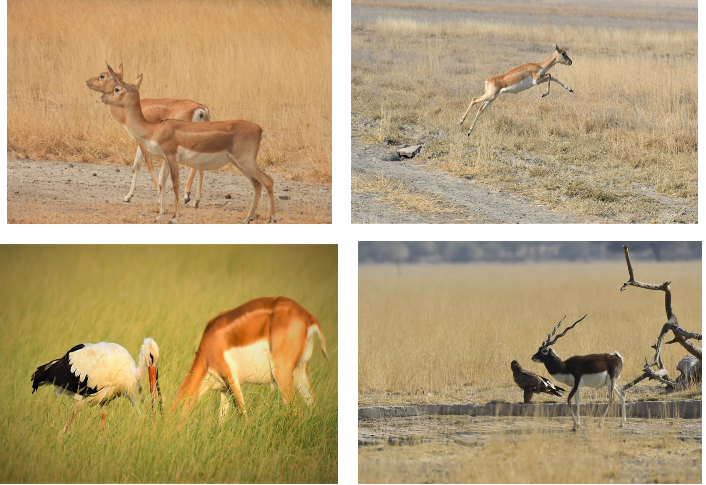
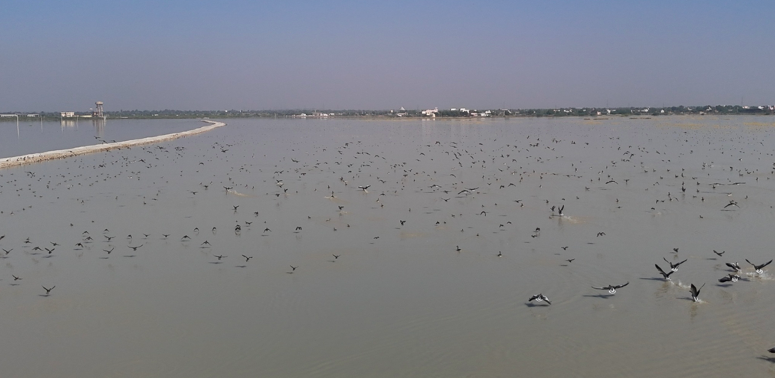
Spread over 719 hectares, it is known for its savannah-like grassland, scattered thorny trees and large population of blackbucks. Thousands of resident and migratory birds visit the area every year.
But the sanctuary faced a serious problem.
Its blackbuck population had grown significantly. With more than 4,200 blackbucks, the sanctuary was carrying far more animals than its ecological capacity. Many animals regularly moved outside the protected area in search of food.
This created both ecological and administrative challenges.
“The blackbucks did not understand the boundaries of the sanctuary. They moved out because they needed more space and food. So we had to think beyond the existing boundary,” Dahiya explains.
That thinking led to Jaswantgarh.
FROM WASTELAND TO SATELLITE SANCTUARY
The proposed site was far from ideal.
The district had just 0.57 per cent forest area. Groundwater was extremely saline. There were no recorded natural waterbodies in the surrounding landscape. The soil varied from sand dunes and rocky patches to highly calcareous and saline stretches.
There was also intense human pressure.
The land was surrounded by agricultural fields, villages and a town. Abandoned salt mines existed nearby. Gaushala land bordered parts of the area.
The first task was therefore not planting.
It was understanding the land.
Groundwater levels were studied. Contour mapping was carried out. Drainage patterns were examined. The objective was to make every drop of scarce rainfall useful while preventing prolonged water accumulation that could increase soil salinity.
FIGHTING THE INVASIVE JULIFLORA
One of the biggest obstacles was Prosopis juliflora, popularly known as vilayati babul.
The invasive plant had spread extensively and was difficult to remove. Simply cutting it was not enough because the roots could regenerate.
Large JCB machines were therefore used to remove the plants from the roots. The pits created after removal were treated to prevent regeneration. Where new shoots appeared, they were removed again using deep ploughing and other equipment.
This was not a one-time exercise.
For nearly two years, the area had to be monitored continuously.
“The hardest part was not removing the invasive vegetation. It was making sure that it did not come back before the native grasses became strong enough to establish themselves,” says Dahiya.
Once the invasive plants and seasonal weeds were cleared, suitable grass species were introduced through seeds, slips and vegetative planting.
The idea was simple: allow useful grasses to establish quickly and outcompete unwanted vegetation.
REBUILDING THE SOIL
The land also needed help from below the surface.
Its organic content was almost zero after decades of degradation. Soil amelioration was therefore taken up along with grassland development.
Fly ash and organic manure were added to improve soil properties and increase nitrogen, phosphorus, potassium and organic content. Water was spread across the landscape instead of allowing it to collect in one place. This helped grasses access moisture while also reducing the risk of increasing soil salinity. The restoration was therefore not merely about planting grass. It was about rebuilding an ecosystem.
MAKING SPACE FOR BOTH PEOPLE AND WILDLIFE
Restoration also required changes in human movement.
Some old routes passing through the developing grassland had to be closed. But villagers were provided with alternative routes.
The aim was not to push people out. It was to create a workable arrangement where people and wildlife could coexist. “Conservation cannot succeed if local communities feel that their lives are being disrupted. We have to find alternatives and make them partners in the process,” Dahiya says.
Convincing villagers was not easy. Securing land from encroachment was another challenge. Staff also had to be motivated to complete intensive work within a limited period.
Dahiya describes the approach as being “a little sour and a little sweet, depending on the situation” — firm when necessary, but flexible enough to build cooperation.
A NEW HOME FOR WILDLIFE
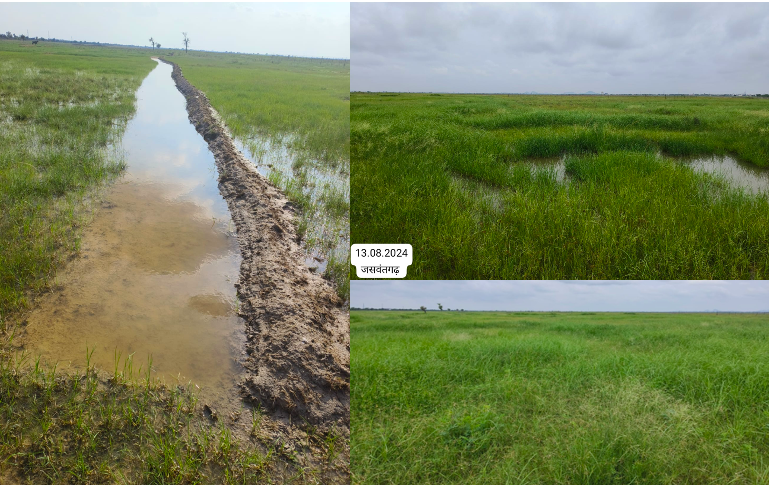
As the habitat improved, animals were shifted from the overcrowded Tal Chhapar landscape to Jaswantgarh. Chinkaras and blackbucks were relocated to the newly developed grassland. The restoration of the waterbody brought another change. Birds began arriving.
Local people noticed the transformation. What had once been an open burial ground surrounded by garbage and dirty water was becoming a cleaner and more productive landscape.
The project also created around a dozen local jobs linked to the maintenance of the grassland, waterbody and wildlife.
A MODEL BEYOND JASWANTGARH
The larger lesson from Jaswantgarh is that ecological restoration does not always require huge infrastructure or expensive interventions.
India has millions of hectares of fallow and degraded land. Some of these landscapes could potentially become grasslands and wildlife habitats if their ecological character is understood first.
“There is no single formula for restoration. Soil, water, rainfall, topography and village conditions are different everywhere. The first step is to understand the land, and then design the intervention around its needs,” says Dahiya.
Jaswantgarh shows what can happen when a wasteland is not treated as wasteland.
It was given water management, better soil, native grasses, wildlife and time.
And slowly, the land began to heal itself.
What once looked like an abandoned patch of ground is now part of a larger conservation vision — one where grass, rather than trees, is the foundation of the ecosystem.
Also Read –How IFS Dharam Singh Meena Revived Uttarakhand’s Heval River Through Science and Forest Restoration