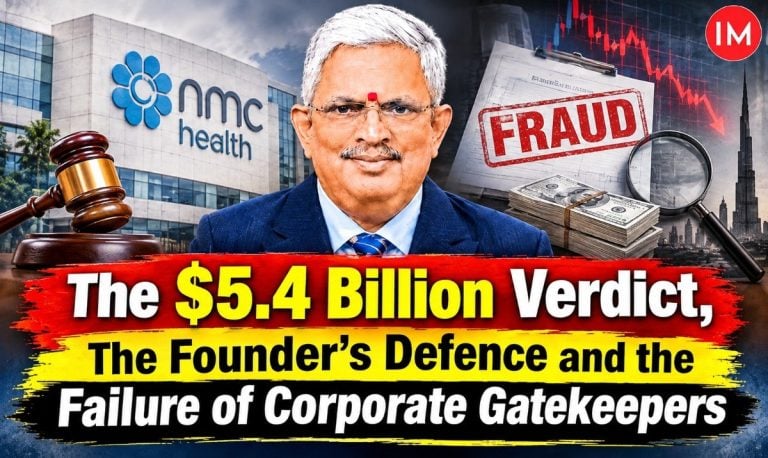
On 5 November 2026, Justice Sir Andrew Smith of the Abu Dhabi Global Market Court of First Instance held NMC Health’s founder, Dr B.R. Shetty, and its former chief executive, Prasanth Manghat, liable for fraudulent and wrongful trading over eight years, and fixed USD 5.397 billion as the starting point for what they must restore to the collapsed group. This note attempts to retrace how a hospital empire built by a pharmacist from Udupi rose to the FTSE 100 and fell within four months of a short-seller’s report; how the fraud worked through hidden borrowings, two sets of books and “sham suppliers”; and why the founder’s defence that he was the fraud’s chief victim collapsed under a trail of more than five hundred transfers into his own accounts. It examines at length the failure of the gatekeepers: Ernst & Young (EY), which signed seven clean opinions without, its accusers say, ever obtaining proper access to the general ledger or controlling its own bank confirmations, and which settled a GBP 2-billion claim for GBP 105.5 million without admitting fault; and a board that was independent on paper but met a short- seller’s warning with denials the UK regulator later found misleading. It then turns to India. Bank of Baroda bought peace for USD 600 million without admitting fault, booking a Rs 5,680-crore exceptional charge, yet remains a creditor, an alleged facilitator and now a defendant in Shetty’s USD 15-billion Bombay suit. India’s enforcement agencies have said little in public. The listed NMC group held no Indian hospitals that this note could trace, but Shetty’s personal vehicles did, with a trail of returned, resold and aborted assets. The note closes with lessons for India’s increasingly foreign-owned hospital chains and a practical way forward.
A Verdict Six Years in the Making
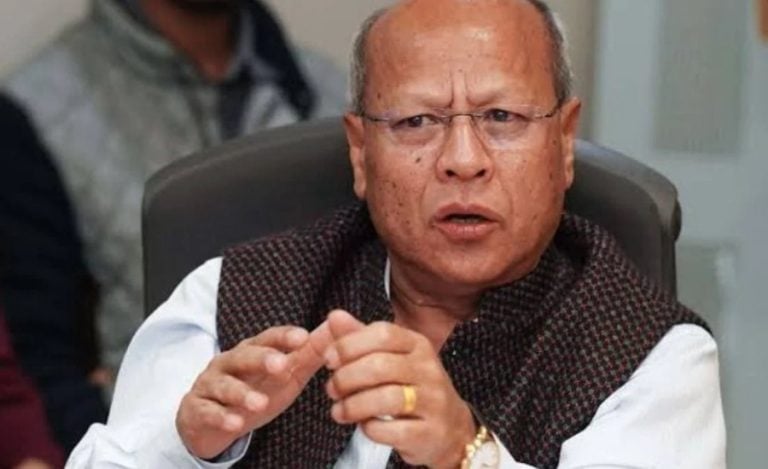
For six long years Bavaguthu Raghuram Shetty told every court, journalist and investigative agency that would listen that he was the biggest victim of the fraud that felled NMC Health. On 5 November 2026 a judge in Abu Dhabi set that claim beside a ledger of more than five hundred bank transfers into accounts bearing Shetty’s own name, and found the claim wanting. Justice Sir Andrew Smith of the Abu Dhabi Global Market (ADGM) Court of First Instance held Shetty and his former chief executive, Prasanth Manghat, liable for fraudulent trading and wrongful trading under sections 251 and 252 of the ADGM Insolvency Regulations 2022, found that both had knowingly participated in fraudulent trading from 30 April 2012 until the group collapsed on 9 April 2020, and identified USD 5.397 billion, roughly Dh 19.82 billion, as the
starting figure for the contributions they must make to the company’s assets.1 At prevailing exchange rates that is in the region of Rs 50,000 crore.
The line that will travel furthest is the judge’s own: “I have concluded that Dr Shetty and Mr Manghat were both party to the business being carried on fraudulently.”2 The final amount each man must pay, together with interest and costs, will be settled at a further hearing.3 The news report that prompted this note, carried on a widely read Indian business platform on the morning of 8 November, summarised these findings faithfully and drew its account of the judgment from Bar & Bench.4
Why should an Indian reader care about an insolvency judgment from an Abu Dhabi financial free zone? Because almost every thread of this story runs back to India. The founder is an Indian citizen and a former vice-chairman of the Udupi municipal council.5 The bank (Bank of Baroda) that paid USD 600 million to settle its part of the same case is majority-owned by the Government of India. Indian banks hold decrees against Shetty as a personal guarantor. Our courts spent four years deciding whether he could leave the country. Indian hospitals were bought, run, handed back and resold in his name. And our investigative agencies were asked, as long ago as 2020, to follow the money into India. The verdict closes one chapter in Abu Dhabi; it opens several in India.
From a Udupi Pharmacy to the FTSE 100
The story begins as an immigrant fairy tale. A young pharmacist from Udupi, short of money for a sister’s wedding, flew to the United Arab Emirates (UAE) in 1973.6 Two years later he opened a small clinic in Abu Dhabi, New Medical Centre, which over four decades grew into the largest private healthcare company in the UAE. NMC listed on the London Stock Exchange (LSE) in 2012 and later entered the FTSE 100.7 At its peak in 2018 it was valued at GBP 8.6 billion and operated in nineteen countries.8 Around the hospitals Shetty built a constellation of other businesses: UAE Exchange and its listed parent Finablr in remittances, the drug maker Neopharma, and, in 2014, a USD 1-billion acquisition of the foreign-exchange house Travelex with partners linked to Centurion Investments.9
Two other characters matter. Prasanth Manghat was NMC’s chief executive until his dismissal in February 2020,10 and he and his brother Promoth were both senior executives in the group.11 And Bank of Baroda, one of India’s largest public sector lenders, through its Abu Dhabi and other branches, served as the NMC group’s principal banker until about 2019, according to Shetty’s own pleadings.12 Keep those three names in view: the founder, the chief executive and the bank. The rest of this note is, in a sense, about which of them knew what, and who pays.
The Anatomy of the Fraud: Two Ledgers and Suppliers Who Supplied Nothing
Strip away the legal vocabulary and the court found a fraud with two moving parts. The first was the misappropriation of the group’s money. The second was the misrepresentation of the group’s finances in its published accounts, so that lenders, investors and auditors never saw the hole that the first part was digging.13
The misrepresentation was audacious in scale. At 31 December 2018 NMC told the world that it owed about USD 1.993 billion. The judgment records unreported debt of about USD 3.888 billion on the same date, nearly double the disclosed figure, and finds that the hidden borrowing grew year after year from 2012 to June 2019.14 How do you hide nearly four billion dollars? The court found that the borrowings were recorded internally and then disguised by manipulating the underlying accounting ledgers, and that when NMC upgraded its accounting systems the fraudsters kept the deception alive by maintaining two sets of books.15
The most instructive device was what the court called the “sham supplier” scheme. A supplier would raise an invoice for goods or services that were never supplied; a bank would finance that invoice; and the money would flow back into the group without ever appearing as borrowing.16 Think of a household that needs a large loan but does not want the family elders to know. It persuades a friendly grocer to issue fat bills for groceries never delivered, gets a moneylender to pay the grocer against those bills, and quietly takes the cash back from the grocer. The family diary shows only a large grocery spend; the debt to the moneylender appears nowhere. Multiply the grocer by dozens and the bills by billions and we have the essence of what Abu Dhabi found. Hospitals are especially fertile ground for this trick, because they buy drugs, consumables and equipment in huge volumes from hundreds of vendors, and supplier financing is routine.
The misappropriation was more personal. Transfers into Shetty’s personal accounts over the relevant period totalled about Dh 4.183 billion, and the accounting evidence on this was unchallenged. The claimants’ schedule listed more than five hundred such transfers, mostly from NMC group accounts at Bank of Baroda into three accounts in Shetty’s name at the same bank. After netting off money that flowed back to the group, the court put the net “Direct Shetty
Payments” at about Dh 2.6 billion.17 The court also found that Shetty used funds taken from NMC to acquire personal assets through NNMC, a company solely owned by him with Shetty and Manghat as its directors, including Travelex, his share of an aircraft, villas in Dubai Hills, a Wyoming oil field and other investments.18 Experts placed the unlawful payments at between USD 1,587 million and USD 1,589 million, and a separate claim of about USD 278.7 million for advisory and professional fees remains to be decided.19 At trial the administrators had also alleged that NMC money paid for a USD 7.5-million private jet, the fitting out of Shetty’s Burj Khalifa apartment and an AED 15-million investment in an Oman cement project; these were allegations put in evidence and should be read as such.20
Finally, the judgment found that Manghat concealed group borrowings from NMC’s auditor, Ernst & Young.21 That one finding explains why a Big Four audit opinion sat on top of a balance sheet that was false for most of a decade.
How the Roof Fell In: A Short-Seller, a Stake That Was Not, and Debt That Kept Multiplying
Frauds of this kind are rarely caught by the institutions designed to catch them. NMC was caught by a hedge fund betting on its fall. On 17 December 2019 Carson Block’s Muddy Waters published a report saying it had serious doubts about NMC’s asset values, cash balances and reported profits, alleging that the balance sheet had been manipulated to understate debt, and questioning whether the independent directors were truly independent.22 NMC responded in the manner of every company so accused: it called the allegations unfounded, baseless and misleading, announced a review by independent directors, and in January 2020 hired the former FBI director Louis Freeh to investigate. By then its shares had fallen 44 per cent.23
The second crack appeared in February 2020, and it came from the founder’s own shareholding. Two large shareholders, including the vice-chairman, told the company that about 26 million of their shares had been pledged as security for loans taken by Shetty under an arrangement to which they were not party; UK regulators began looking at Shetty’s inaccurate disclosure of his own stake.24 On 17 February Shetty resigned from the board amid investor concern that he faced a margin call and had misrepresented his holding, and within days Manghat was dismissed as chief executive.25
Then the numbers began to multiply. On 10 March 2020 NMC disclosed that it had found more than USD 2.7 billion of facilities that had never been disclosed to or approved by its board, taking
total debt to about USD 5 billion.26 Two weeks later the figure became USD 6.6 billion, more than three times what NMC had reported the previous June.27 In April 2020 the English High Court placed the London-listed parent into administration, and in September NMC Healthcare, NMC Holding and thirty-four group companies entered administration in the ADGM.28 Abu Dhabi Commercial Bank (ADCB), the largest creditor, was the moving force throughout.
Notice who is missing from this chronology of discovery. Not the statutory auditor, which had signed seven clean opinions. Not the board, with its majority of independent directors and its fully independent audit committee. Not the market regulator. The gatekeepers that a FTSE 100 company is supposed to have did not raise the alarm; a hedge fund that profits when share prices fall did. Their failure is serious enough to deserve two sections of its own, which follow the discussion of the founder’s defence.
Amid the wreckage, the hospitals themselves kept running. Creditors voted for a debt-for-equity restructuring, and on 25 March 2022 thirty-four NMC companies exited administration as subsidiaries of a new group owned by the creditors, with ADCB taking three of seven board seats and 37.5 per cent of the USD 2.25-billion exit instruments.29 The rump companies stayed in administration for one purpose: to pursue the people and institutions blamed for the collapse. The 5 November judgment is the largest return on that pursuit so far.
What the Court Decided, and What It Pointedly Did Not
The findings on the two men are unusually blunt for a commercial judgment. “In my judgment, Dr Shetty was dishonest,” the judge wrote, adding that Shetty could not escape responsibility for the group’s finances by relying on others, whether as chief executive of NMC plc or afterwards, and that it was hard to believe he knew as little as he claimed about the group’s affairs and his own bank accounts.30 Manghat fared no better. The court found him a dishonest party to the fraud throughout the relevant period, who knowingly facilitated the misappropriation of NMC funds “for the benefit of Dr Shetty, himself and others” and played the leading role in operating the fraud.31
The court went further than fraud. It upheld the administrators’ claims under Articles 282 and 285 of the UAE Civil Code and the UAE company law, observing that even without the fraud findings both men would have been liable for grossly failing in their duties as directors, and it upheld the unjust enrichment claims against both.32 In ADCB’s parallel action, Manghat was held liable for about USD 1.022 billion of outstanding liabilities and USD 168.989 million in lost profits.33
Just as telling is what the judge did not decide. Bank of Baroda had been the third defendant in the administrators’ action and settled near the end of the trial. The administrators had argued that Shetty and the bank’s then managing director, P.S. Jayakumar, agreed a repayment arrangement in return for the bank not disclosing the true position of the accounts. The judge found those arguments “persuasive” but declined to rule on them: “It would be unfair to Baroda and to Mr Jayakumar personally to make a finding about that,” since he had not heard the bank’s answer to the closing submissions.34 That is not an exoneration; it is a door the court chose not to open after the bank had paid to close it.
Two cautions are in order. This is a judgment of a court of first instance, open to challenge on appeal, and the quantum is yet to be fixed, with provision against double recovery across the civil and insolvency claims.35 And at the time of writing, this note could trace no public statement from Shetty responding to it.
The Defence: “Delegate or Stagnate”
Fairness demands that the founder’s case be put at its strongest before it is judged. Shetty’s defence, consistent since 2020, is that he was the victim of a sophisticated fraud engineered by Manghat and other senior managers. In the witness box he described his management philosophy in four words, “Delegate or stagnate, that was my principle,” told the court that reviewing all the company’s paperwork was practically impossible, and said he did not fully understand the accounting ledgers. His spokesperson stressed that he had cooperated throughout and returned voluntarily to the UAE in 2024.36 Earlier he had told the same judge that the people who defrauded NMC arranged for a bogus account to be opened in his name at Bank of Baroda.37
There is more to the defence than wounded innocence. Shetty argues that his signatures on personal guarantees and other documents were forged, that Bank of Baroda’s systems generated more than a hundred money-laundering alerts that were closed without action, that the bank extended credit without adequate security and kept borrowing concerns from the auditors, and that some of the disputed money ended up in businesses connected with the Manghat brothers, including Avitis Super Speciality Hospitals in Kerala.38 In a 2020 New York suit he accused EY of issuing fraudulent audits while aware of the laundering of loan proceeds.39
Steel-manned, the argument runs like this. NMC was a FTSE 100 company with a professional chief executive, a chief financial officer, an audit committee, independent directors and a Big Four auditor. Modern corporate governance is designed precisely so that a septuagenarian founder-chairman does not sign vouchers. If every one of those gatekeepers failed, why should the man at the top of the organisation chart, rather than those who ran the machinery, bear the blame? The chief executive had the access, the expertise and, on
Shetty’s case, the motive. And a bank that saw five hundred transfers and a hundred alerts and did nothing is hardly a neutral witness to the founder’s guilt.
Why the Alibi Collapsed
The first and fatal weakness of the defence is the oldest question in fraud investigation: who benefited? A victim does not usually receive Dh 4.18 billion. The money did not drift into anonymous offshore accounts; it arrived, in more than five hundred instalments, in three accounts bearing Shetty’s name, and was used to buy Travelex, an aircraft interest, villas and an oil field through a company he alone owned.40 The court rejected the argument that funds passing through his accounts without his knowledge could not have enriched him, finding that he was “well aware” of the payments.41 A man can plausibly claim ignorance of a ledger entry in a subsidiary in Oman; it is much harder to claim ignorance of the balance in one’s own bank account.
The second weakness is legal. “Delegate or stagnate” is sound advice on management and no advice at all on law. A director may delegate tasks; he cannot delegate his duty of care, still less his duty of honesty. That is why the court said that even without the fraud findings Shetty would have been liable for gross failure of his duties.42 The governance architecture he invokes is a reason to expect more from the founder, not less: he chaired the board that was supposed to oversee those very managers.
The third weakness is the contemporaneous record. When told that NMC’s funding was “tight” and that Manghat proposed using UAE Exchange, another Shetty company, the founder replied “Sure” by email; and he told the court that he did not find it unusual for NMC money to pay for the jet.43 These are not the reflexes of a man kept in the dark.
The fourth weakness is that the forgery plank has already been tested elsewhere and has not held.
The Dubai International Financial Centre (DIFC) Courts held him personally liable on guarantees to ICICI Bank for about USD 106 million and finally refused him leave to appeal in July 2025, ruling that none of his grounds had a real prospect of success.44 A Mint report on that case stated that handwriting experts confirmed the guarantee signatures were his; this detail rests on a single press report and has not been independently corroborated here.45 The DIFC Chief Justice similarly dismissed his attempt to appeal a USD 33- million judgment in favour of Bank of Baroda.46
The fifth weakness is the pattern of personal financial engineering that came to light before any of the litigation began: the pledging of other shareholders’ shares for the founder’s own loans and the misreporting of his stake.47 A founder whose borrowings were secured against NMC shares
had an obvious interest in a share price propped up by flattering accounts. Finally, his litigation map invites scepticism. His USD 8-billion New York suit against Bank of Baroda, EY and others was dismissed in 2024 on the ground that New York was the wrong forum,48 and the claim has now resurfaced, enlarged to USD 15 billion, in the Bombay High Court. The two co-defendants in Abu Dhabi ran what lawyers call a cut-throat defence, each blaming the other. The court believed neither, which is perhaps the most eloquent finding of all.
None of this means that every allegation Shetty makes against others is false. The court has not adjudicated his claims against individual bank officials, and the questions he raises about Bank of Baroda’s alerts are, as the next section shows, questions the administrators raised too. But being right about someone else’s negligence is not a defence to one’s own dishonesty.
(Note : This is the first part of a two-part series by P. Sesh Kumar, IAAS-82, Former Director General, CAG of India. The second part, examining the wider implications of the NMC Health collapse and the way forward for India, will follow soon.)