For decades, the Chambal ravines were synonymous with guns, fear and dacoits. But behind that violent reputation, there was another, lesser-known story – one of trust, transformation and unlikely human connections.
At the heart of it was Rajendra Chaturvedi, a 1969-batch IPS officer of the Madhya Pradesh cadre, who served in some of the most difficult terrains of the Chambal. His official residence, once a place where police officers dealt with wanted criminals, gradually became an unexpected meeting point for former dacoits seeking help to rebuild their lives.
They would arrive carrying tiffin boxes, Bhind pedas, ghee and sunflower oil. But they were no longer coming as fugitives. They came to seek help with their children’s education, family problems and the challenges of starting afresh.
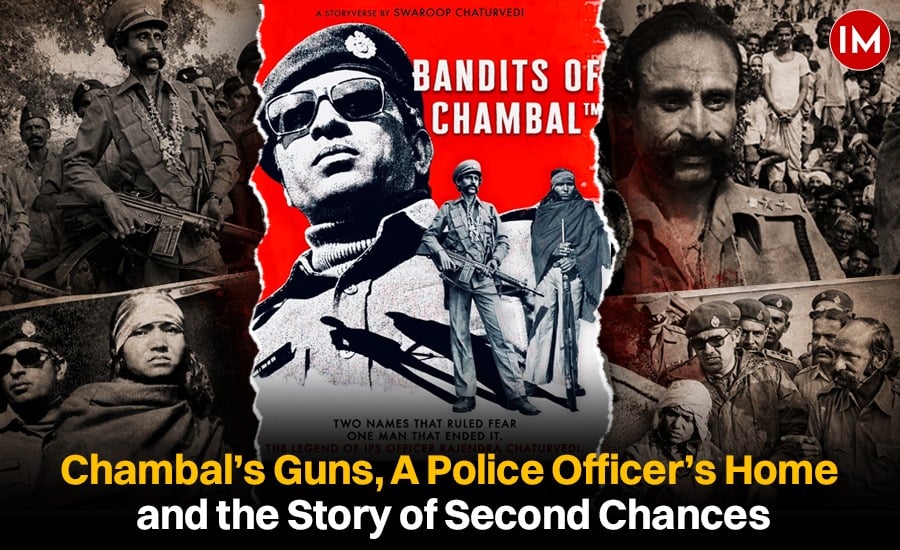
His son, Swaroop Chaturvedi, witnessed this unusual transformation from close quarters. As a child, he saw the Chambal not just through the lens of policing, but through the people who lived on both sides of the law. Years later, those memories, conversations and experiences have inspired him to tell this largely untold side of the ravines in his forthcoming book, Bandits of Chambal.
It is a story not only about dacoits and police encounters, but about what happens when fear gives way to trust, and criminals begin looking for a way back into ordinary life.
“My father never believed that surrender was the end of the story. For him, the real test began after a person put down the gun. He believed that if we wanted the Chambal to change, we had to give people a reason to choose a different life — education for their children, dignity for their families and the opportunity to work”, Mr. Swaroop said during a conversation with Indian Masterminds.
THE DAY THE RAVINES ENTERED THEIR HOME
In the 1970s and 1980s, the Chambal region was synonymous with armed gangs. But Rajendra Chaturvedi believed that a person’s past did not always have to decide his future.
His family saw this belief in action.
Former dacoits who had surrendered in the 1972 operations remained in touch with him. They often came to the family home in Gwalior. Some needed help with school admissions. Others needed jobs or medical treatment. Their families also needed support.
Read Also: Rajendra Chaturvedi: The Policeman Who Walked Alone Into The Chambal Ravines – Part 1
For young Swaroop and his elder brother Arunvithi, these visits were unusual.
The men looked different from the people they saw in ordinary life. Some had large moustaches. Some carried licensed weapons. Yet they were now sitting inside their home and talking to their father.
The children slowly understood that these were men who had once lived a very different life.
“WE CALLED THEM BAAGHIS”
Rajendra Chaturvedi did not like using the word “daaku” for people who had surrendered and were trying to rebuild their lives. The family used the word “baaghi” instead.
That did not mean their crimes were forgotten. It meant that surrender could be the beginning of another life. Swaroop remembers how his father looked at them.
“He never excused their crimes. But he believed that a person should not be defined forever by his worst act. His belief was that there is a saint in every sinner.” That idea shaped much of the family’s work.
The former dacoits became sources of information for the police. Some helped the administration understand the ravines and the gangs still operating there. But the relationship went beyond policing. They were now also helping each other.
A HOME THAT BECAME A BRIDGE
Rajendra was not the only one working with vulnerable communities. His wife, Dipannita Chaturvedi, was deeply involved in social work. She served as President of the Mahila Raksha Samiti and worked with women facing serious problems.
Lady doctors, lawyers and women from civil society joined her efforts. They helped undertrial women. They supported women facing caste ostracisation, trafficking, domestic abuse and abandonment. They also helped with legal advice, medical care, employment and vocational training.
The work created another bridge between the police family and marginalised communities. Former dacoit families were among those who sought assistance. The Chaturvedi home became a place where people could come without fear.
THE FORMER DACOITS CAME WITH THEIR PROBLEMS
After surrender, survival was still difficult. Leaving the ravines did not automatically create a new life. Former dacoits needed work. Their children needed schools. Their families needed medical care. They needed acceptance from society. Some approached Rajendra Chaturvedi for help in getting their children admitted to schools.
Others sought medical treatment at Gwalior Medical College. Some were helped in finding contractual government jobs. The goal was simple: make surrender meaningful. A person who had put down a gun needed something to pick up in its place. A job. A skill. A school admission. A stable family life. Without these things, rehabilitation could remain only a word on paper.
MALKHAN SINGH: FROM THE RAVINES TO A NEW LIFE
Among the most prominent names in this story was Malkhan Singh, popularly known as the “Bandit King of Chambal”. Rajendra Chaturvedi played an important role in bringing him towards surrender. But the story did not end when the guns were surrendered. Malkhan later remained connected with the family and with the wider effort to improve the lives of people around him.
According to Swaroop, he became involved in community work. He supported the rebuilding of a village temple and encouraged young boys to seek careers in the police and armed forces. The transformation was not about erasing the past. It was about what came after it.
PHOOLAN DEVI AND ANOTHER KIND OF TRANSFORMATION
Phoolan Devi’s story was even more complex. She entered public life after her surrender and later became a Member of Parliament. For many poor and oppressed women, her journey became a powerful symbol.
But there was also a personal connection with the Chaturvedi family. Before her first Lok Sabha election, Phoolan met Dipannita in Bhopal. She had lunch with her and sought her blessings.
“THEY WERE NO LONGER JUST NAMES IN A POLICE FILE”
Swaroop remembers that the former dacoits gradually became familiar faces. “When Mohar Singh and Madho Singh came to our home with food from Bhind, they were no longer just names in a police file. They were people we knew, people who spoke to our father and people who trusted our family.”
This was perhaps the most unusual part of Rajendra Chaturvedi’s work. He did not see policing only as a contest between the police and criminals.
He saw the possibility of changing the relationship itself. That approach was not always understood by his colleagues.
Some questioned his methods. Some saw his work as a “one-man show”. Others believed that encounters would be easier than negotiations. But Rajendra stayed with his approach.
THE CHILDREN WHO SAW THE CHANGE
For his sons, the experience was also a lesson in human behaviour. They saw men who had once lived with guns come home with sweets and food. They saw their father listen to them. They saw former dacoits seek help for their children.
And they saw their mother work with women who had nowhere else to go. At the same time, security remained a serious concern. The children were rarely allowed outside the official residence without protection. School trips were accompanied by armed guards.
Yet inside that guarded home, an unexpected thing was happening. People from opposite sides of the law were learning to trust one another.
REHABILITATION WAS PART OF POLICING
For Rajendra Chaturvedi, surrender was never simply about taking weapons away. It was about giving people a reason to leave the guns behind. That meant rehabilitation. It meant family support. It meant education and employment. It meant allowing former offenders to become useful members of society while still recognising the harm caused by their crimes.
His philosophy was simple. A surrender could end an armed career. But only rehabilitation could begin a new life. The Chambal story is therefore not only about encounters, intelligence or surrender operations. It is also about what happened after the guns were put down.
The former dacoits who once lived in the ravines began knocking on doors. And, in one unusual police family, those doors opened.