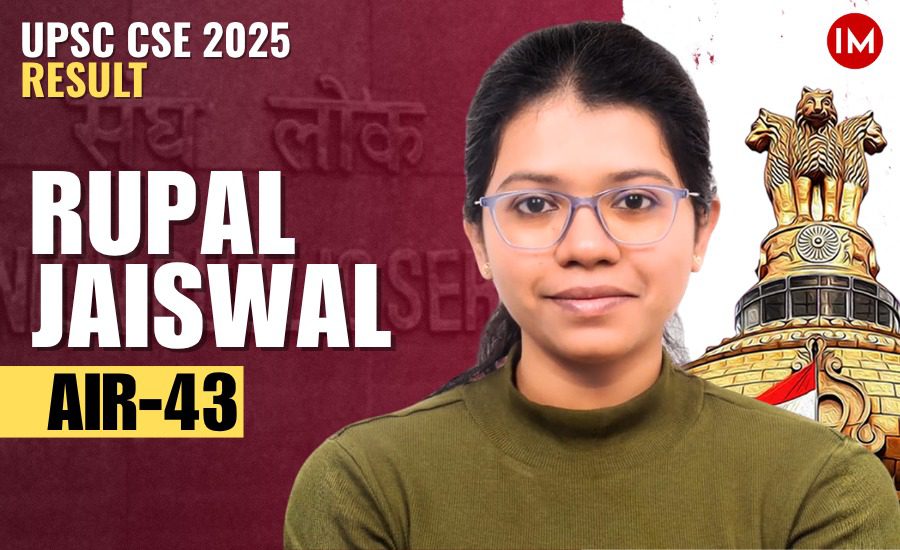
In the quiet lanes of Khandwa, an aspirational district in Madhya Pradesh, a young girl often found herself asking uncomfortable questions about development gaps, lack of waste management, and limited opportunities. That girl was Rupal Jaiswal.
Born and brought up in Khandwa, Rupal’s early education unfolded in the same town. Her father, Dhananjay Jaiswal, a contractor, and her mother, a homemaker, provided a grounded upbringing. But it was her curiosity and her habit of questioning the status quo that set her apart.
“When I moved out and started comparing Khandwa with cities like Pune, I kept wondering why such disparities exist. My father told me, ‘Instead of complaining, do something about it.’ That stayed with me,” Rupal shared in an exclusive conversation with Indian Masterminds.
That moment quietly planted the idea of civil services.
LAW, MUMBAI, AND A TURNING POINT
Rupal pursued a BA LLB (Hons) from Pune, stepping into a fast-paced urban life far removed from her hometown. After graduating in 2020, she joined a law firm in the city, gaining nearly two years of professional experience.
But something felt incomplete.
By the end of 2022, she made a bold decision: to leave her job and prepare for the UPSC Civil Services Examination. It was a shift from corporate corridors to uncertain, self-driven preparation.
“I always wanted a dynamic job where I could challenge myself. Civil services offered that opportunity,” she says.
FAILURE, RANK 512, AND THE FINAL LEAP TO AIR 43
Her first attempt didn’t go as planned. She couldn’t clear prelims after faltering in CSAT. For someone who had always been academically strong, it was a jolt.
“I wasn’t used to not clearing an exam. It brought self-doubt for some time,” she admits.
But she didn’t stop.
In her second attempt in 2024, she secured AIR 512. Yet, it wasn’t enough to get her preferred service, the IAS. That became her reason to return stronger.
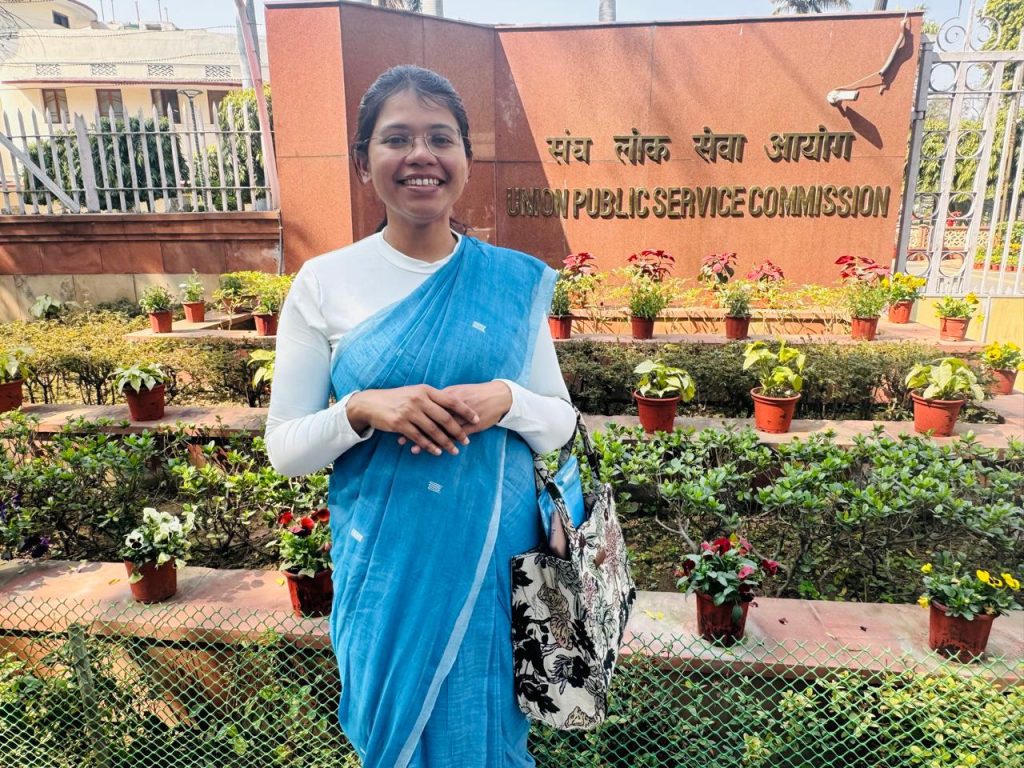
And in 2025, she did exactly that, securing AIR 43, a rank that ensures her entry into the Indian Administrative Service.
A SELF-STUDY STRATEGY THAT WORKED
Rupal chose a path many hesitate to take, preparing without coaching.
She began by carefully selecting limited study resources, guided by topper videos on YouTube. Once finalized, she refused to switch sources midway.
“Every new book distracts you. I decided to stay loyal to my sources,” she explains.
Her preparation rested on three pillars:
- Multiple revisions of standard books
- Self-made online notes, regularly updated with current affairs
- Answer-writing practice based on topper copies and PYQs
Before mains, she condensed entire subjects into crisp 5–10 page revision notes, enabling her to revise everything within 30 minutes before entering the exam hall.
“That’s how you retain and reproduce such a vast syllabus,” she says.
WHY LAW WAS HER OPTIONAL, DESPITE WARNINGS
Despite being advised against selecting law as her optional subject due to its perceived unpredictability, Rupal stayed firm.
With a degree and professional experience in law, she saw it as both a strength and a safety net.
“I knew I was most comfortable with the law. And if things didn’t work out, I wanted to stay connected to my domain,” she shared with Indian Masterminds.
INSIDE THE INTERVIEW ROOM
Rupal’s interview preparation revolved around one key document, her Detailed Application Form (DAF). From Khandwa’s geography to its cultural icons, she prepared every detail thoroughly.
Her interview began on a light note. The chairperson asked her about a famous singer from Khandwa.
“I said Kishore Kumar, and we ended up discussing his songs. The board even joked that my generation only listens to Arijit Singh,” she smiles.
But the tone soon shifted.
She was asked a complex legal question: how much maintenance should a wife receive if her husband owns ₹20,000 crore?
Pressed for a number, she answered – 10%.
When challenged further, she held her ground with logic: “Maintenance is meant to ensure a reasonable standard of living, not to punish the husband.”
Her composure paid off. She scored 193 and 198 in her interviews across attempts.
A VISION ROOTED IN REALITY
As she prepares to enter the IAS, Rupal is clear about her priorities. Women’s empowerment stands at the forefront, through self-help groups and employment generation.
She also wants to focus on improving the quality of education, ensuring government schools provide industry-relevant learning and well-trained teachers.
“Education should prepare children for real-world demands,” she says.
THE MESSAGE SHE WANTS ASPIRANTS TO REMEMBER
After years of preparation, setbacks, and success, Rupal offers a grounded perspective:
“Treat this exam like an exam, not life. Give your best, but don’t compromise your mental health or relationships.”
It’s a line that cuts through the noise of one of the country’s toughest competitions, reminding aspirants that success here is meaningful, but not everything.
For Rupal, the journey was never just about clearing an exam. It was about growing into someone capable of taking responsibility, making decisions, and staying composed when it mattered most.
Now, as she steps into public service, the questions that once pushed her forward may finally begin to find answers, this time, through her own work.
And that’s where her real journey begins.