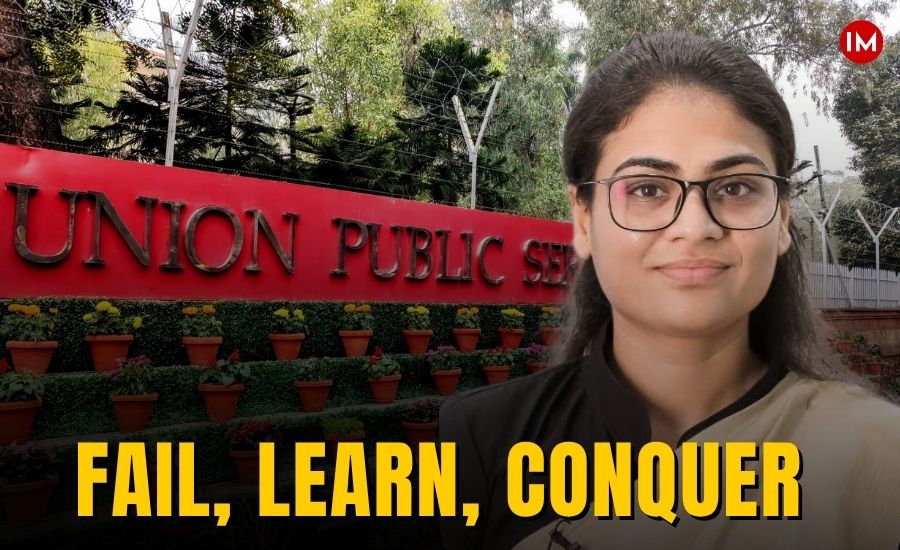
Imagine cracking one of the toughest exams in India, the UPSC Civil Services, after facing setbacks that could shake anyone’s confidence. Priyansha Garg, IAS (2023 batch, West Bengal cadre), a determined young woman from Agra, did just that, securing an impressive All India Rank of 31 in her fourth attempt. A computer science engineering graduate, she dove into UPSC preparation straight out of college, clearing prelims on her first try but stumbling before soaring. Her story isn’t just about passing an exam—it’s about learning from failures, refining strategies, and staying focused through a gruelling journey.
EARLY BEGINNINGS AND INITIAL SUCCESS
Hailing from Agra, Priyansha’s academic foundation in computer science engineering from Maharaja Agrasen Institute of Technology in Delhi (2018) equipped her with a structured approach to problem-solving, which she later applied to her UPSC preparation. In 2019, just a year after graduating, she cleared the UPSC prelims in her first attempt—a remarkable feat for a newcomer. However, she missed the mains cutoff by 19 marks, a setback that fuelled her determination to refine her strategy.
Despite this early success, the next two years brought challenges. In 2020 and 2021, Priyansha failed to clear the prelims, a phase she attributes to overcomplicating her preparation. “I tried to do a lot more,” she recalls, emphasising the importance of sticking to the basics. Her fourth attempt in 2022 marked a turning point. By returning to a streamlined approach, she not only cleared the prelims for both Civil Services and Forest Services but also excelled in the mains and secured a top rank.
KEY STRATEGIES FOR UPSC PRELIMS
Priyansha’s preparation strategy for the UPSC prelims is a goldmine for aspirants. She advocates for a focused approach, emphasising limited resources and a deep understanding of the exam’s pattern. “Keep your resources limited,” she advises, recommending standard books like Lakshmikant for polity, Spectrum for modern history, and NCERTs for geography and economics.
Her prelims strategy revolves around securing “low-hanging fruits”—the 25 to 30 straightforward questions in the paper that can yield 60 marks. With cutoffs typically around 88-90, targeting these questions ensures a strong foundation. To achieve this, Priyansha recommends solving previous years’ UPSC prelims papers in a time-bound manner, ideally from 9:30 AM to 11:30 AM, to simulate the exam environment. Mock tests, she adds, help build a knowledge base for static portions like history while also familiarising aspirants with the UPSC’s question-framing style.
One of Priyansha’s unique tactics is her “25 questions in 25 minutes” approach. She divides the 100-question paper into four sections, attempting 25 questions at a time to maintain pace and urgency. This method prevents overthinking and ensures she doesn’t miss easier questions toward the end. By attempting 94-95 questions, she maximises her chances while leaving 10-12 uncertain ones for the final 15-20 minutes. This structured approach, inspired by a friend, helped her stay calm and efficient during the exam.
MASTERING CURRENT AFFAIRS AND MAINS PREPARATION
For current affairs, Priyansha avoided the time-intensive task of reading newspapers cover-to-cover. Instead, she relied on monthly magazines for concise, exam-relevant content. She also recommends the Indian Express Explained section for its in-depth coverage of topics like the functioning of the Lok Sabha Secretariat or the roles of the Speaker and Vice President—areas often overlooked in standard texts but frequently tested by UPSC.
Her mains preparation focused heavily on answer writing, which she credits for her high score of 868 in the written exam. “Practice answer writing from the very beginning,” she advises, suggesting aspirants write two answers daily using previous years’ questions or topics from coaching materials. This habit not only improves content knowledge but also hones the ability to structure answers effectively. Priyansha kept the UPSC syllabus at the forefront, using it to define the scope of her studies and avoid irrelevant topics. For instance, in economics (GS3), she focused on government budgeting by analysing past questions to tailor her notes precisely.
EXCELLING IN PUBLIC ADMINISTRATION OPTIONAL
Priyansha’s choice of Public Administration as her optional subject played a crucial role in her success. In her first attempt, her scores were 104 in Paper 1 and 139 in Paper 2, which held her back from clearing the mains. In her fourth attempt, she improved significantly, scoring 153 in Paper 1 and maintaining 139 in Paper 2. Her preparation for Paper 1 focused on key topics like introduction, thinkers, public policy, comparative public administration, and developmental administration. She ensured she had crisp definitions, examples, and terminology at her fingertips—for instance, instantly recalling terms like “institutional pluralism” and “citizens as customers” for New Public Management (NPM).
For Paper 2, she used Aravam as a base text, supplemented by her own notes from Google searches and Anudeep Sir’s ARC notes, which also aided her GS2 preparation. Priyansha’s secret weapon was studying topper answer copies to identify structural gaps in her own writing. By repeatedly practising and comparing her answers to those of successful candidates, she refined her approach to mirror high-scoring responses. For Paper 1, she relied on classroom handwritten notes. Her methodical approach to mastering terminology and examples ensured her answers stood out.
ETHICS AND MENTAL HEALTH
For the ethics paper (GS4), Priyansha adopted a systematic approach. She prepared definitions, examples, and quotations for every term in the syllabus, ensuring her answers were diverse and comprehensive. For instance, when tackling a question like “An unexamined life is not worth living,” she included social, political, and administrative examples to enrich her response. This preparation helped her complete the paper efficiently and avoid last-minute brainstorming.
Mental health, Priyansha emphasises, is critical in the unpredictable UPSC journey. After facing setbacks, she advises aspirants to maintain a backup plan, such as taking a job after graduation to reduce pressure and build maturity. “Don’t latch your self-esteem to the exam,” she cautions, noting that even bright, hard-working candidates may face failures. She also recommends taking short breaks—three to four days after prelims or mains—to rejuvenate through hobbies, meditation, or time with friends.
A BALANCED APPROACH TO STUDY HOURS
Priyansha’s study routine was disciplined yet flexible. She averaged seven to eight hours of quality study daily, dropping to three to four on tough days. For prelims, she studied in two-hour blocks, while for mains, she extended to three-hour sessions. She stresses the importance of time-bound practice, aligning mock tests with UPSC’s schedule (9 AM to 12 PM or 2 PM to 5 PM) to synchronise her body clock with exam conditions.
Priyansha’s journey underscores the power of persistence, strategic planning, and self-belief. Her advice to aspirants is clear: have a strong reason for pursuing UPSC, choose your optional wisely, stick to limited resources, and practice answer writing consistently. For UPSC aspirants, Priyansha Garg’s story is a practical guide to navigating the challenges of the exam with focus and determination.