Where do tigers find the most delicious and abundant food in the country? Which place offers the easiest access to their favorite prey? And which destination do tigers seem to prefer because of this bounty?
If these questions are on your mind, the answer lies in one remarkable place – the Pench Tiger Reserve in the Seoni district of Madhya Pradesh.
According to a recent government report, Pench Tiger Reserve in Madhya Pradesh boasts the highest density of prey animals in the country, making it a paradise for tigers. The report states that the reserve supports an impressive 94 herbivores per square kilometer. These include species like sambar, deer, gaur, and even cheetal (spotted deer), creating a rich and diverse prey base.
In total, around 70,000 animals roam the forests of Pench, providing a plentiful food supply for its big cats. But what makes Pench such a thriving ecosystem for prey species? And which animals play the biggest role in sustaining this ideal hunting ground?
Read on to discover why Pench is not just a haven for wildlife, but a gourmet destination for the majestic tiger.
Indian Mastermind spoke exclusively with 1997 batch IFS (Indian Forest Serice) officer Rajnish Kumar Singh, the Deputy Director of Pench Tiger Reserve, to delve deeper into the recent findings and understand why Pench has emerged as the leading tiger habitat in the country. What makes this reserve stand out?

THE REPORT
The Wildlife Institute of India, after a technical review of data from the Government of India’s All India Tiger Assessment Report, released a groundbreaking study in April 2025. According to this report, the Pench Tiger Reserve in Seoni District of MP, ranks first in the country in terms of prey availability for tigers.
The data reveals that Pench has an exceptional density of herbivores – such as sambar, deer, gaur, and cheetal – averaging 94.85 animals per square kilometer. This figure surpasses that of any other tiger reserve in India.
Based on the biomass of wild animals – an essential food source for carnivorous wildlife – Pench ranks first among all tiger reserves in India, with 9,876.25 kg per square kilometer. Kanha Tiger Reserve ranks second with 8,602.15 kg/sq km, followed by Mudumalai at 8,484.4 kg/sq km, and Corbett at 5,534.95 kg/sq km. This reflects the exceptional efficiency of its management and conservation efforts.
Wildlife experts emphasize that such a high concentration of prey plays a critical role in ensuring a stable and thriving tiger population. Adequate food supply supports not only the health and growth of tigers but also benefits other carnivores like leopards within the ecosystem.
Published on April 18, 2025, this report offers a comparative analysis of ungulate (hoofed animal) densities across protected areas in India. The findings clearly establish Pench as the most prey-rich tiger reserve in the nation – making it a vital stronghold for India’s big cats.
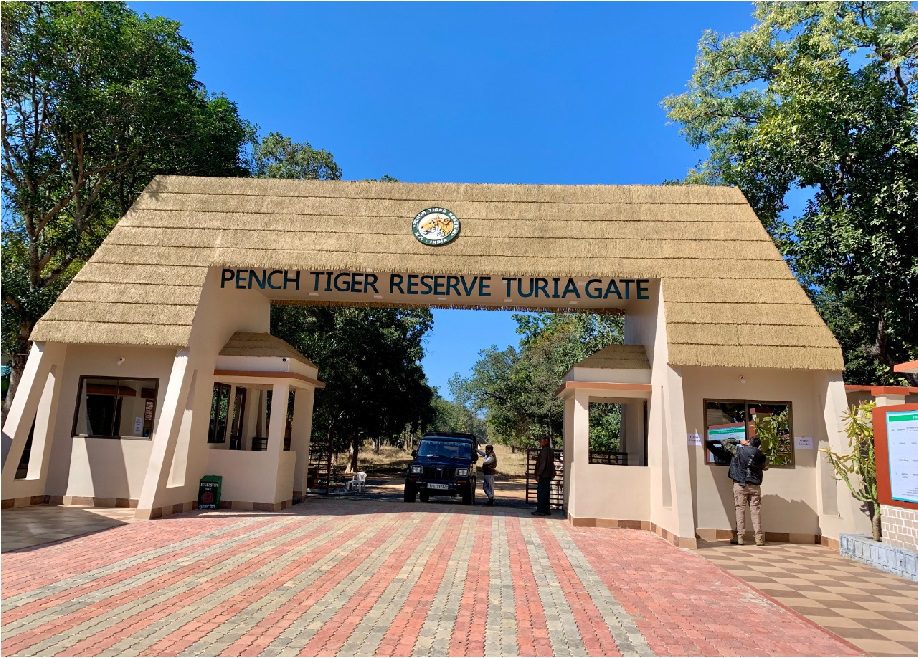
A THRIVING HABITAT
Pench Tiger Reserve holds the highest prey density for tigers, not just in the state but across India. As Mr Singh shared, while Pench may not top the charts for any single species, its collective strength reflects a healthy ecosystem that supports a wide variety of wildlife.
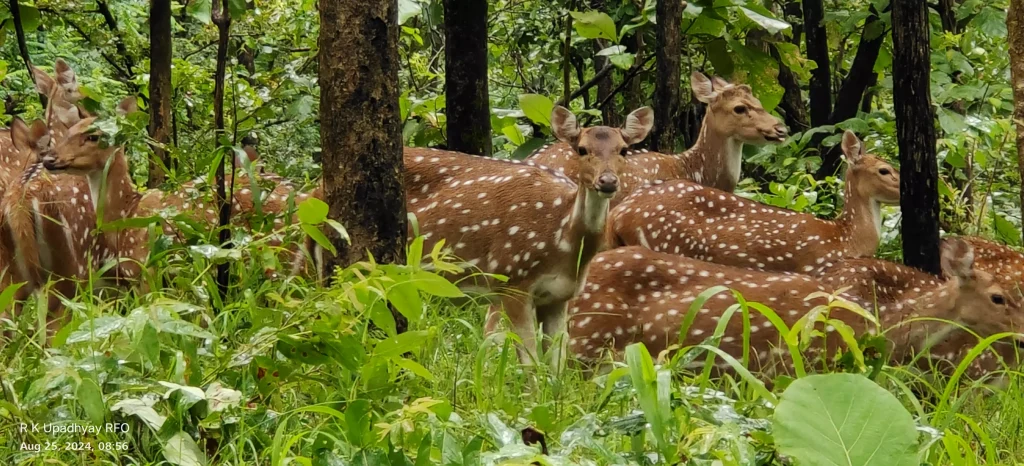
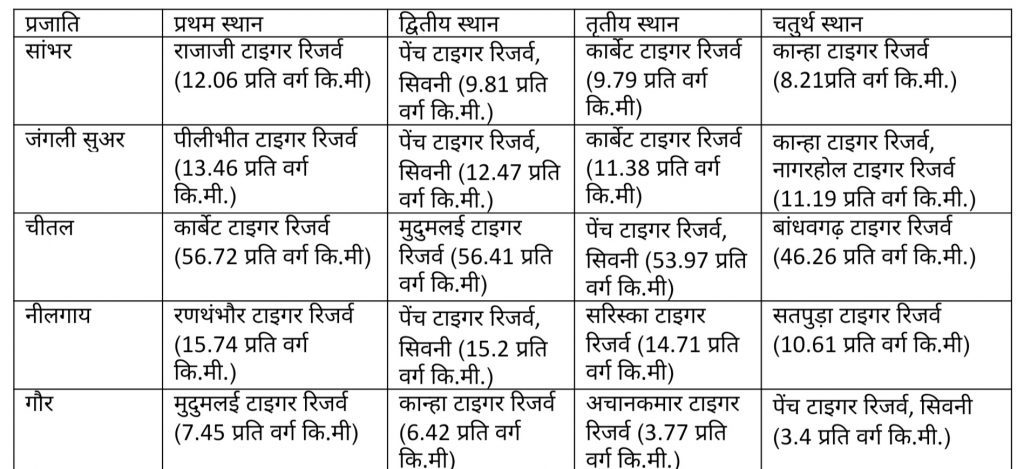
Pench Tiger Reserve has the second-highest density of wild boar and nilgai, third-highest for chital, and fourth for gaur among all protected areas in India, based on the number of hoofed animals per square kilometer
Mr Singh said, “This report from the Wildlife Institute of India is based on the data we submitted for the All India Tiger Estimation in 2022. While the tiger-centric results were released about a year later, the findings related to herbivore populations have only recently been published. Based on that data, Pench has emerged as the number one tiger reserve in terms of prey base.”
REASONS: WHATS MAKE PENCH UNIQUE
While explaining Pench’s ecological uniqueness, Mr Singh highlighted several key reasons behind its exceptional status. “Herbivores generally require grasslands to thrive. In most other tiger reserves – like Kanha, for instance – grasslands have to be actively managed. The forest canopy in these areas is tall, and the leaves – being high up – offer limited fodder value to ground-dwelling herbivores. Pench, however, stands out due to its natural forest structure, where dense forest patches and open grasslands coexist seamlessly.”
This mixed landscape ensures that grass is available throughout the terrain, offering consistent grazing opportunities for herbivores. Consequently, the herbivore population is significantly higher here.
He added that two other key factors also contribute to the high prey density – reliable water availability and strong protection measures. However, Mr Singh emphasized that the abundant, naturally occurring grass across the reserve is the single most important factor behind Pench’s exceptional herbivore density.
Today, the reserve is home to around 70,000 herbivorous animals, forming a rich and sustainable prey base for tigers and other carnivores.
SIZE VS STRENGTH
Mr Singh also shared a striking fact about Pench’s size and its tiger population –“Our tiger reserve may be relatively small, with a core area of just 411 square kilometers. Yet, despite its size, it supports an impressive abundance of prey.”
He continued, “According to camera trap data, between 75 to 80 adult tigers are regularly seen in the area. Across the broader landscape, the estimated tiger population stands at around 123. This is incredibly encouraging and validates that our habitat management practices are truly wildlife-friendly.”
INTERSTING INSIGHTS
Mr Singh also offered fascinating insights into species diversity within the reserve. “If we look at individual species, Pench isn’t ranked number one for most. For instance, we’re third in chital population. But we’re number one when it comes to gaur and nilgai.”
“What truly sets Pench apart,” he added, “is the collective picture – the full bouquet, so to speak. When you consider all herbivore species together, Pench ranks at the top. That speaks volumes about the diversity and balance of our habitat.”
It shows that multiple species have adapted well here, making Pench a rich and balanced ecosystem. This blend of high prey density, species diversity, and effective conservation makes Pench Tiger Reserve one of the most ecologically significant tiger habitats in India.
ABOUT PENCH TIGER RESERVE
Pench Tiger Reserve is located in the Seoni and Chhindwara districts of Madhya Pradesh, with a portion extending into Maharashtra. It derives its name from the Pench River, which flows through the reserve from north to south. Pench, with its mix of dry deciduous forests and open grasslands, provides ideal grazing for herbivores and supports a thriving predator population. Home to tigers, leopards, wild dogs, and over 300 bird species, it’s one of India’s most ecologically balanced reserves. Pench inspired Rudyard Kipling’s The Jungle Book and is one of the most ecologically balanced and well-managed reserves in India.