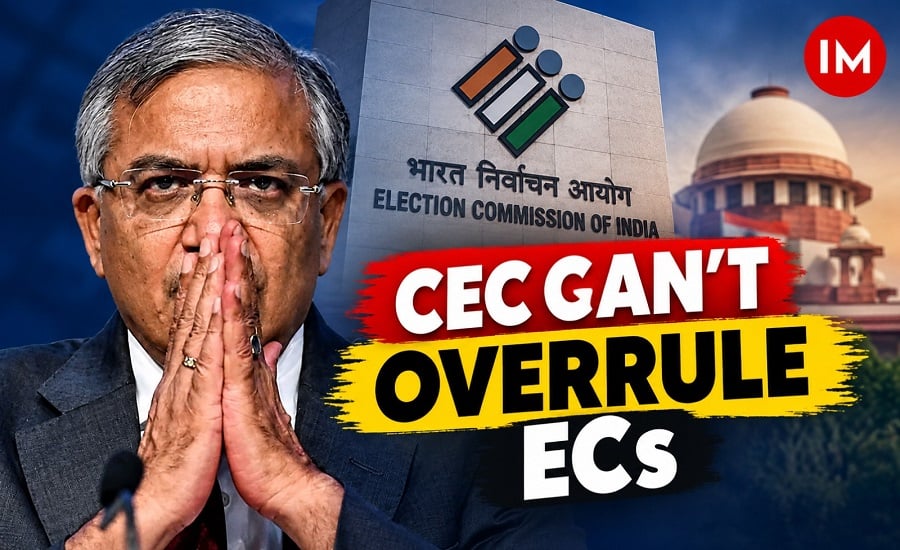
New Delhi: The Chief Election Commissioner (CEC) is the head and Chairperson of the Election Commission of India (ECI), the constitutional body entrusted with the superintendence, direction and control of elections. But does the CEC’s position mean that their opinion automatically prevails whenever there is a disagreement with the other Election Commissioners?
The constitutional and statutory framework provides a more nuanced answer.
The Election Commission is designed as a multi-member body. While the CEC occupies the position of Chairperson, the other Election Commissioners are not merely advisers whose views can simply be disregarded. Under the present legal framework, the Commission is expected to function through consensus as far as possible. Where the members differ, the law provides for the matter to be decided by the majority.
This principle was also examined by the Supreme Court in its landmark 1995 judgment in T.N. Seshan v. Union of India, in which the Court upheld the constitutional validity of a multi-member Election Commission and rejected the proposition that the CEC’s word must necessarily be final.
The issue has assumed renewed relevance following a report by The Indian Express that Election Commissioners Sukhbir Singh Sandhu and Vivek Joshi formally recorded objections at least 14 times over 10 months concerning decisions and orders related to electoral-roll management and the Special Intensive Revision (SIR) process. The Election Commission has, however, said that differing views are a normal part of institutional deliberations and that all decisions taken by the full Commission over the past year were unanimous.
What Does Article 324 of the Constitution Say?
Article 324 of the Constitution forms the basic constitutional foundation of the Election Commission.
Article 324(1) vests the superintendence, direction and control of elections in the Election Commission.
Article 324(2) provides for the Commission to consist of the Chief Election Commissioner and such number of other Election Commissioners as the President may fix from time to time.
Article 324(3) provides that when other Election Commissioners are appointed, the Chief Election Commissioner shall act as the Chairman of the Election Commission.
This distinction is important.
The Constitution expressly makes the CEC the Chairman, but Article 324 does not say that the CEC’s opinion shall be final on every question before the Commission.
The role of Chairperson therefore cannot, by itself, be interpreted as conferring unilateral decision-making power over the other members.
Read also: “Difference of Opinion Is Normal”: ECI Responds to Reports of Internal Differences Over SIR
CEC Is the Chairperson, But Not a One-Member Commission
The Supreme Court dealt with this precise issue in T.N. Seshan, Chief Election Commissioner of India v. Union of India, decided in 1995.
The case arose after the Election Commission was converted into a multi-member body in 1993, with M.S. Gill and G.V.G. Krishnamurthy appointed as Election Commissioners. Then CEC T.N. Seshan challenged the arrangement and questioned, among other things, the status of the other Election Commissioners vis-à-vis the CEC.
The Supreme Court upheld the constitutional validity of the multi-member Election Commission.
In examining the respective positions of the CEC and the Election Commissioners, the Court made it clear that the Election Commissioners are integral members of the Commission and therefore must have a say in its decision-making process.
The Court rejected the argument that the other Election Commissioners merely function as advisers to the CEC.
It observed that if the CEC were treated as superior in the sense that the CEC’s word was always final, the other Election Commissioners would effectively become non-functional or merely ornamental. The Court held that such an intention could not be derived from Article 324 or attributed to the Constitution-makers.
This reasoning is at the heart of the understanding of the CEC as “first among equals” in the functioning of the Commission.
What Happens If the CEC and Election Commissioners Disagree?
The present statutory position is particularly clear.
The Chief Election Commissioner and Other Election Commissioners (Appointment, Conditions of Service and Term of Office) Act, 2023 contains a specific provision dealing with the disposal of the Commission’s business.
Section 18(1) provides that the Election Commission may, by unanimous decision, regulate the procedure for transaction of its business and allocation of its business among the CEC and other Election Commissioners.
More importantly, Section 18(2) states that the business of the Election Commission shall, as far as possible, be transacted unanimously.
But what happens when unanimity is not possible?
The law expressly provides that if the CEC and the other Election Commissioners differ in opinion on any matter, the matter shall be decided according to the opinion of the majority.
This means that disagreement does not automatically give the CEC the casting or overriding authority.
In a three-member Commission, the practical position is straightforward:
- If the CEC and one Election Commissioner support a particular position while the third member disagrees, the view supported by the two members constitutes the majority.
- If the two Election Commissioners agree on a position while the CEC takes the opposite view, the two Election Commissioners constitute the majority and their view prevails.
- If all three agree, the matter is decided unanimously.
Thus, the CEC’s status as Chairperson does not convert the Commission into a one-person decision-making body.
The “First Among Equals” Principle
The phrase “first among equals”, or primus inter pares, helps explain the institutional position of the CEC.
The CEC is first in the sense that the Constitution specifically designates the CEC as Chairperson of the Commission. The CEC presides over the Commission, but the office does not automatically carry a veto over the views of the other Election Commissioners.
The Supreme Court’s reasoning in T.N. Seshan is particularly significant because it examined precisely the argument that the CEC’s special position should mean that the other Commissioners occupy a subordinate role.
The Court did not accept that interpretation.
Instead, it held that because the Election Commissioners form part of the Election Commission, they must have a meaningful role in decision-making. Treating their views as merely advisory would effectively undermine the purpose of having a multi-member constitutional body.
Why Does the CEC Have a Different Constitutional Status?
This does not mean that the Constitution treats the CEC and the other Election Commissioners as identical in every respect.
Article 324(5) provides the CEC with a distinct constitutional safeguard concerning removal from office.
The CEC cannot be removed except in the same manner and on the same grounds as a Judge of the Supreme Court. The Constitution also protects the CEC’s conditions of service from being varied to their disadvantage after appointment.
For an Election Commissioner or Regional Commissioner, the Constitution provides that removal from office requires the recommendation of the CEC.
These differences in removal protection can sometimes create the impression that the CEC is legally superior to the other Election Commissioners in every aspect.
But the Supreme Court in T.N. Seshan specifically distinguished the CEC’s special constitutional protections from the question of decision-making authority.
The Court reasoned that differences relating to tenure, service conditions and removability could not by themselves establish that the CEC possesses the final word on every matter before the Commission.
What Exactly Did the Supreme Court Decide in 1995?
The Seshan judgment is important because it addressed the constitutional status of a multi-member Election Commission at a time when the structure itself was being challenged.
The Court held that the scheme of Article 324 envisages a multi-member body comprising the CEC and Election Commissioners.
The Court also distinguished Election Commissioners from Regional Commissioners. While Regional Commissioners assist the Commission, the Election Commissioners themselves constitute the Election Commission along with the CEC.
Consequently, they cannot be reduced to officials who simply tender advice to the Chairperson.
The Court’s reasoning was that if the CEC were considered superior in the sense that the CEC’s word was final, the other Election Commissioners would become non-functional or ornamental—an outcome that could not reasonably be inferred from Article 324.
The judgment also emphasised the importance of the Chairperson carrying colleagues along rather than treating them as subordinates. The Court recognised that disagreements could arise in a multi-member body but expected holders of high constitutional office to deal with differences with dignity and institutional responsibility.
What Does the 2023 Law Say About Consensus and Majority?
The statutory framework introduced through the 2023 Act reinforces the collective character of the Commission.
Section 18 follows a two-stage approach.
The first preference is unanimity. The Commission’s business is, as far as possible, to be transacted unanimously.
But the law also recognises that unanimity cannot always be guaranteed.
Therefore, where the CEC and other Election Commissioners differ in their opinions, the law provides a mechanism for resolving that disagreement: the majority view prevails.
This provision is significant because it means that a difference of opinion within the three-member Commission is not, by itself, legally anomalous.
Dissent can occur during deliberations. What matters is that the final decision follows the legally prescribed decision-making process.
Why the Issue Has Come Into Focus Now
The question of how the three-member Commission functions has gained renewed attention following The Indian Express investigation published on September 23, 2026.
According to the report, Election Commissioners Sukhbir Singh Sandhu and Vivek Joshi formally recorded objections at least 14 times over a 10-month period concerning decisions and orders connected with electoral-roll management and the SIR exercise. Their objections reportedly touched on issues including new voter registration, deletion and restoration of names, appeals, changes to Form 6 and control of the voter database.
The report also said the two Commissioners raised concerns regarding changes in the management of the Election Commission’s IT systems and the centralisation of access to electoral-roll data. In separate communications, they reportedly approached Cabinet Secretary T.V. Somanathan over concerns relating to the integrity and administration of the voter database systems.
The developments have therefore brought the legal principle of collective decision-making within the Election Commission into sharper public focus.
What Was the Dispute Over Form 6?
One of the issues highlighted in the reported objections concerned Form 6, which is used by eligible citizens to apply for inclusion in the electoral roll.
According to The Indian Express, a new declaration connected with the SIR process was introduced into Form 6 on the ECINet portal. The declaration asked applicants whether their names, or those of their parents or grandparents, appeared in the electoral roll from the last SIR.
The report said Election Commissioner Vivek Joshi had objected in May to altering Form 6 through the SIR framework, arguing that Form 6 was a statutory form prescribed under the Registration of Electors Rules, 1960 and could not be altered without the appropriate amendment to the rules. Election Commissioner Sukhbir Singh Sandhu subsequently recorded agreement with Joshi’s position.
These objections illustrate why the question of who formally constitutes the Election Commission for purposes of decision-making is legally important.
The issue is not simply whether an individual Commissioner agrees or disagrees with a particular administrative measure. It also concerns the procedure through which the Commission reaches and records its final decision.
What Does the Election Commission Say?
The Election Commission has rejected the suggestion that the existence of internal notes or differing observations means that final decisions were taken without collective approval.
In its clarification issued on September 23, the Commission said that differing views and observations are a normal part of deliberations in any institution and form part of the decision-making process before a final decision is reached.
The Commission also said that not only the three Election Commissioners but every official within the Commission is authorised to offer suggestions aimed at improving the electoral system.
The Commission further argued that focusing on specific internal notes and observations over a 10-month period, while leaving out the larger body of approvals, decisions, instructions and initiatives, presents only one side of the picture.
According to the ECI, the Commission has taken numerous decisions, issued instructions, introduced around 40 new initiatives and undertaken several electoral reforms, including electoral-roll revisions such as SIR across the country.
The ECI stated that all these decisions were the outcome of unanimous decisions of the full Commission over the past year.
This is the Commission’s institutional response to the reported internal objections and is distinct from the legal question of how disagreement is to be resolved under Section 18 of the 2023 Act.
So, Can the CEC Overrule the Other Election Commissioners?
The legal position can be understood through an important distinction.
The CEC can certainly participate in decision-making, preside over the Commission as its Chairperson and have their view recorded on an issue. But the CEC does not have a unilateral constitutional veto that allows the office-holder to simply override the other two Commissioners.
If there is disagreement, the law provides for a majority-based resolution.
Therefore, if the CEC supports a particular position and one Election Commissioner supports the CEC while the other disagrees, the CEC-backed position has the support of two members.
But if both Election Commissioners support a position opposed by the CEC, the two Commissioners constitute the majority.
The determining factor is therefore the majority within the Commission, not the identity of the person occupying the Chair.
Does Dissent Within the Election Commission Violate the Law?
Not by itself. A multi-member constitutional body can have differing views during deliberations. In fact, Section 18 of the 2023 Act expressly anticipates the possibility of disagreement by providing a majority-based mechanism for resolving it.
The existence of a dissenting opinion therefore does not automatically mean that the Commission has acted unconstitutionally.
The relevant questions are whether the Commission followed the applicable law, whether the decision was properly placed before the Commission, whether the required decision-making process was followed and whether the resulting decision represents the legally prescribed decision of the Commission.
This distinction becomes particularly important when internal objections concern whether a particular action was actually authorised by the Commission or whether it was undertaken administratively without the requisite approval.
The Larger Constitutional Principle
The structure of the Election Commission reflects an institutional balance.
Article 324 vests electoral superintendence, direction and control in the Election Commission, rather than describing the CEC as the sole repository of those powers.
The CEC is the Chairperson, but the Commission consists of the CEC and the other Election Commissioners when such Commissioners are appointed.
The Supreme Court’s 1995 interpretation and the present statutory framework therefore point in the same broad direction: the CEC has a distinct leadership and constitutional position, but the Commission is intended to function collectively.
The 2023 Act makes the operational mechanism explicit by preferring unanimity and, where unanimity is not possible, providing that differences of opinion are resolved according to the majority.
CEC Has Special Protection, Not a Special Veto
The most important distinction, therefore, is between constitutional protection and decision-making authority.
The CEC enjoys special protection under Article 324(5), particularly regarding removal from office. The CEC is also constitutionally designated as the Chairperson when the Commission is multi-member.
But neither of these provisions creates a general rule that the CEC’s opinion must prevail over the opinions of the other Election Commissioners.
The T.N. Seshan judgment remains important on this point: the Supreme Court rejected the proposition that the other Election Commissioners are merely advisers and made clear that they have a role in the Commission’s decision-making.
Thus, in a three-member Election Commission, the institutional design is not CEC versus Election Commissioners. It is a Commission of three members, chaired by the CEC, expected to seek consensus and, where differences remain, to decide according to the majority as prescribed by law.
The recent debate over internal objections and SIR has consequently brought renewed attention to a constitutional question that has existed for decades: the CEC may be first among equals, but the law does not make the CEC a one-person Election Commission.
Read also: CPWD Asks Ministries to Vacate Shastri Bhawan, Krishi Bhawan by Sept 30 for Central Vista Project