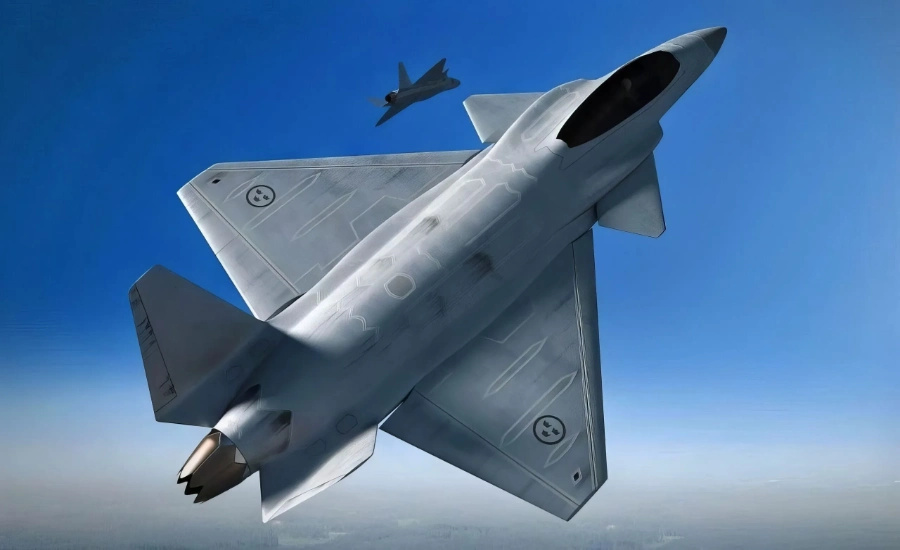
New Delhi: Airbus is exploring a possible Airbus-Saab future combat aircraft partnership after the collapse of the common fighter element of Europe’s Future Combat Air System (FCAS). The move could reshape Europe’s next-generation fighter plans, while India may become an important potential partner in the longer term. However, there is currently no official confirmation that India has been invited to join an Airbus-Saab fighter programme.
The development comes as European countries rethink how they will build their future air-combat capabilities following major disagreements over the original FCAS fighter project.
Why Is Airbus Looking at Saab for FCAS Programme
The original FCAS programme brought France, Germany and Spain together to develop a next-generation European combat-air system. Airbus and France’s Dassault Aviation had been major industrial partners in the fighter element of the programme. However, disagreements over industrial responsibilities and workshare led France and Germany to abandon plans for a common next-generation fighter earlier in 2026. Other FCAS work, particularly combat-cloud technologies, is continuing.
Read also: Everything You Need to Know About Dassault’s 40-Year Support Plan for India’s Rafale Jets
Reuters reported in July that Airbus is courting a Swedish defence company as Europe searches for alternative arrangements for future fighter development. This makes Saab an important company to watch as Europe reorganises its future combat-air strategy.
Airbus-Saab Future Combat Aircraft Partnership: What Could Saab Bring to the Programme
Saab already has extensive experience in designing combat aircraft and advanced airborne systems. Its Gripen E-series fighter combines modern sensors, electronic warfare systems and networked combat capabilities. Saab also develops GlobalEye, an airborne early-warning and control platform designed to provide long-range detection and real-time information.
Saab also has an existing industrial relationship with Airbus. According to Saab, the Swedish company is a Tier-1 supplier to both Airbus and Boeing and provides aircraft structures and other engineering work.
That existing relationship could make deeper cooperation technically easier, although no final Airbus-Saab future fighter partnership has been officially announced.
What Would a Future Airbus-Led Combat System Look Like
A future fighter programme would probably involve much more than simply building a new aircraft. Airbus describes modern future air combat as a connected “system of systems,” where crewed fighters operate alongside uncrewed aircraft and other military platforms through secure digital networks.
Artificial intelligence, low-observable technologies, advanced computing, secure communications and crewed-uncrewed teaming are expected to play important roles. Airbus says future uncrewed collaborative combat aircraft, sometimes called “loyal wingmen,” could fly alongside crewed fighters and perform missions such as attacking targets, jamming enemy radar and gathering battlefield information.
Airbus-Saab Future Combat Aircraft Partnership: Why Could India Become Important
India could be attractive to future international combat-aircraft programmes because the country is rapidly expanding its domestic aerospace and defence manufacturing capabilities. However, India’s involvement in a future Airbus-Saab programme remains speculative at this stage.
Neither the Indian Ministry of Defence nor the official Airbus and Saab material reviewed for this report confirms that New Delhi has formally joined or received an invitation to join such a programme. That distinction is important because reports about possible future cooperation should not be treated as a confirmed agreement.
India Is Already Building Its Own AMCA Fighter
India’s immediate next-generation fighter priority is the indigenous Advanced Medium Combat Aircraft (AMCA) programme. In May 2025, Defence Minister Rajnath Singh approved the AMCA Programme Execution Model.
The Aeronautical Development Agency (ADA) is responsible for executing the programme through industry partnerships. Under the approved model, Indian private and public-sector companies can compete to participate.
Companies can bid independently, through joint ventures or as consortium members, but the bidder must be an Indian company compliant with Indian laws and regulations.
The government described the programme as an important step towards strengthening India’s indigenous aerospace capabilities and achieving greater self-reliance.
Airbus-Saab Future Combat Aircraft Partnership: Could India Join a European Fighter Programme
In theory, deeper cooperation with European aerospace companies could give India access to experience in areas such as advanced sensors, electronic warfare, propulsion, artificial intelligence and crewed-uncrewed teaming.
India, in return, could offer a large aerospace market, growing manufacturing capabilities and an increasingly important defence-industrial ecosystem.
But any major partnership would involve difficult questions over intellectual property, technology transfer, manufacturing responsibilities, costs and control over sensitive technologies.
For India, these issues would also have to be balanced against the country’s goal of developing AMCA as an indigenous programme.
Airbus Is Still Developing Future Combat Technologies
Despite the restructuring of the fighter element of FCAS, Airbus continues working on future air-combat technologies. Airbus says the wider FCAS concept is based around connected crewed and uncrewed platforms operating through a Combat Cloud.
The company is also working on technologies including low observability, artificial intelligence, advanced computing and collaborative combat.
Germany and France have also said that remaining FCAS projects, including cloud-related technologies, will continue despite abandoning their common fighter aircraft plan.