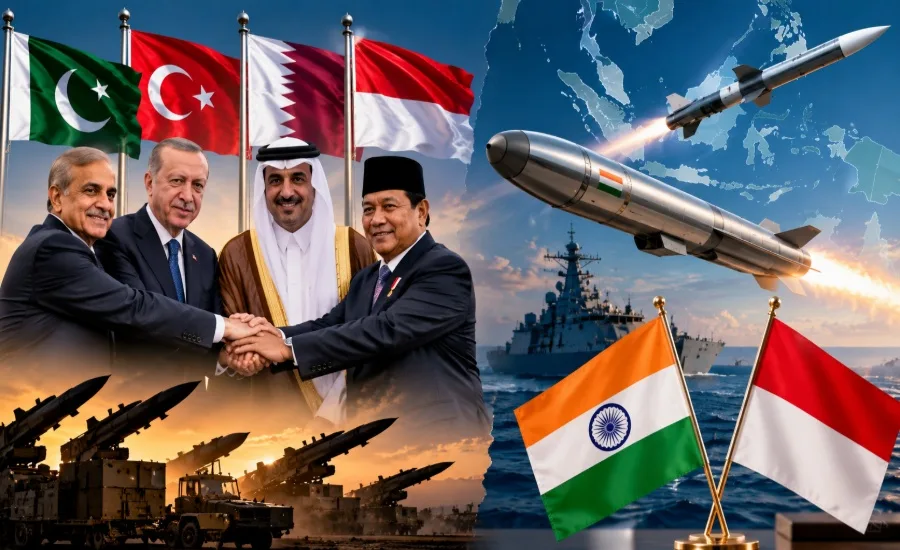
Doha: Pakistan, Türkiye, Qatar and Indonesia signed the Badr MoU in Doha on October 21, 2026, to strengthen defence cooperation. However, a times of India report believe the agreement is unlikely to put India’s missile deals with Indonesia at risk.
The pact focuses on defence manufacturing, military training, research and development (R&D), while India and Indonesia have separate bilateral defence arrangements. Official statements from the participating countries confirm the pact’s main objectives, while India’s official records highlight ongoing india indonesia defence cooperation.
What Is The Badr MoU
The Badr MoU is a multilateral defence cooperation agreement signed by Pakistan, Türkiye, Qatar and Indonesia in Doha, Qatar.
The agreement aims to bring the four countries closer in defence production, military technology development, technical training and research. It is also intended to strengthen their defence industries and improve their ability to develop modern military equipment.
According to Qatar News Agency, the agreement was signed by the four countries’ defence ministries, along with Pakistan’s defence production organisation and Türkiye’s Presidency of Defence Industries. The participating countries may also allow other friendly nations to join under agreed conditions.
The Turkish presidency’s official statement also described the agreement as an important step towards stronger defence and security cooperation among the four countries.
What Does The Badr MoU Aim To Achieve
The agreement focuses on several areas of defence cooperation.
1. Joint Defence Manufacturing
The four countries aim to use their respective industrial capabilities to strengthen defence manufacturing. This could create opportunities for joint projects and closer cooperation between their defence industries.
2. Military Research And Development
The agreement promotes cooperation in research and development. This may help the participating countries explore new technologies and develop solutions for modern military requirements.
3. Technical Military Training
The pact also aims to improve technical training and the exchange of defence-related knowledge. Such cooperation can help participating countries develop skills needed to operate and support modern military systems.
4. Stronger Defence Industries
The agreement seeks to improve industrial cooperation and help the four countries meet their own defence requirements, as well as those of friendly and allied nations. However, the official statements describe the agreement’s broad objectives. They do not establish that every proposed project, production programme or technology-sharing arrangement has already been finalised.
Will The Badr MoU Affect India’s Missile Deals With Indonesia
The key question for India is whether Indonesia’s participation in the agreement could affect its defence contracts with New Delhi.
According to defence experts, the Badr MoU is unlikely to derail India’s missile agreements with Indonesia. They point to the difference between a broad defence cooperation framework and specific bilateral arms contracts.
India and Indonesia have been strengthening their defence relationship through separate agreements and discussions on military equipment, technology and industrial cooperation.
India’s official statement on Prime Minister Narendra Modi’s July 2026 visit to Indonesia confirms cooperation involving the BrahMos missile system and an air-to-air missile cooperation agreement. These existing bilateral arrangements form an important part of the wider India–Indonesia strategic partnership.
Why India’s BrahMos And Astra Missile Deals Matter
India’s defence cooperation with Indonesia is significant because it supports New Delhi’s wider effort to expand defence exports and build long-term partnerships in the Indo-Pacific region.
BrahMos Cruise Missile
The BrahMos is a supersonic cruise missile developed through cooperation between India and Russia. It is designed for precision strikes against designated targets.
The India–Indonesia defence relationship includes cooperation involving the BrahMos missile system. Any future supply arrangements will depend on the applicable agreements, approvals and implementation conditions.
Astra Air-To-Air Missile
The Astra is an Indian-developed beyond-visual-range air-to-air missile designed to engage aerial targets.
India and Indonesia have also identified air-to-air missile cooperation as an area of defence engagement. This reflects the broader effort to expand military and defence-industrial ties between the two countries.
The two missile programmes are separate from the Badr MoU. Indonesia’s participation in the multilateral pact does not, by itself, demonstrate that its existing cooperation with India has been cancelled or changed.
Why Defence Experts Do Not Expect The Indian Deals To Collapse
The distinction between a memorandum of understanding and a confirmed defence contract is central to the issue. A memorandum of understanding generally establishes a framework for cooperation. Its actual legal effect depends on the wording and terms of the document.
The Badr MoU’s publicly stated objectives focus on defence manufacturing, military training, research and development. The official announcements do not identify the agreement as a replacement for Indonesia’s bilateral defence arrangements with India.
Experts have also pointed to safeguards relating to sensitive information, intellectual property and defence sovereignty in India’s agreements with Indonesia.
Such safeguards are important because purchasing or operating a weapon does not automatically give a buyer unrestricted access to the technology used to design or manufacture it. However, the full contractual terms are not publicly established by the official announcements cited here. Therefore, the exact protections and their legal scope should not be assumed beyond what has been disclosed.
Badr MoU Vs India–Indonesia Defence Cooperation
The two arrangements serve different purposes.
| Feature | Badr MoU | India–Indonesia Defence Cooperation |
| Participants | Pakistan, Türkiye, Qatar and Indonesia | India and Indonesia |
| Main focus | Multilateral defence industry cooperation | Bilateral defence and military cooperation |
| Key areas | Manufacturing, training, research and development | Cooperation involving BrahMos and air-to-air missiles |
| Main objective | Strengthen cooperation among four countries | Develop the India–Indonesia strategic partnership |
| Does one automatically cancel the other? | No such effect has been announced | Existing arrangements must be assessed on their own terms |
The comparison shows why Indonesia’s involvement in the Badr agreement should not automatically be treated as a threat to India’s defence relationship with Jakarta.
What Does The Badr MoU Mean For India’s Defence Strategy
The Badr MoU highlights the growing importance of international defence partnerships and joint manufacturing arrangements.
For India, the development underlines the need to protect sensitive defence technology while continuing to build relationships with countries that purchase or operate Indian-made equipment.
India’s official statements on its partnership with Indonesia support continued engagement in defence, maritime security, military training and defence-industrial cooperation.
The situation also highlights a wider lesson: countries can participate in different international defence arrangements while maintaining separate bilateral partnerships. The practical impact depends on the specific terms of each agreement, rather than the number of agreements a country signs.
Read also: What Is the India-Indonesia BrahMos Missile Deal? Key Details Explained
FAQs
Defence experts quoted by The Times of India believe the Badr MoU is unlikely to derail India’s missile cooperation with Indonesia. The agreement’s stated objectives do not announce the cancellation of existing bilateral arrangements.
The Badr MoU is a defence cooperation agreement signed in Doha on October 21, 2026. It aims to strengthen defence manufacturing, military training, research and development among the four countries.
India and Indonesia are strengthening their defence partnership through cooperation involving the BrahMos missile system and an air-to-air missile agreement. These initiatives support their wider bilateral defence and strategic relationship.