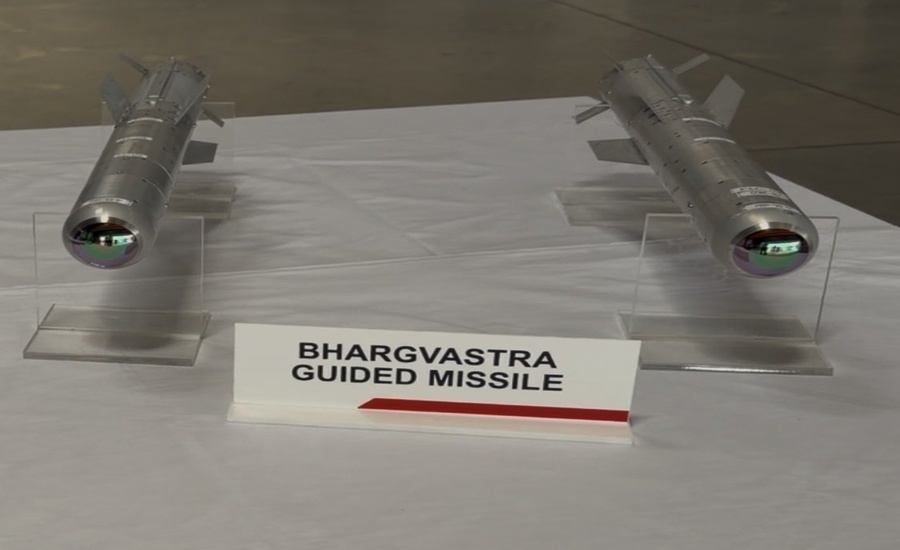
New Delhi: India’s indigenous Bhargavastra counter-drone system has moved further through its development and evaluation phase. Solar Defence and Aerospace Limited (SDAL) demonstrated the vehicle-mounted, multi-layered system at its Nagpur facility on July 23–24, 2026, with representatives of India’s defence services seeing the technology. The system is being developed to counter individual hostile drones as well as larger drone swarms.
The latest demonstration comes as low-cost drones and autonomous swarms are becoming an increasingly important challenge for modern air defence systems.
What Is the Bhargavastra Counter-Drone System
Bhargavastra is an indigenous counter-unmanned aerial system being developed by Solar Defence and Aerospace Limited.
Read also: What is Sudarshan Chakra Air Defence Programme And How It Helps to Build Massive Shield
It is designed as a mobile “hard-kill” system. In simple terms, this means Bhargavastra is intended to physically destroy hostile drones rather than depend only on electronic jamming.
Solar Group’s official website lists Bhargavastra as its counter-drone system and says initial trials of its micro-missile have been successful.
Bhargavastra Counter-Drone System Demonstrated in Nagpur
According to information attributed to Solar Defence and Aerospace Limited, Bhargavastra was demonstrated at the company’s Nagpur facility on July 23 and 24.
SDAL Chairman Satyanarayan Nuwal told that Navy officers had visited the facility, followed by Army officers. He said the company demonstrated elements including the radar, electro-optical control system and missile.
The company is working to bring these different components together into a complete counter-drone defence system.
How Does Bhargavastra Work
One of Bhargavastra’s key features is its multi-layer engagement architecture. The system combines unguided rockets for dealing with drone threats with precision micro-missiles for more accurate interception.
This approach could allow cheaper interceptors to be used against large numbers of relatively inexpensive drones instead of relying entirely on larger and more expensive air-defence missiles.
Earlier information about the system showed that Bhargavastra is being designed specifically to counter threats such as weaponised drones and autonomous drone swarms.
Designed to Fight Large Drone Swarms
Large drone swarms can create a difficult challenge for conventional air-defence systems because many small aerial targets may arrive at almost the same time. Bhargavastra is being developed with this problem in mind.
Earlier trials demonstrated the firing of its rockets in both single and salvo modes. Those tests were conducted at the Seaward Firing Range at Gopalpur in Odisha in May 2025.
The system’s combination of rockets and precision interceptors is intended to provide different layers of defence depending on the type and number of incoming drones.
Radar and Electro-Optical Systems Also Tested
Bhargavastra is more than a launcher and interceptor system. Nuwal said the company has also tested its radar and electro-optical control system as part of the development programme. He said micro-missile testing had previously been carried out at Balasore and Pokhran.
Earlier reports on Bhargavastra said its radar architecture was designed to detect medium-to-large UAVs from around 10 km and very small drones from around 6 km under specified conditions.
These figures relate to earlier reported development specifications and should not be treated as final operational performance until official user evaluation is completed.
Internal Trials of Bhargavastra Counter-Drone System Expected to Continue
Bhargavastra has not yet reached the end of its development process. Nuwal said on July 24 that SDAL expects to complete the system’s internal trials within the next two to three months.
This distinction is important: a demonstration to military representatives does not automatically mean that the system has been inducted or ordered by all three services. Further evaluation and procurement decisions would be separate steps.
Why Bhargavastra Could Be Important for India
Drone warfare has made the cost of interception an increasingly important defence issue. Using a very expensive conventional surface-to-air missile against every small and inexpensive drone may not always be practical, particularly during a large swarm attack.
SDAL is therefore positioning Bhargavastra as a more economical hard-kill solution built specifically for drones and drone swarms.
Its mobile configuration could also allow the system to be deployed according to operational requirements rather than being limited to a fixed installation.
A Boost for India’s Indigenous Defence Technology
Bhargavastra also fits into India’s wider push to develop more critical defence technologies domestically.
Solar Group says it has developed several defence products in India, including the Nagastra-1 loitering munition, while its official information confirms successful initial trials of the Bhargavastra micro-missile.
If Bhargavastra successfully completes development and future military evaluations, it could add a specialised layer to India’s defences against small UAVs and mass drone attacks.
For now, however, the project remains under development, with further internal trials expected before the programme moves to its next stages.
Read also: India’s S-400 Alternative Advances: Solar Industries Enters Project Kusha Programme