In a dramatic display of global power projection, the United States and China conducted two significant military advancements on November 5. The U.S. Air Force successfully launched the Minuteman-II intercontinental ballistic missile (ICBM), a powerful weapon capable of carrying three nuclear warheads and reaching targets as far as 13,000 miles away — including Moscow and Beijing.
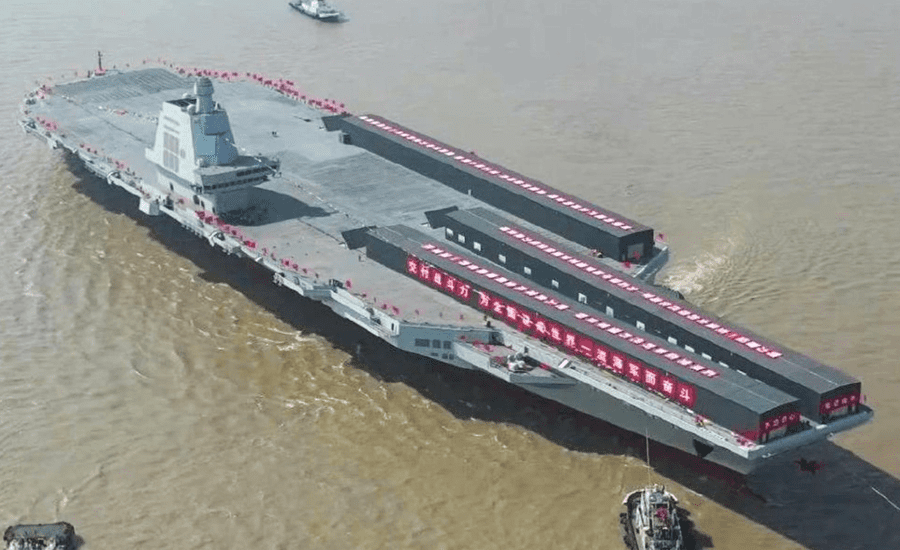
Meanwhile, China officially commissioned its domestically developed aircraft carrier, the Fujian, into the People’s Liberation Army Navy. This event marked a new milestone in China’s defense modernization efforts, reflecting the country’s growing ambition to become a dominant maritime power.
President Xi Jinping Presides Over Fujian’s Historic Launch
In a grand ceremony held in Sanya, Hainan Province, President Mr. Xi Jinping personally attended and oversaw the Fujian’s commissioning. He toured the massive warship, inspecting its combat systems and learning about the new electromagnetic catapult technology — a feature previously exclusive to the United States.
Reports indicate that Mr. Xi personally approved the integration of the electromagnetic aircraft launch system (EMALS) on the Fujian, signaling a strategic shift in China’s naval modernization policy.
Fujian: The Symbol of China’s Maritime Ambition
First launched in June 2022, the Fujian represents the pinnacle of China’s shipbuilding and defense engineering capabilities. Named after a historic Chinese emperor, the 80,000-ton warship features a 316-meter-long flat deck, three electromagnetic catapults, and two aircraft lifts.
It can carry between 70 to 100 aircraft and helicopters, including the J-35A Marine, China’s advanced fifth-generation stealth fighter. With this technology, aircraft can take off faster and more efficiently, reducing operational costs and boosting sortie rates.
China Becomes Second Nation with EMALS Technology
The Fujian makes China the second nation, after the United States, to deploy electromagnetic catapult technology — a significant leap from older steam-powered systems. The carrier’s technological advancements are expected to enhance the Chinese Navy’s operational range, efficiency, and readiness, aligning with Beijing’s goal of achieving a 460-ship fleet by 2030.
Currently, China operates the world’s largest navy by numbers, with more than 356 ships and submarines.
Global Balance Shifts: Experts Warn of Regional Implications
Security analysts have noted that while the Fujian can support the launch of advanced J-35 fighter jets, the U.S. Ford-class carriers still require modifications to fully deploy the F-35 Lightning II stealth fighters. This rapid Chinese progress in carrier technology has drawn global attention and concern.
Military experts caution that China’s expanding naval strength could shift the defense equilibrium in regions such as the South China Sea and Indian Ocean, influencing maritime trade routes and security dynamics.
Why India Is Watching Closely
For India, the launch of the Fujian raises strategic concerns. Analysts predict that the growing Chinese naval presence could impact India’s maritime security and influence in the Indian Ocean region.
Currently, India operates two aircraft carriers — INS Vikramaditya and INS Vikrant. While INS Vikrant is expected to serve for several decades, INS Vikramaditya may be decommissioned around 2035, potentially widening the capability gap between the Indian and Chinese navies.
Developmental Outlook and Strategic Significance
From a developmental standpoint, both the U.S. and China are investing heavily in defense innovation, maritime infrastructure, and advanced propulsion systems. These advancements not only signify a competitive military race but also stimulate local industries, research institutions, and technological ecosystems.
As the world’s major powers expand their naval capabilities, the coming years could witness an accelerated evolution of global defense architecture, with far-reaching implications for peace, diplomacy, and economic stability.