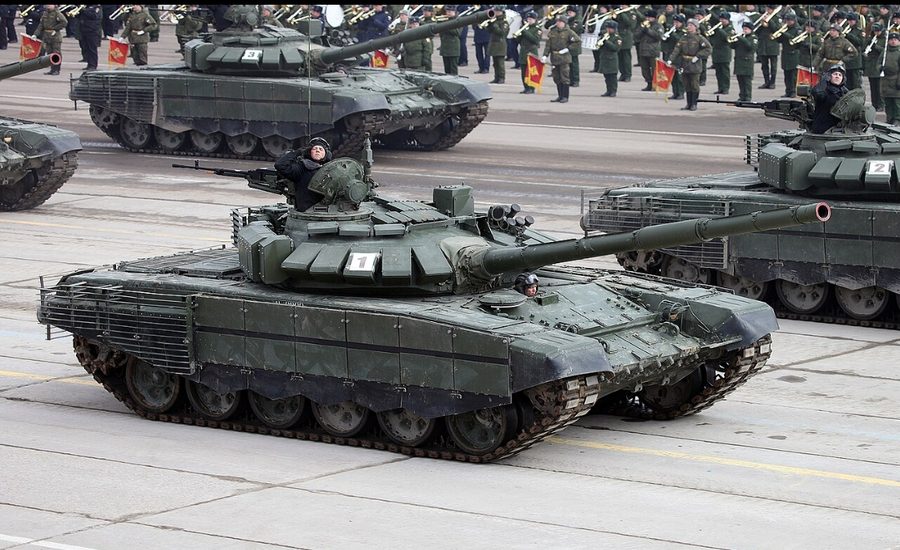
New Delhi: India is preparing a major T-72 tank upgrade program to strengthen its armored forces as security challenges from China and Pakistan continue to evolve.
The Indian Army, which inducted the Soviet-origin T-72 tanks in 1978, aims to improve mobility, firepower, night-fighting capability, and overall battlefield performance to keep the platform combat-ready for future conflicts.
What is the Reason of Indian Army T-72 Modernization Program
The T-72 has served as the backbone of the Indian Army’s armored corps for decades. When it entered service in 1978, it was considered one of the world’s most advanced tanks.
Read also: Indian Army Plans Smart Combat Tanks With AI, Anti-Drone Systems Under Project Ranjeet
Key strengths included:
- Powerful 125 mm main gun
- Advanced fire-control systems for its time
- Low-profile design that reduced visibility
- Strong power-to-weight ratio
- High battlefield mobility
These advantages gave India a significant edge over regional rivals during the early years of service.
Background of Indian Army T-72 Modernization Program
Military technology evolved rapidly after the 1980s.
During the 1991 Gulf War, Western tanks equipped with:
- Thermal imagers
- Advanced night-vision systems
- Better targeting technology
- Superior fire-control systems
It proved more effective than older Soviet-era platforms such as the T-72. The conflict highlighted the growing need for modernization of legacy armored vehicles worldwide.
Major Upgrades Planned for T-72 Tanks
According to reports, India is carrying out a large-scale modernization effort focused on extending the service life of the tanks until next-generation armored vehicles enter service.
Indian Army T-72 Modernization Program: Key Upgrades
- Engine power increase from 780 HP to 1000 HP
- Improved mobility across difficult terrain
- Indigenous fire-control systems
- Better night-fighting capability
- Modern thermal imaging technology
- Advanced targeting systems
- Future integration of unmanned combat technologies
The first batch of 96 T-72 tanks has already been fitted with upgraded systems, including thermal imaging fire-control technology developed under India’s self-reliance initiative.
Focus on Indigenous Defence Technology
A major part of the modernization program is the use of Indian-developed systems.
Recent upgrades include:
- Thermal Imaging Fire Control Systems (TIFCS)
- Improved fire detection systems
- Better battlefield awareness technology
- Indigenous electronics and targeting solutions
These upgrades support the government’s “Make in India” and defence self-reliance goals.
What is the Role of T-90 Tanks
While the T-72 remains important, India has also inducted more advanced T-90 tanks.
Important developments:
- First T-90 tanks entered Indian service in 2001.
- Initial batch consisted of 124 tanks imported from Russia.
- Armoured Vehicles Nigam Limited (AVNL) recently delivered the Indian Army’s 1,000th T-90 tank.
The T-90 fleet is expected to operate alongside upgraded T-72 tanks until future combat platforms are introduced.
Future Ready Combat Vehicles to Replace T-72
India is simultaneously working on next-generation armored platforms.
The Indian Army plans to gradually replace ageing T-72 tanks with:
- Future Ready Combat Vehicles (FRCV)
- Future Infantry Combat Vehicles (FICV)
These projects aim to provide:
- Better protection
- Network-centric warfare capability
- Advanced sensors
- Modern weapons systems
- Improved survivability
The modernization effort is expected to transform India’s mechanized warfare capabilities over the next decade.
What is the Importance of Indian Army T-72 Modernization Program
The upgrade program is considered important because:
- China continues to strengthen military infrastructure along the Line of Actual Control (LAC).
- Pakistan is modernizing parts of its armored fleet.
- Modern battlefields increasingly rely on night-fighting and precision-targeting technologies.
- Upgraded tanks can remain effective until future combat vehicles are inducted.
Military planners view the T-72 modernization as a cost-effective solution to maintain combat readiness while next-generation platforms are being developed.