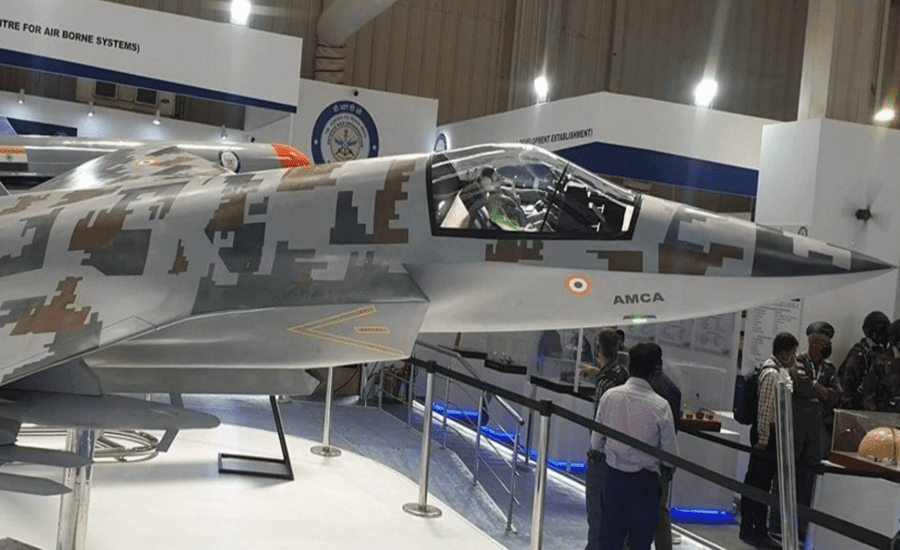
New Delhi: India’s AMCA RFP has entered a crucial stage, with the Ministry of Defence setting strict timelines for the country’s ambitious fifth-generation stealth fighter program.
The newly issued tender requires the first AMCA prototype to fly within 30 months of contract signing and complete 1,800 test sorties across five prototypes within 84 months before mass production can begin.
This move highlights India’s push for faster indigenous defence manufacturing and self-reliance in advanced combat aviation.
What Is the AMCA Program?
The Advanced Medium Combat Aircraft (AMCA) is India’s indigenous fifth-generation stealth fighter jet being developed for the Indian Air Force (IAF).
Read also: India Expands Indigenous Military Drone Fleet With Agnikaa VTOL-1 FPV Kamikaze Systems
Key features expected in AMCA:
- Stealth design for low radar visibility
- Internal weapons bay
- Advanced avionics and sensors
- Electronic warfare capabilities
- Supercruise capability
- Multi-role combat operations
- Air superiority and deep-strike missions
The project is being led by the Aeronautical Development Agency (ADA) with support from DRDO and Indian industry partners.
Major Highlights of the New AMCA RFP
According to reports, the Ministry of Defence has issued RFPs to shortlisted private-sector bidders for prototype development and testing.
Key Requirements
- First prototype rollout within 24 months
- First prototype flight within 30 months
- Five prototypes to be developed
- 1,800 mandatory flight-test sorties
- Entire testing program to be completed within 84 months
- Series production only after successful completion of trials
The government has reportedly described the 84-month deadline as mandatory.
Timeline Planned for AMCA Development
The RFP outlines an aggressive testing schedule.
Proposed Flight Timeline
| Prototype | Expected First Flight Timeline |
| Prototype 1 | 30 Months |
| Prototype 2 | 37 Months |
| Prototype 3 | 46 Months |
| Prototype 4 | 52 Months |
| Prototype 5 | 64 Months |
All five prototypes will collectively conduct extensive testing before certification and production approval.
Why the 1,800 Sorties Matter
Flight testing is one of the most critical phases of any fighter aircraft program.
The 1,800 sorties will help validate:
- Stealth performance
- Flight stability
- Engine reliability
- Radar systems
- Weapons integration
- Electronic warfare systems
- Combat effectiveness
- Operational safety
Only after successful completion of these trials can the aircraft move into serial production.
AMCA RFP: Which Companies Are in the Race?
According to reports, the Defence Ministry has invited selected private-sector players to participate in the AMCA program.
Reported contenders include:
- Tata Advanced Systems
- Larsen & Toubro (L&T)
- Bharat Forge
Some companies have also formed partnerships with other Indian defence firms to strengthen their bids.
Expected Engine and Production Roadmap
The first AMCA prototypes are expected to use the GE F414 engine.
Current projections suggest:
- Prototype rollout around 2028-29
- Flight testing until around 2034
- Series production around 2034-35
- Induction into the Indian Air Force from 2035 onward
The IAF is expected to induct multiple squadrons of the aircraft once production begins.
Read also: What Makes the F414 Engine Deal So Special? Inside India’s Biggest Defence Technology Breakthrough