Bengaluru: India’s first Indigenous optical inter-satellite link is being developed by Bengaluru-based Astrogate Labs, marking a major step forward for the country’s space communications sector. The company aims to make the indigenous Optical Inter-Satellite Link terminal flight-ready by 2027, strengthening India’s capabilities in advanced satellite networking and space-based communications.
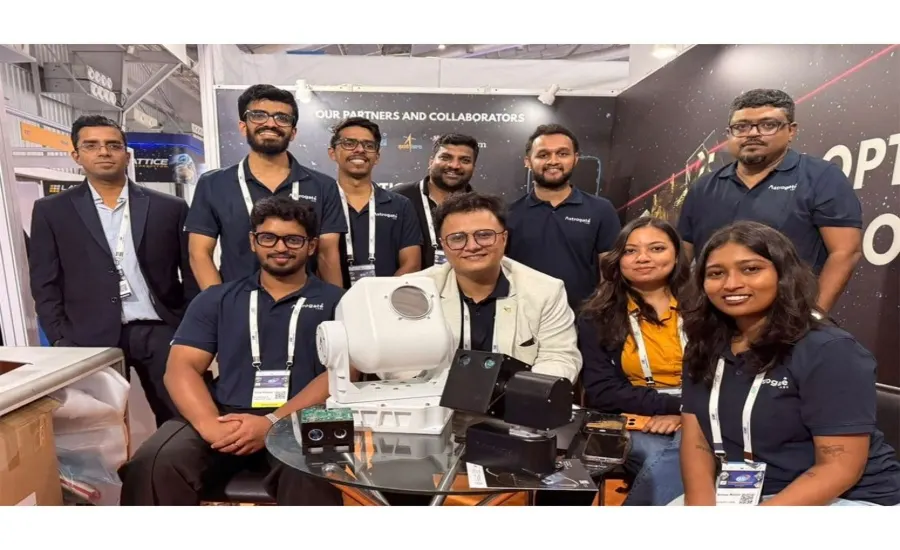
The announcement was made during the Bengaluru Space Expo 2026, where Astrogate Labs also showcased its AstroLink Micro laser communication terminal. The development highlights the growing role of India’s private space sector in building next-generation space technologies.
What Is An Optical Inter-Satellite Link
An Optical Inter-Satellite Link allows satellites to communicate directly with each other using laser beams instead of traditional radio frequency systems.
Read also: India Is Building Its Own Space Station—Here’s What We Know So Far
This technology enables data to move across a network of satellites in space before being transmitted to Earth, reducing delays and improving efficiency.
Why Is OISL Important
As satellite constellations continue to grow, traditional RF communication faces limitations in spectrum availability and bandwidth.
Laser-based optical communication offers higher data speeds, lower latency, stronger security, and greater bandwidth capacity.
Details of Indigenous Optical Inter-Satellite Link
Astrogate Labs is developing India’s first indigenous OISL terminal with complete ownership of the technology within the country.
According to the company, this project will help strengthen India’s sovereign capabilities in advanced space communications.
Built On Proven Technology
The company has already supplied space-to-ground laser communication terminals to ISRO.
Astrogate says it is the only Indian company to deliver this strategic laser communication technology to the national space agency.
Flight Readiness Targeted For 2027
Astrogate’s existing space-to-ground laser communication terminals have reached Technology Readiness Level (TRL) 8, meaning they are fully qualified for flight. The company expects this technological foundation to help achieve OISL flight readiness by 2027.
AstroLink Micro Demonstrated At Bengaluru Space Expo 2026
At the Bengaluru Space Expo 2026, Astrogate unveiled AstroLink Micro, a 10 Gbps laser communication terminal. The system demonstrates the company’s capability to provide high-speed optical communications for future satellite missions.
Indigenous Optical Inter-Satellite Link: Expanding Beyond Satellite-To-Ground Links
The launch of the OISL program represents Astrogate’s transition from satellite-to-ground communication systems to satellite-to-satellite connectivity. This is considered a critical building block for future Low Earth Orbit (LEO) satellite constellations.
How Will India Benefit from Indigenous Optical Inter-Satellite Link
The indigenous OISL system can help India build a secure and independent satellite communication network. Such systems are increasingly important for commercial, scientific, and national security applications.
Support For Defence And Strategic Networks
Astrogate is targeting applications in satellite backhaul, sovereign defence constellations, and orbital computing. These areas are becoming critical as countries invest heavily in space-based infrastructure and secure communications.
Reduced Dependence On Foreign Technologies
An indigenous OISL capability will reduce reliance on foreign suppliers for advanced satellite communication technologies. It also aligns with India’s broader goal of building a self-reliant space ecosystem through private-sector innovation.
Global Context: Why OISL Technology Matters
Leading global companies are already deploying optical inter-satellite communication systems.
SpaceX has reported operating thousands of laser links across its Starlink constellation, demonstrating the scalability of optical mesh networks in space.
India’s Opportunity
With Astrogate Labs entering this segment, India could join a small group of nations and companies capable of developing advanced laser communication networks for space applications.
FAQs
Astrogate Labs has set a target of achieving flight readiness for its indigenous Optical Inter-Satellite Link terminal by 2027.
An Optical Inter-Satellite Link is a laser-based communication system that allows satellites to exchange data directly with one another in space without relying entirely on ground stations.
The technology can strengthen India’s space communication infrastructure, support defence and commercial satellite networks, and reduce dependence on foreign communication systems.