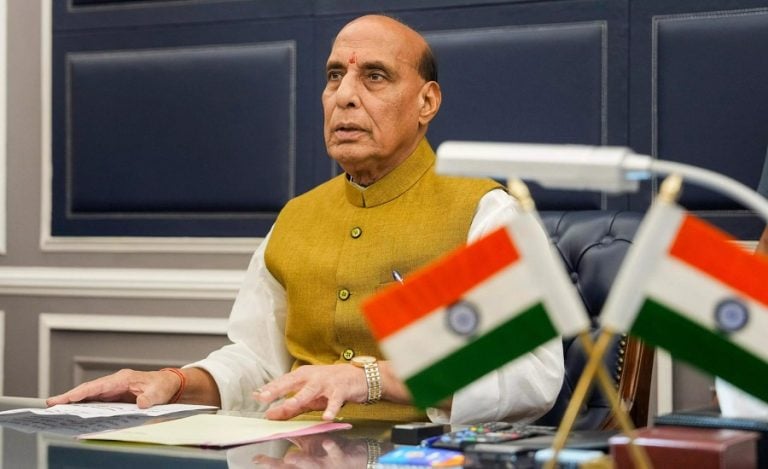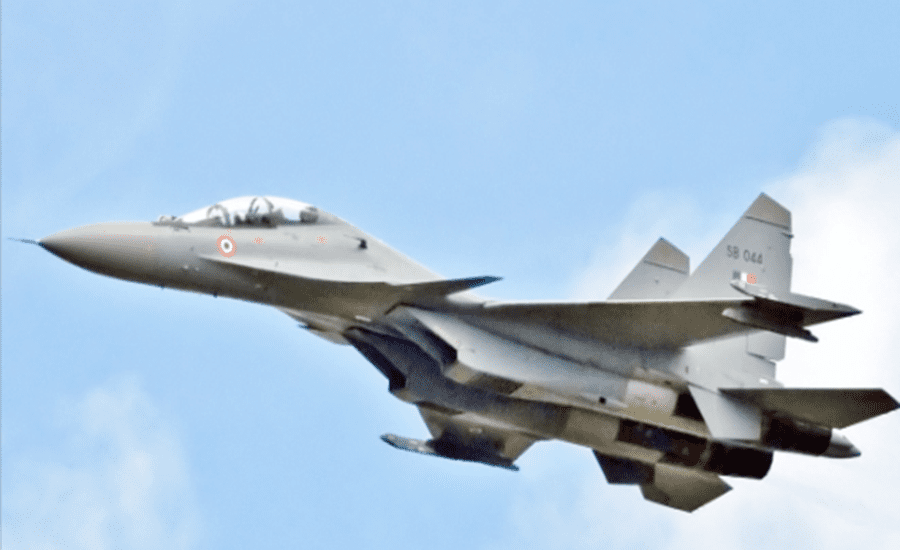
New Delhi: The ₹1.1 Lakh Crore Defence Package has received a major boost after the Defence Acquisition Council (DAC), chaired by Defence Minister Rajnath Singh, approved a series of military acquisition proposals for the Indian Army, Navy and Air Force. The package focuses on indigenous defence manufacturing, advanced missiles, electronic warfare systems, naval propulsion technologies and battlefield mobility solutions. Nearly 98% of the approved procurements are expected to come from Indian industry, supporting the government’s self-reliance mission.
DAC Approves ₹1.1 Lakh Crore Military Procurement Plan
The Defence Acquisition Council has granted Acceptance of Necessity (AoN) for multiple procurement proposals worth around ₹1.10 lakh crore. The approvals cover advanced systems for the Army, Navy and Air Force, making it one of the largest defence modernisation packages cleared in recent years.
Read also: India Strengthens Air Dominance With Proposed Su-30 MKI And RVV-BD Missile Integration
A major highlight of the package is the strong focus on domestic manufacturing, with almost all equipment expected to be sourced from Indian companies.
Details of Su-30MKI Upgrade
The Indian Air Force will undertake the overhaul and modification of 40 Su-30MKI fighter aircraft through Hindustan Aeronautics Limited (HAL).
The upgrade will significantly improve the combat capabilities of India’s frontline fighter fleet and extend the operational life of the aircraft.
Sukhois To Fire R-37M Long-Range Missile
One of the most important upgrades involves integrating the R-37M long-range air-to-air missile with the Su-30MKI. The missile is designed to engage high-value airborne targets such as AWACS aircraft, aerial refuellers and other strategic assets from very long distances. According to defence reports, the missile has a range of around 200 km and can travel at hypersonic speeds.
Why The R-37M Is Important
Modern air warfare depends heavily on airborne early warning and control aircraft (AWACS) and aerial refuelling tankers. The ability to target these assets from long distances could significantly reduce an adversary’s operational effectiveness during a conflict. The acquisition reflects lessons learned from recent operational requirements and long-range air combat needs.
Su-30MKI Upgrade: Astra Mk-2 Remains India’s Long-Term Solution
India is simultaneously developing the Astra Mk-2 beyond-visual-range air-to-air missile. The missile is expected to provide an indigenous solution for long-range aerial engagements and strengthen India’s self-reliance in advanced missile technology.
Bridging Capability Gap
Until Astra Mk-2 becomes fully operational, the R-37M integration is expected to provide an immediate capability enhancement for the Air Force. This approach allows India to address current operational requirements while continuing indigenous development efforts.
Navy To Develop Indigenous Marine Gas Turbines
The Indian Navy has received approval for the design, development and procurement of a new 24–28 MW Marine Gas Turbine. The project aims to reduce dependence on imported propulsion systems used in warships such as destroyers and frigates.
Make-I Programme To Support Development
The turbine project will be executed under the Make-I category of India’s defence acquisition procedure. Under this model, the government funds a large part of development costs, encouraging domestic innovation and technology creation.
Strengthening India’s Naval Future
The indigenous marine gas turbine programme is expected to support future warship construction and reduce long-term dependence on foreign suppliers. The move aligns with India’s broader naval modernisation strategy and indigenous shipbuilding ambitions.
Arudhra Radars To Enhance Naval Surveillance
The Navy will also procure Arudhra radars developed by DRDO. These advanced radars will replace older surveillance systems at naval air stations and improve long-range aerial detection and situational awareness. The radar system can track multiple aerial targets simultaneously and strengthen maritime domain awareness across strategic coastal regions.
Army To Receive Advanced Mobility And Combat Systems
The Army will acquire advanced light helicopters and high-mobility vehicles to improve logistics and operational flexibility in challenging terrain.
CBRN Reconnaissance Vehicles
Specialised Chemical, Biological, Radiological and Nuclear (CBRN) reconnaissance vehicles have also been approved. These platforms will help detect, identify and mark contaminated areas during military operations.
Mine Warfare And Bridging Systems
The package includes self-propelled mine layers, trawl tanks and Sarvatra bridge systems. These systems will improve mobility and battlefield engineering capabilities for combat formations operating across varied terrain.
Electronic Warfare Capability Gets A Boost
The Indian Air Force will also receive Ground-Based Multi-Purpose Jammers. These systems are designed to disrupt enemy radar networks and improve India’s electronic warfare capabilities during combat operations.
The addition of advanced jamming systems will enhance survivability for aircraft and strengthen overall mission effectiveness.
Indigenous Manufacturing Remains The Key Focus
A defining feature of the procurement package is its strong emphasis on domestic production. According to official information, around 98% of the approved acquisitions will be sourced from Indian industry, supporting the growth of India’s defence manufacturing ecosystem.
Read also: Explained: India’s 1,000 QRSAM Missiles Procurement And Its Strategic Importance
FAQs
The upgraded Su-30MKI fighters are expected to be equipped with the R-37M long-range air-to-air missile, designed to engage high-value airborne targets such as AWACS aircraft and aerial refuellers.
It is a military procurement package approved by the Defence Acquisition Council to strengthen the capabilities of the Indian Army, Navy and Air Force through new equipment, upgrades and indigenous development projects.
The project will reduce India’s dependence on imported warship engines and support future indigenous naval shipbuilding programmes.