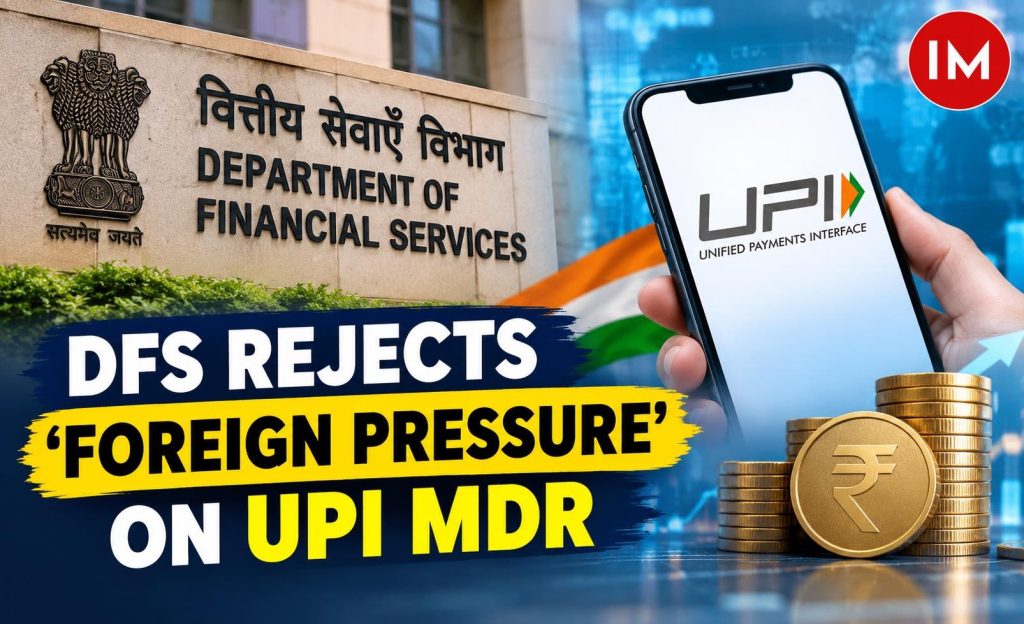
New Delhi: The Department of Financial Services (DFS) has rejected allegations that the recently announced Merchant Discount Rate (MDR) on select high-value UPI transactions was introduced under external influence, saying the claims are “patently false and misleading.”
The clarification comes days after the government and the National Payments Corporation of India (NPCI) announced a new MDR framework for select Person-to-Merchant (P2M) UPI transactions above ₹2,000, effective from October 15, 2026. Under the framework, person-to-person (P2P) UPI transfers will remain free, while the vast majority of merchant transactions will continue to be exempt from MDR.
MDR Announcement Triggered Criticism and Questions
The introduction of MDR on select merchant transactions sparked criticism from sections of traders, fintech users and opposition voices, with some alleging that the move was linked to concerns raised in the United States Trade Representative’s (USTR) 2026 report regarding India’s digital payments ecosystem.
Read Also: Bank of Baroda Launches UPI Global Reverse Acceptance for International QR Payments Across India
The USTR report had highlighted issues such as:
- The inability of foreign payment networks to participate in UPI credit-card transactions on the same terms as RuPay.
- NPCI’s proposed 30% market-share cap for third-party UPI application providers.
Following these claims, DFS issued a detailed clarification explaining the rationale behind the MDR framework.
DFS Says RuPay Preference Policy Remains Unchanged
Addressing allegations linked to the USTR’s observations on credit transactions, DFS said the NPCI circular issued on September 15 continues to permit UPI credit-card transactions only through RuPay credit cards.
According to the department, no other credit-card network has been allowed into the UPI credit ecosystem under the latest framework. DFS argued that this reflects the government’s continued policy of promoting RuPay as a domestic alternative and helping it expand its presence in India’s payments market.
Revenue Model Needed for Smaller UPI Players: DFS
On the issue of NPCI’s proposed 30% market-share cap for third-party application providers, DFS said implementation has remained difficult because smaller payment companies have struggled to compete against dominant players without a sustainable revenue model.
The department said MDR on select high-value merchant transactions is intended to provide such a revenue stream, allowing smaller and emerging payment companies to expand their operations and compete more effectively within the UPI ecosystem.
According to DFS, the objective is to encourage greater competition and reduce dependence on a handful of dominant platforms rather than benefit foreign companies.
Government Says Move Supports Digital Payments Sovereignty
Rejecting suggestions of external influence, DFS said the MDR framework should instead be viewed as a measure aimed at strengthening India’s digital payments infrastructure and supporting domestic companies operating in the sector.
The department argued that enabling more Indian payment firms to build viable businesses within the UPI ecosystem would contribute to the long-term resilience and self-reliance of the country’s electronic payments network.
RuPay Debit Cards Continue Under Zero-MDR Framework
DFS also reiterated that the government remains committed to promoting RuPay debit and credit cards as domestic payment alternatives.
To ensure continued adoption of RuPay debit cards, the government has retained the zero-MDR framework for RuPay debit-card transactions. The department said this policy is intended to preserve a strong domestic payments option for consumers and merchants.
What the Government Has Clarified
According to DFS:
- The MDR framework was not introduced under foreign pressure.
- RuPay remains the only credit-card network currently enabled for UPI credit transactions.
- MDR on select high-value transactions is intended to create a sustainable revenue model for smaller payment companies.
- The measure is aimed at strengthening domestic competition within the UPI ecosystem.
- RuPay debit-card transactions will continue under the zero-MDR framework.
- Person-to-person UPI transactions remain completely free.
The clarification comes amid continuing debate over the MDR framework, which the government says is designed to balance the long-term sustainability of the UPI ecosystem with continued free access for individual users and small merchants.