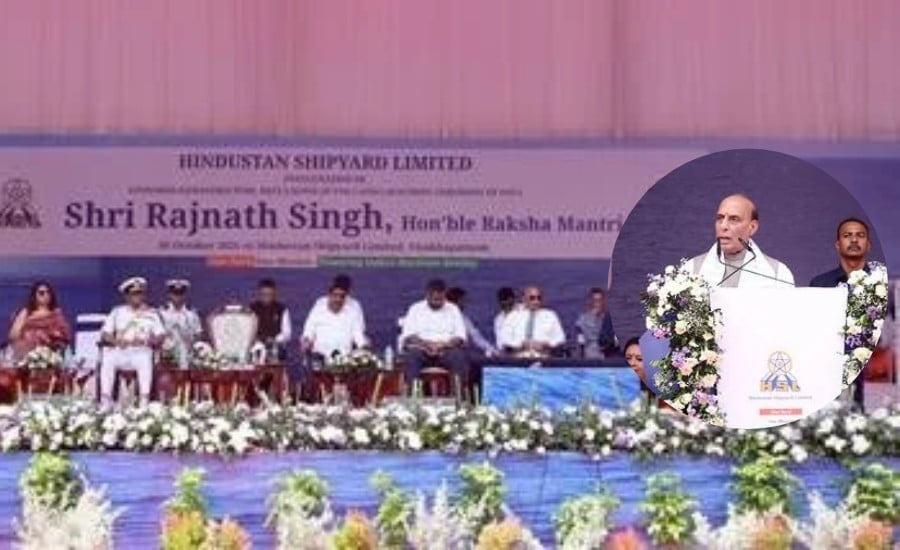
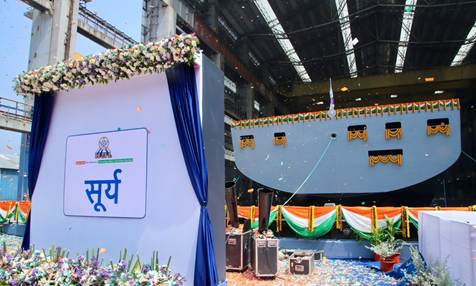
Visakhapatnam: Defence Minister Rajnath Singh launched the first indigenous Fleet Support Ship (FSS-1), named ‘Surya’, at Hindustan Shipyard Limited (HSL) in Visakhapatnam on October 6. He also laid the keel for the fifth Fleet Support Ship (FSS-5) and inaugurated the upgraded Slipway-4 and a 300-tonne Goliath Crane at the shipyard.
The three developments are aimed at strengthening HSL’s capacity to build and launch larger and more complex ships and expanding India’s indigenous shipbuilding capabilities.
‘Surya’ to Support Extended Naval Operations
The Fleet Support Ship programme is designed to provide logistical support to naval operations, including at-sea replenishment.
Read Also: Indian Navy Gets Strategic Boost As Rajnath Singh Launches First Fleet Support Ship FSS-1
According to the Ministry of Defence, the FSS vessels will have enhanced cargo and fluid-carrying capacity, onboard first-line maintenance workshops, a helicopter deck capable of supporting Multi-Role Helicopter operations and self-defence systems.
Singh said Fleet Support Ships would contribute to the Indian Navy’s reach and endurance during prolonged deployments, particularly in the Indian Ocean Region.
HSL Upgrades Slipway and Adds 300-Tonne Crane
The upgraded Slipway-4 has been extended and strengthened to enable HSL to build and launch ships of up to 45,000 DWT.
A new 300-tonne Goliath Crane, spanning Slipways 3 and 4, has been manufactured by L&T Geostructure with Konecranes under the Make in India initiative.
The crane incorporates programmable logic controller (PLC) controls, variable-frequency drives, tandem lifting, remote diagnostics and condition-monitoring systems. The facility is intended to support the handling of heavier ship blocks during modern block-construction activities.
Rajnath Singh Calls for HSL to Improve Delivery and Productivity
Singh said HSL should focus on quality, productivity and timely delivery, while strengthening indigenous design capabilities and its engagement with MSMEs and startups.
He also called for closer integration between HSL and Andhra Pradesh’s industrial ecosystem, including universities, technology companies and startups.
According to the Defence Minister, the wider ecosystem could support shipbuilding through manufacturing suppliers, research, digital technologies, maritime technologies and skilled manpower.
Visakhapatnam Proposed as Maritime Industrial Hub
Singh highlighted the presence of the Eastern Naval Command, Naval Dockyard, HSL and Visakhapatnam Port as elements of an integrated maritime ecosystem in the city.
He called for Visakhapatnam to be developed as a major Maritime Industrial Hub, bringing together naval expertise, shipbuilding, engineering, port infrastructure, research and skilled manpower.
He also called for greater integration among the Navy, HSL, DRDO, academia, industry, MSMEs and startups to strengthen India’s maritime industrial ecosystem.
HSL’s Role in Indigenous Shipbuilding
Singh recalled the launch of Jala Usha at Visakhapatnam in 1948, describing it as the first ship built in independent India. He also highlighted HSL’s more than eight decades of contribution to India’s maritime and defence requirements.
HSL achieved Miniratna Category-I status in 2025 after coming under the Ministry of Defence.
The Defence Minister said Indian shipyards should move beyond self-reliance towards global competitiveness in areas including quality, cost, technology, delivery and reliability.
The launch of ‘Surya’, keel laying of FSS-5 and commissioning of upgraded shipbuilding infrastructure mark the latest developments at HSL as it expands its capacity for larger naval platforms. The Defence Ministry said the focus will remain on indigenous shipbuilding, timely delivery, modern infrastructure and stronger industry participation.
Read Also: Rajnath Singh Flags Navy’s Expanding Maritime Role as Commanders Review Readiness, Technology Push