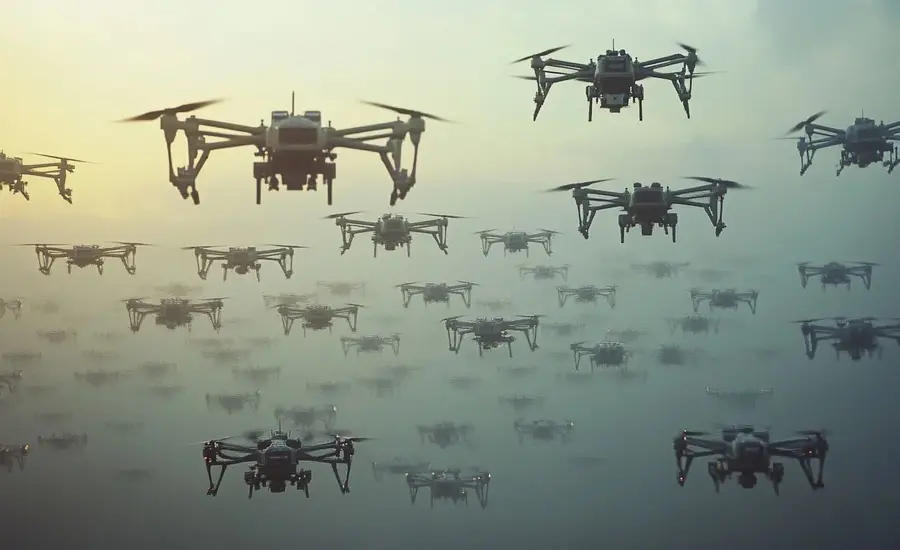
In a major leap for indigenous drone technology, the Indian Institute of Technology Bombay (IIT Bombay) research team has unveiled a novel control system that allows vertical take-off and landing (VTOL) unmanned aerial vehicles (UAVs) to fly in coordinated formations without relying on GPS or inter-drone communication.
This breakthrough — a “bearing-only” control paradigm based purely on camera measurements — promises to transform drone operations in GPS-denied, interference-prone or adversarial environments.
Background of the Research on GPS-Free VTOL Drone
The conventional drone-swarm paradigm depends heavily on GPS signals, inter-vehicle communication links or a central controller to maintain formation and navigation. In hostile or remote terrains – where GPS can be jammed or spoofed – these systems can fail.
Read Also: Meet Abhimanyu Stealth Drone: Silent Defender Set to Outsmart Every Enemy Radar
To address this, the IIT Bombay team led by Dwaipayan Mukherjee and research scholar Chinmay Garanayak developed a completely new approach: each drone uses only onboard camera images to determine the bearing (i.e., the direction) of other drones and maintain formation, excluding GPS, external communication or centralised control.
The system was tested on VTOL drones—a class of aircraft capable of vertical take-off and hovering, especially suited for confined urban or tactical spaces.
Importance of This Breakthrough Research
Camera-Only Navigation: By relying solely on camera-based bearings, the system eliminates the need for GPS signals, which are vulnerable to jamming, spoofing or unavailability. The approach also removes dependence on communication between drones or a ground controller.
Lightweight & Efficient Design: Without bulky GPS modules or inter-drone radios, the drones become lighter, consume less power and become more cost-effective – ideal for large swarm deployment.
Handles VTOL Under-Actuated Dynamics: VTOL drones are inherently more complex—they have six degrees of freedom but fewer independent control channels (under-actuated). The IIT Bombay team incorporated full under-actuated dynamics (position, orientation, velocity, forces, torques, inertia) in their mathematical model, improving stability during complex manoeuvres.
GPS-Free VTOL Drone: Two Operational Modes Validated
Constant-velocity formation: Drones move in a pre-set formation using bearing and bearing-rate data.
Time-varying formation: Drones adapt to changes by also using their own velocity measurements besides bearings, enabling dynamic re-shaping of the swarm.
Faces Behind GPS-Free VTOL Drone
Prof. Dwaipayan Mukherjee: Lead professor at IIT Bombay, heading the research on bearing-only swarm control.
Chinmay Garanayak: Research scholar working under Prof. Mukherjee, describes the bearing-only control goal as achieving formation coordination purely via inter-agent bearing measurements.
Both are responsible for the mathematical proof of convergence and stability of the formation control scheme, which is critical for real-world deployment.
Technical Details & Challenges Addressed
1. Bearing-Only Measurement: Each drone’s onboard camera identifies neighbouring drones; algorithms convert visual bearings into formation control – no ranging or GPS required.
2. Communication-Free Operation: Eliminates complexity, latency and vulnerability tied to inter-drone communication or central command links.
3. Under-Actuated VTOL Control: As most bearing-only systems ignore real drone dynamics, this research explicitly models full under-actuated VTOL behaviour—improving reliability in realistic flight.
4. Stability Proofs: The research includes formal convergence proofs ensuring that the swarm reaches and maintains desired formation even starting from imperfect initial conditions.
5. Dynamic Formation Capability: The drones can switch formations mid-flight—cluster to linear, adapt to mission path changes—thanks to the flexible control scheme.
Potential Applications & Defence Significance
GPS-Denied Environments: In electronic warfare zones or subterranean/urban canyons, GPS signals may fail; this system fills that gap.
Swarm Surveillance & Reconnaissance: Multiple VTOL drones can conduct formation surveillance, urban mapping, disaster response without relying on infrastructure.
Military & Tactical Missions: The Indian defence sector can deploy large swarms with less technical dependency, improved stealth and reduced vulnerability.
Commercial & Civil Uses: Search and rescue, infrastructure inspection, large-scale mapping in remote areas where GPS is unreliable.
What’s Next & Future Road-Map
The team plans experimental real-flight trials of the swarm control system—moving beyond simulation. They also aim to integrate collision-avoidance mechanisms with mathematical guarantees, since most existing systems rely on ad-hoc methods without formal proof.
Successful deployment would mark a significant step toward fully autonomous, self-reliant drone systems for India’s defence and civil sectors.
Importance of GPS-Free VTOL Drone for India
The innovation supports India’s push for Atmanirbhar Bharat in defence manufacturing. By reducing reliance on external navigation systems (like foreign GPS), India strengthens sovereignty in drone technology.
The fact that this research comes from IIT Bombay reinforces India’s growing capabilities in high-end robotics and control systems.