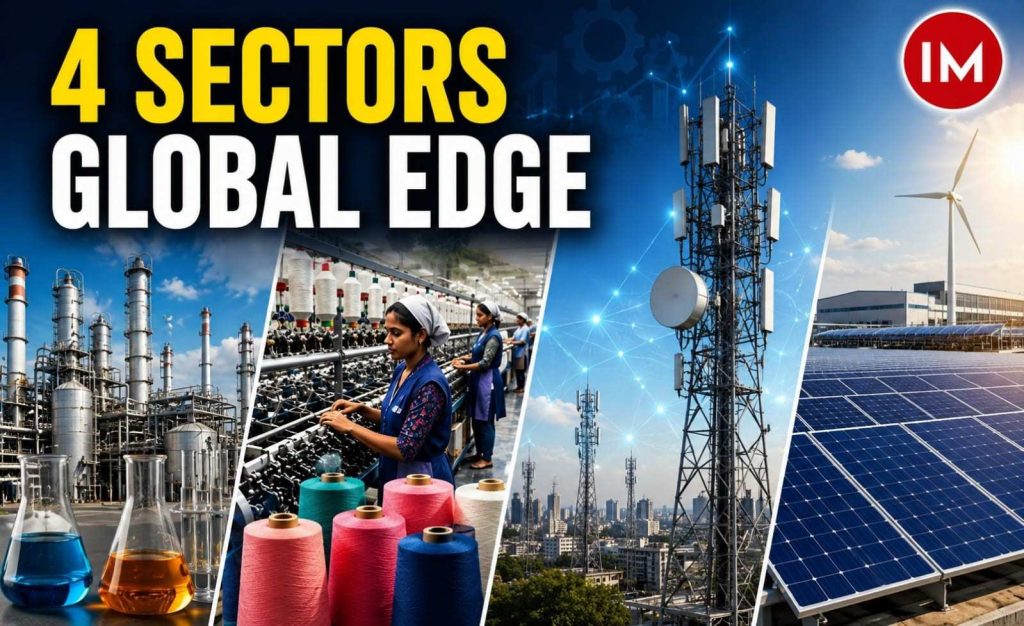
New Delhi: NITI Aayog has identified chemicals, textiles, telecom and networking equipment, and solar photovoltaic (PV) manufacturing as four high-potential sectors that could strengthen India’s position as a global manufacturing hub. Its report, “Key Sectors to Position India as a Global Manufacturing Hub,” examines their market potential, competitiveness, infrastructure, technology readiness and scope for greater domestic value addition and exports.
The report proposes sector-specific interventions based on global manufacturing trends and international best practices. NITI Aayog said the current edition covers four sectors, with assessments of eight more sectors to follow.
Four-Phase Assessment
The study was carried out through four broad phases:
- Sector shortlisting: Identifying sectors with strong domestic and global market growth potential.
- Comprehensive assessment: Evaluating market potential, competitiveness and strategic relevance.
- Global benchmarking: Studying successful approaches adopted by leading manufacturing countries.
- Actionable recommendations: Developing sector-specific interventions and a roadmap to improve competitiveness and unlock growth.
Read Also: NITI Aayog Unveils Roadmap to Professionalise Caregiving, Position India as Global Care Hub
NITI Aayog said the present report covers four sectors, with assessments of eight additional sectors to follow.
Chemicals: Focus on Downstream Value Addition
India’s chemicals industry is broadly driven by petrochemicals and organic chemicals, specialty chemicals and inorganic chemicals.
The report identifies opportunities to increase domestic value addition by expanding downstream production and improving feedstock utilisation.
Key priorities include:
- Expanding domestic manufacturing capabilities.
- Improving industry competitiveness.
- Reducing import dependence.
- Making strategic use of Free Trade Agreements (FTAs).
- Strengthening downstream production and value chains.
Textiles: Scope to Expand Global Competitiveness
The textile and apparel sector remains a major contributor to India’s manufacturing and employment landscape.
According to the report, the sector contributes approximately 2% of national GDP, 11% of manufacturing GVA and 9% of merchandise exports. It provides livelihoods to more than 45 million people.
In FY2025, India exported $37.7 billion worth of textile products and accounted for 4.1% of global textile and apparel exports, making it the world’s sixth-largest textile exporter.
The report highlights several areas for strengthening the sector:
- Improving raw material availability.
- Expanding manufacturing infrastructure.
- Increasing market access through deeper trade integration.
- Strengthening skills, technology adoption and productivity.
- Promoting technical textiles and man-made fibre-based products.
- Expanding sustainable textiles and premium Indian weaves.
Telecom and Networking Equipment: Strengthening Domestic Components
India is currently the world’s second-largest telecommunications market, with more than 1.2 billion subscribers, around 85% telecom penetration and nearly 75% internet usage, according to the report.
The sector has scope for greater global competitiveness through deeper localisation and stronger domestic component manufacturing.
The report identifies priorities including:
- Promoting joint ventures and technology transfers.
- Developing integrated industrial clusters.
- Expanding high-potential export segments.
- Strengthening testing and certification infrastructure.
- Improving specialised skills and productivity.
Solar PV: Building a Deeper Manufacturing Ecosystem
India had installed 106 GW of solar capacity by March 2025 and needs to add around 174 GW to reach its 2030 target of 280 GW of solar capacity.
The domestic PV market, estimated at ₹32,400 crore ($3.7 billion), is projected to grow at a 17–20% CAGR between FY2023 and FY2030, supported by utility-scale and rooftop solar, open-access projects and green hydrogen-linked demand.
The report recommends strengthening the solar manufacturing value chain through:
- Greater upstream manufacturing capabilities.
- Technology partnerships and joint ventures.
- Increased research and development.
- Performance-linked support.
- Integrated clean-tech manufacturing clusters.
- Industry-led skill development.
- Stronger trade partnerships and government-to-government frameworks.
Sector-Specific Action to Drive Manufacturing Growth
The report is intended to serve as a roadmap for strengthening the manufacturing ecosystem in the selected sectors.
NITI Aayog has emphasised that industry and government collaboration, along with interventions tailored to sector-specific challenges, will be important for improving competitiveness and increasing India’s value addition and export potential.
The report will be followed by assessments of eight more manufacturing sectors, expanding the framework for India’s broader manufacturing growth strategy.