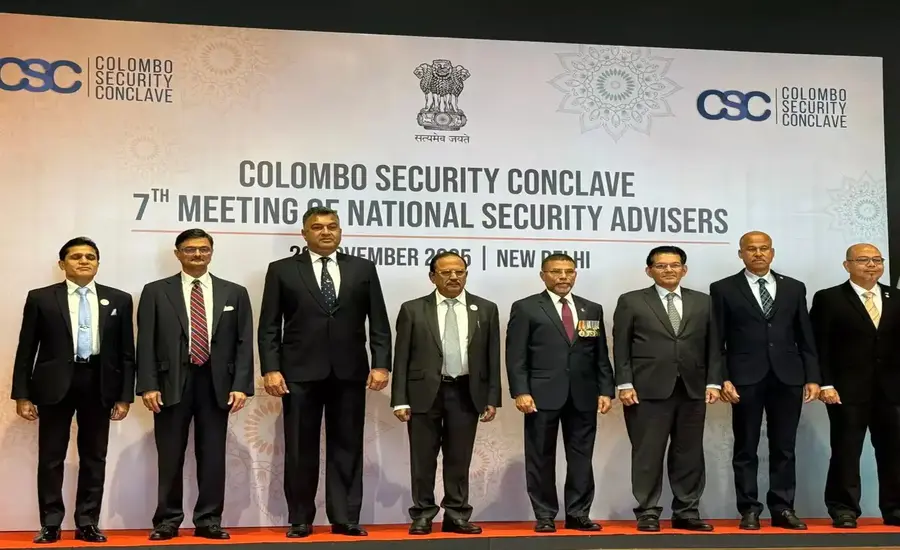
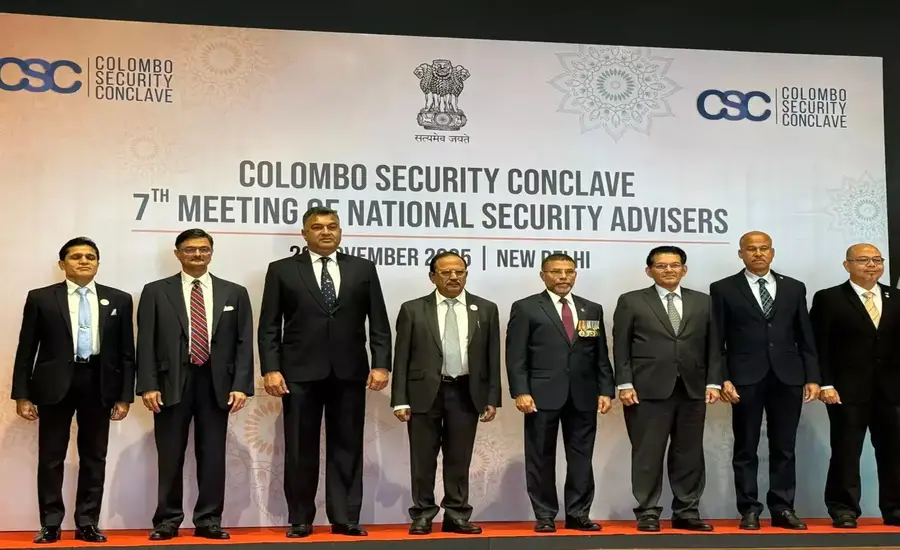
New Delhi: On 20 November 2025 in New Delhi, the Government of India hosted the 7th National Security Adviser-level meeting of the Colombo Security Conclave (CSC). Chaired by India’s National Security Adviser, Ajit Doval, the meeting brought together senior security officials from key Indian Ocean Region (IOR) states.
The assemblage of these regional security partners underlines India’s growing role as a security facilitator and convener in the IOR, and signals an intensification of multilateral cooperation across a spectrum of challenges — from maritime safety to cyber-security.
Colombo Security Conclave: Member States, Guest and Observer Participation
The meeting included delegation leads such as:
- The Maldives is represented by NSA Ibrahim Latheef.
- Mauritius with NSA Rahul Rasgotra.
- Sri Lanka, represented by Defence Ministry Secretary Air Vice-Marshal (Retd) Sampath Thuyacontha.
- Bangladesh, represented by NSA Dr Khalil‑ur‑Rehman.
- The Seychelles attended as Observer, represented by Major General Michael Rosette, Chief of Defence Forces.
Malaysia joined for the first time as a Guest, represented by Deputy Director General of its National Security Council Badrul Shah Mohd Idris.
Read also: No More Land Scams: Supreme Court Backs Blockchain in Land Registration to Curb Corruption
Significantly, the Seychelles’ accession as a full member of the Conclave was welcomed.
Colombo Security Conclave: The Five Pillars of Cooperation
At the heart of the meeting were discussions around reinforcing cooperation across five core pillars:
1. Maritime Safety and Security – Given the strategic importance of the Indian Ocean, enhancing awareness, shared maritime domain knowledge, and response coordination was underscored.
2. Countering Terrorism and Radicalisation – Recognising evolving non-state threats and radical networks in the maritime and littoral spaces.
3. Combating Trafficking and Transnational Organised Crime – Tackling smuggling, trafficking (arms, drugs, persons) and cross-border organised crime syndicates operating through the IOR.
4. Cyber-Security and Protection of Critical Infrastructure & Technology – As digitalisation expands, so do cyber-threats; protecting critical maritime infrastructure, ports and networked systems featured prominently.
5. Humanitarian Assistance and Disaster Relief (HADR) – Recognising that the region is vulnerable to natural disasters (tsunamis, cyclones, rising sea levels), joint HADR capacity-building and coordination was reaffirmed.
Colombo Security Conclave: Review of Progress Since 6th Meeting
During the meeting the first Secretary-General of the Conclave (appointed by India) presented a comprehensive review of progress since the 6th NSA-level meeting held in Mauritius in December 2023.
Key take-aways from the review included:
- Advances in capacity-building initiatives and joint training exercises among member states.
- Implementation of information-sharing mechanisms for maritime domain awareness.
- Cyber-monitoring frameworks, and frameworks for mutual assistance in HADR scenarios.
- Identification of gaps and next-steps, particularly in operationalising some of the pillars more fully.
Strategic Significance for India and the Region
- For India, hosting the 7th meeting of the Conclave underscores its ambition to play a central role in securing the Indian Ocean Region — a maritime space of enormous strategic, economic and security importance. By bringing together like-minded states, India signals leadership in regional security architecture.
- From a regional perspective, with states like the Maldives, Mauritius, Sri Lanka, Bangladesh and now the Seychelles as full members, the Conclave is developing into a multi-dimensional platform: not only defence/military collaboration, but broader security & resilience cooperation.
- Furthermore, the widening membership (including Malaysia as Guest) enhances the geographic reach of the Conclave’s influence beyond the immediate littoral of the Indian Ocean.
Colombo Security Conclave: The Seychelles’ Accession as Full Member
The decision by the Seychelles to accede as a full member is a notable milestone. As a small island state with strategic location (at the confluence of East and West Indian Ocean shipping routes), Seychelles’ full membership brings additional maritime domain value and reinforces the Conclave’s inclusive maritime security footprint.
This also sends a message of greater small-state participation in regional security frameworks, which helps diversify partnership and burden-sharing in the region.
Operational Challenges and Forward-Looking Agenda
While the 7th meeting signifies progress, several operational challenges remain:
- Translating agreed pillars into concrete operational mechanisms (e.g., shared maritime patrols, joint cyber-drills) will require sustained funding and political will.
- Sustaining information-sharing in the face of national sensitivities and competing priorities.
- Aligning disparate capacities across smaller states with larger ones, ensuring mutual benefit.
- Countering evolving non-traditional threats (e.g., hybrid maritime threats, cyber-intrusions, climate-induced disasters) will require nimble responses.
Looking ahead, the Conclave will likely push for:
- Joint exercises on maritime interdiction, search-and-rescue, cyber-attack simulation.
- A common information-sharing centre or portal for maritime, cyber and HADR intelligence.
- Capacity building and training modules for smaller island states.
- Broadening membership further, perhaps with additional guest states or full members from the Indian Ocean-Asia-Pacific rim.
Key Implications for Wider Geopolitics
The Indian Ocean is increasingly becoming a zone of strategic competition — great-power naval presence (China, US), expanding maritime trade, and growing interest in under-sea infrastructure (cables, pipelines). In this environment, regional cooperation frameworks such as the CSC gain significance: they provide indigenous, regionalised responses rather than externally dominated security solutions.
India’s stewardship of the Conclave also ties into its broader “Security and Growth for All in the Region” (SAGAR) vision, and complements other regional initiatives such as the Indian Ocean Rim Association (IORA) and the Quad (Quadrilateral Security Dialogue).