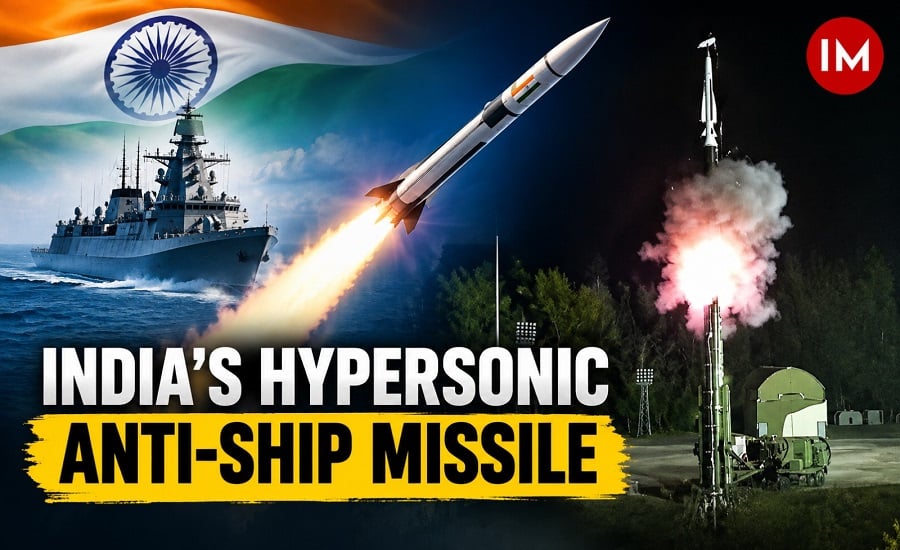
New Delhi: India is advancing the development of a long-range hypersonic anti-ship missile that could significantly strengthen its ability to deter hostile naval forces in the Indian Ocean Region. The Defence Research and Development Organisation (DRDO)-developed Long-Range Anti-Ship Missile (LR-AShM) is designed to strike targets at ranges of around 1,500 kilometres and travel at hypersonic speeds.
The missile is intended to meet the Indian Navy’s coastal battery requirements and is being developed to engage both stationary and moving targets, including major warships. Reports indicate that its induction could take place around 2027–2029, subject to further trials, evaluation and the completion of the development programme.
The programme represents a significant step in India’s effort to develop advanced indigenous weapons and strengthen maritime deterrence. However, the missile should not yet be described as fully operational or ready for routine deployment.
What Is the LR-AShM Hypersonic Missile?
The LR-AShM is a long-range hypersonic glide missile developed by DRDO laboratories in collaboration with Indian industry partners. Its design combines a two-stage solid-propellant rocket system with a glide vehicle that manoeuvres at hypersonic speeds after the powered launch phase.
Unlike a conventional cruise missile that relies on sustained powered flight, a hypersonic glide vehicle is accelerated by a rocket before following a manoeuvring flight path towards its target. This combination of speed and manoeuvrability is intended to make an incoming weapon more challenging for an adversary to track and intercept.
The missile is designed to carry different payload configurations and engage targets on land or at sea, according to descriptions of the programme. Its ability to attack moving targets is particularly relevant to maritime operations, where warships can change course while a missile is in flight.
Read also: DRDO’s New Lightweight Armour Technology Targets 30mm AP Threats
Range, Speed and Key Features
The LR-AShM is reported to have a range of approximately 1,500 kilometres. Published descriptions indicate that it can reach speeds of around Mach 10 during parts of its flight, while maintaining an average speed of approximately Mach 5 during the glide phase. These are reported performance figures, and should not be treated as a complete, officially confirmed operational specification.
Its key reported features include:
- Long-range strike capability: A reported range of around 1,500 kilometres, enabling engagement of targets far from the launch site.
- Hypersonic flight: Speeds above Mach 5, with descriptions of the missile indicating a higher peak speed during its flight.
- Manoeuvrable trajectory: A quasi-ballistic flight path with manoeuvres and atmospheric skips intended to complicate interception.
- Moving-target engagement: Designed to engage both stationary targets and moving naval assets.
- Indigenous technology: Developed through DRDO laboratories and Indian industry partners, including work on propulsion, control systems, sensors and avionics.
The exact time required to cover a given distance would depend on the missile’s flight profile and speed throughout its journey. A single maximum-speed figure does not mean the missile travels at that speed for its entire flight.
How Could It Challenge Enemy Warships?
The LR-AShM’s strategic significance lies in the combination of long range, high speed and manoeuvrability. In a conflict, the ability to threaten hostile naval assets from a distance could give Indian forces more options for defending the coastline and deterring an adversary’s surface fleet.
Aircraft carriers, destroyers and other large warships are valuable but complex targets. Their protection can include surveillance aircraft, ship-based radar, electronic warfare and layered missile-defence systems. A fast, manoeuvring missile could place additional demands on these defences by reducing the time available to detect, track and respond to an incoming threat.
However, no missile is automatically impossible to intercept. Its effectiveness would depend on factors such as the target’s location, the quality of targeting information, the missile’s terminal guidance, and the defensive systems deployed by the opposing force.
For India, the weapon could eventually add another layer to its maritime strike capability, particularly in the strategically important Indian Ocean Region, where naval movements and sea-lane security have major economic and security implications.
DRDO’s Testing and Development Progress
The LR-AShM programme has progressed through flight testing. A trial conducted off the Odisha coast in November 2024 marked an early milestone for the weapon. A subsequent Phase-II test was reported in May 2026, with tracking systems used to monitor the missile’s flight.
The programme’s development involves work on propulsion, flight control, guidance and the ability to manoeuvre under the intense thermal and aerodynamic conditions associated with hypersonic flight.
Before a weapon enters operational service, successful development trials must be followed by further testing and evaluation. These stages help establish whether the missile can consistently meet its performance requirements under the conditions expected during military use.
The reported 2027–2029 induction window should therefore be understood as a projected timeline rather than confirmation that the missile has already completed all user trials or entered operational service.
Initial Production and Future Variants
Some reports have cited an initial production rate of approximately 10–15 missiles annually, potentially rising to 25–40 units as production expands. These figures should be treated as reported projections, not as a confirmed Ministry of Defence production order or an officially announced manufacturing schedule.
If production is scaled up, it would depend on the outcome of development and user trials, the services’ requirements, industrial capacity and procurement decisions.
The LR-AShM has primarily been described as a system intended to meet the Indian Navy’s coastal battery requirements. Other launch configurations, including possible variants for additional armed services or platforms, have been discussed in reporting on the programme. Such options should not be confused with confirmed deployments or approved induction plans.
Significance for Aatmanirbhar Bharat
The LR-AShM reflects India’s broader effort to develop advanced defence technologies domestically. Hypersonic weapons require expertise in high-temperature materials, propulsion, guidance, control systems and precision manufacturing. Progress in these areas can also strengthen the country’s wider defence research and industrial ecosystem.
The programme could contribute to India’s maritime deterrence by giving the armed forces another potential option against high-value naval targets. Its ultimate operational value, however, will depend on successful testing, reliable production, accurate targeting and integration with the Navy’s wider surveillance and command systems.
If inducted as projected, the LR-AShM would represent an important addition to India’s long-range anti-ship capabilities. For now, its reported range and hypersonic performance mark a promising development, while its final specifications, production scale and operational timeline remain subject to the programme’s progress.
Read also: INS Samarthak Joins Indian Navy: 5 Key Facts About India’s New Warship