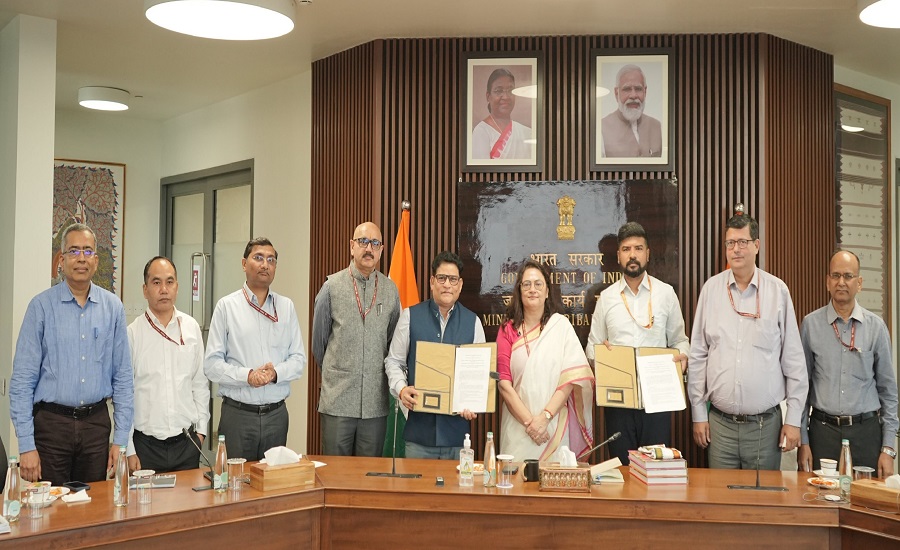
New Delhi: The Ministry of Tribal Affairs (MoTA) and the Indira Gandhi National Centre for the Arts (IGNCA) have signed a Memorandum of Understanding (MoU) to strengthen the preservation, documentation, digitisation, research and promotion of India’s diverse tribal cultural heritage.
The MoU was signed in New Delhi on September 28, 2026, in the presence of Ranjana Chopra, Secretary, Ministry of Tribal Affairs, and senior officials from both institutions. Dr K. Anil Kumar, HoD, IGNCA, and other senior IGNCA officials also attended the event.
The partnership brings together MoTA’s tribal research ecosystem and network of Tribal Research Institutes (TRIs) with IGNCA’s academic, archival, research and curatorial expertise. The Ministry supports TRIs as institutions involved in research, documentation and preservation of tribal cultural heritage.
Focus on Documentation and Digitisation of Tribal Culture
The MoU establishes an institutional framework for the systematic identification, documentation, preservation and dissemination of tribal cultural traditions.
The collaboration will cover a wide range of tangible and intangible heritage, including:
- Tribal arts and crafts
- Music and traditional musical instruments
- Tribal languages
- Oral traditions and folklore
- Traditional cuisines
- Customary practices
- Indigenous and traditional knowledge
- Traditional ecological knowledge
The partnership will also focus on documenting cultural traditions that are endangered or at risk of being lost. Recent reporting on the agreement has highlighted the planned creation of knowledge repositories and archives, along with exhibitions dedicated to tribal culture.
Read also: ITDC and Ministry of Tribal Affairs Launch Capacity Building Programme for Tribal Homestay Owners
Digital Archives and Tribal Museums
A key area of cooperation will be the development of digital archives and interactive museum galleries showcasing tribal arts, artefacts and cultural traditions.
The partnership will also support dedicated galleries and digital museums highlighting the historical contributions of tribal communities, including their role in India’s freedom struggle.
Dr. K. Anil Kumar said the collaboration would support the establishment of digital archives and state-of-the-art interactive tribal museum galleries, including dedicated showcases on the contribution of tribal communities to the freedom struggle.
The focus on tribal museums and documentation is also in line with the Ministry of Tribal Affairs’ broader efforts to strengthen research, conservation and community participation in tribal heritage institutions.
Support for Endangered Tribal Languages and Traditions
The collaboration will support the identification, protection and promotion of endangered tribal languages, oral traditions, indigenous art forms and folklore.
It will provide an institutional mechanism for systematically recording and preserving cultural practices that are largely community-based and passed down through generations.
The partnership will also cover tribal knowledge related to traditional practices and ecological systems, helping create wider access to documented cultural resources while supporting their continued recognition.
Youth Camps to Promote Tribal Cultural Awareness
The MoU also envisages organising youth camps in educational institutions and other centres of learning.
These initiatives will aim to increase awareness about:
- Tribal cultural values
- Sustainable conservation practices
- Tribal languages and traditions
- Customary practices
- The diversity of India’s tribal cultures
The initiative is intended to create greater engagement among younger generations with tribal cultural heritage.
Exhibitions, Publications and Digital Platforms
The partnership will facilitate wider dissemination of tribal heritage through multiple platforms, including:
- Museums and exhibitions
- Cultural festivals
- Publications
- Digital platforms
- Knowledge-sharing initiatives
It will also create greater opportunities for tribal scholars, artists, artisans, performers and traditional knowledge holders to showcase their work at national and international platforms.
Recent reporting on the MoU also noted provisions for academic exchanges, knowledge-sharing and capacity-building initiatives focused on the history, culture and social development of tribal communities.
Officials Highlight Importance of Collaboration
Ranjana Chopra, Secretary, Ministry of Tribal Affairs, welcomed the initiative and highlighted the importance of preserving and promoting India’s diverse tribal cultural traditions.
She said the collaboration would contribute to tribal empowerment and help expand recognition of the country’s rich tribal heritage.
Ganesh Nagarajan, Deputy Secretary, Ministry of Tribal Affairs, said the MoU provides an institutional framework for bringing together the strengths of MoTA and IGNCA to preserve and promote India’s tribal cultural heritage.
Dr. K. Anil Kumar, HoD, IGNCA, described the partnership as an important collaboration for preserving, documenting and promoting India’s tangible and intangible tribal heritage.
Partnership to Strengthen Tribal Heritage Preservation
India’s tribal communities have a diverse cultural heritage encompassing languages, music, arts, crafts, cuisines, folklore, oral traditions, customary practices and traditional ecological knowledge.
The MoTA-IGNCA partnership is designed to create a structured framework for documenting this heritage and making it accessible through archives, museums, exhibitions, publications and digital platforms.
The collaboration will therefore combine research, documentation, conservation, digitisation and cultural dissemination to strengthen efforts to preserve India’s diverse tribal traditions for future generations.
Read also: NITI Aayog Gears Up for Special Campaign 6.0 to Clear Pending Matters and Improve Office Cleanliness