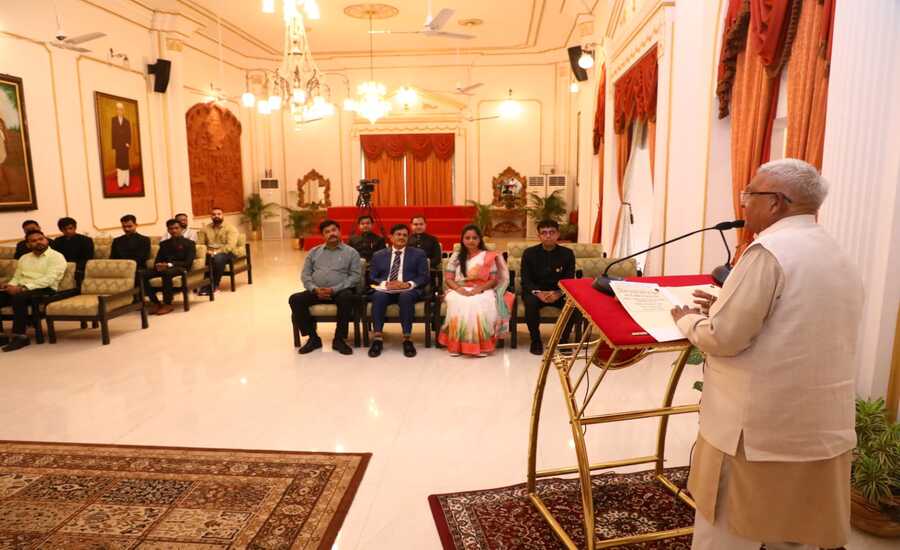
Bhopal: Mangubhai Patel on Monday called upon Indian Forest Service (IFS) trainee officers to adopt a people-centric and service-oriented approach in forest governance, emphasising their broader responsibility towards society and the environment.
Addressing the 2024–26 batch during a courtesy visit at Lok Bhawan in Bhopal, the Governor underlined that the role of forest officers extends far beyond administrative duties.
“Responsibility Towards Humanity and Future Generations”
Highlighting the significance of the service, Mangubhai Patel stated, “The Indian Forest Service is not merely an administrative duty, but a responsibility towards humanity, nature, wildlife and future generations.”
He stressed that the true success of forest officers lies in their ability to improve the lives of people residing in forest areas, urging trainees to work with empathy and sensitivity, particularly for tribal and underprivileged communities.
Read Also: IFS Transfers: Sandeep Divyajyoti Behera Posted to J&K, Satyaprakash Singh to Delhi
Focus on Tribal Welfare and Legal Awareness
The Governor advised trainee officers to study forest laws and tribal welfare provisions in detail and ensure their implementation in accordance with local needs. He emphasised that governance in forest regions must align with the socio-economic realities of indigenous populations.
He also highlighted the importance of respecting tribal traditions and safeguarding their constitutional rights, while promoting traditional knowledge systems such as the use of medicinal plants and indigenous practices.
Climate Change and Conservation Take Centre Stage
Addressing growing environmental concerns, the Governor pointed out that climate change and ecological challenges demand urgent and sustained action.
“A constructive mindset, firm resolve and a spirit of service are essential to protect forests and wildlife,” he said, adding that conservation must remain the top priority for all forest officers.
Community Participation Crucial for Protection Efforts
Mangubhai Patel emphasised that building trust with local communities is vital for effective forest governance. He urged officers to maintain simple behaviour and develop a strong local connect.
He noted that public participation plays a crucial role in curbing illegal activities such as tree felling and poaching. In this context, he cited Prime Minister Narendra Modi’s “Ek Ped—Maa Ke Naam” campaign as an example of community-driven conservation efforts.
Madhya Pradesh’s Rich Biodiversity Highlighted
The Governor observed that Madhya Pradesh is endowed with rich forest cover and biodiversity, making it one of the leading states in conservation.
He noted that the state is widely recognised for its population of tigers, leopards and other wildlife species, and credited scientific forest management practices for strengthening conservation outcomes.
Balancing Conservation with Inclusive Development
Stressing the dual responsibility of forest officers, the Governor said they must strike a balance between environmental conservation and inclusive development.
He urged officers to promote education in tribal areas and raise awareness about government schemes related to health, education, and livelihoods during their field engagements.
Encouraging proactive outreach, he said officers should act as facilitators of development while ensuring ecological sustainability.
A Call for Service-Oriented Governance
Concluding his address, Mangubhai Patel reiterated that forest governance must be rooted in service, sensitivity, and sustainability.
His message to the IFS trainees underscored the evolving role of forest officers—not just as administrators, but as custodians of natural resources and partners in community development.