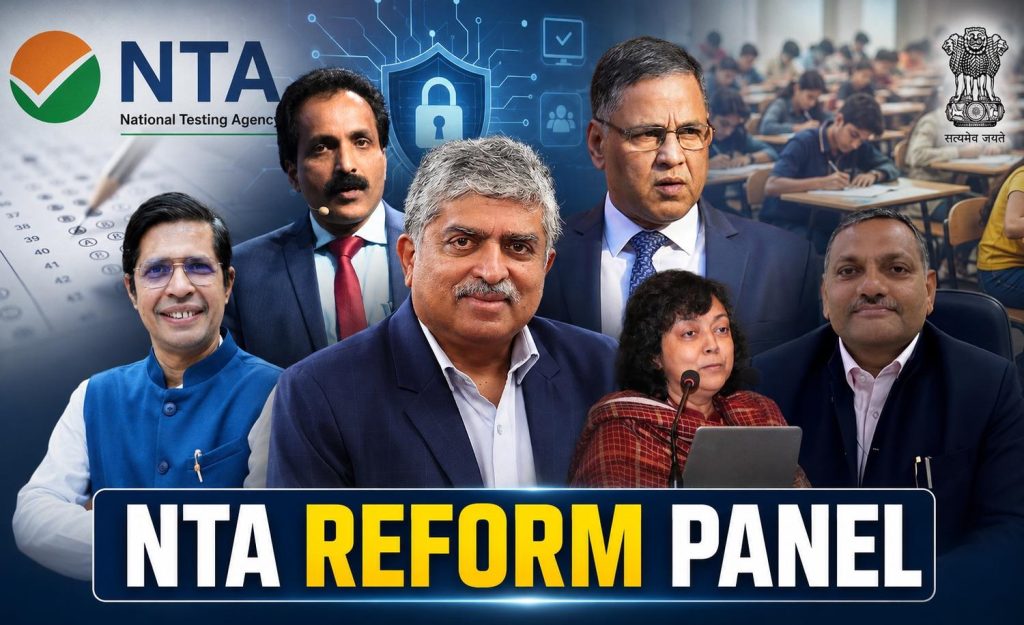
New Delhi: In a major step towards restoring confidence in India’s competitive examination system, the Centre has constituted a High-Powered Task Force on Examination Reforms under the leadership of Infosys co-founder and technology expert Nandan Nilekani. The multidisciplinary panel has been entrusted with recommending structural, technological and governance reforms for the National Testing Agency (NTA) to make examinations more transparent, secure, reliable and future-ready.
The task force brings together experts from technology, education, intelligence, administration, logistics and space science, reflecting the government’s intent to comprehensively overhaul the country’s examination ecosystem following recent controversies surrounding national-level entrance examinations.
PM Modi: Examination System Must Be Reliable and Transparent
Announcing the initiative, Prime Minister Narendra Modi said the government has been taking continuous measures to safeguard students’ interests and ensure accountability in the examination system.
Sharing a video message, the Prime Minister said those responsible for tampering with students’ futures were already behind bars and that the government had established fast-track courts to expedite such cases.
He further noted that the Centre is moving towards introducing stronger legal provisions through new legislation to deal with examination-related offences.
“Our examination system needs to be reliable and transparent, and it must make maximum use of technology. Keeping all these factors in mind, we have decided to constitute a high-powered task force under the leadership of the world-renowned technology expert Nandan Nilekani,” the Prime Minister said.
He added that the recommendations of the panel would be implemented at the earliest to strengthen the credibility of future examinations.
Expert Panel to Drive Technology-Led Reforms
The newly constituted task force has been mandated to recommend comprehensive reforms covering:
- Technology-driven examination systems
- Structural reforms within the NTA
- Better governance and institutional accountability
- Enhanced examination security
- Operational efficiency
- Greater transparency and fairness
- Strengthened use of digital technologies
- Robust mechanisms to prevent malpractice and paper leaks
The recommendations are expected to become the blueprint for a complete transformation of the NTA’s examination framework.
Who Are the Members of the Task Force?
The multidisciplinary panel comprises distinguished experts from diverse domains.
Nandan Nilekani – Chairman
Infosys co-founder and one of India’s foremost technology leaders, Mr Nilekani will head the committee and lead the technology-driven overhaul of the country’s examination system.
Mr Nilekani (born 1955) is a visionary Indian tech entrepreneur, bureaucrat, and the architect of India’s digital transformation. As a co-founder of Infosys, he helped pioneer the country’s IT revolution, serving as its CEO from 2002 to 2007. Later, he chaired the Unique Identification Authority of India (UIDAI), creating Aadhaar—the world’s largest biometric identity system. This established India’s Digital Public Infrastructure (DPI), enabling innovations like UPI for cashless payments. A dedicated philanthropist and author, Nilekani continues to guide public policy, recently leading a high-powered task force to reform and secure India’s national examination systems using advanced technology.
Dr. S. Somanath – Former ISRO Chairman
Former Chairman of the Indian Space Research Organisation (ISRO), Dr. Somanath is widely regarded as one of India’s leading aerospace engineers. During his tenure, ISRO achieved major milestones including Chandrayaan-3and Aditya-L1.
He also played a key role in developing the PSLV, GSLV and LVM3 launch vehicles and previously headed the Vikram Sarabhai Space Centre (VSSC) and Liquid Propulsion Systems Centre (LPSC). Following his tenure, he joined Agnikul Cosmos as an observer. In 2026, Prime Minister Modi appointed him to a high-powered national task force to reform India’s public examination systems.
Leveraging his experience with space missions, Mr Somanath is tasked with introducing zero-defect standards, multi-layer verification procedures, and redundant security frameworks. His role focuses on designing high-reliability administrative systems to eliminate technical glitches and human errors from the National Testing Agency (NTA) infrastructure.
Tapan Deka – Former Intelligence Bureau Director
A 1988-batch IPS officer of the Himachal Pradesh cadre, Mr Deka is one of India’s most experienced intelligence professionals. Having served as Director of the Intelligence Bureau (IB), he brings decades of expertise in counter-terrorism, national security, intelligence gathering and risk management. Leading the premier agency from 2022 to 2026, he became one of its longest-serving chiefs. Deka spent nearly three decades within the IB, specializing in counter-terrorism, cybersecurity, and operations in Jammu & Kashmir and the Northeast.
Known for dismantling major terror modules, he also managed international intelligence liaisons in Washington, D.C. Following his retirement, Prime Minister Narendra Modi appointed him to a high-powered national task force to reform India’s public examination systems.
His experience is expected to strengthen examination security and anti-malpractice mechanisms.
Prof. V. Kamakoti – Director, IIT Madras
An eminent computer scientist and Director of IIT Madras, Prof. Kamakoti specialises in computer architecture, cybersecurity, artificial intelligence and secure computing systems.
His expertise will help shape the technological backbone of future examination systems.
Anita Karwal – Former Education Secretary
Anita Karwal is a distinguished retired Indian Administrative Service (IAS) officer of the 1988 Gujarat cadre who served as India’s Union Education Secretary. Heading the Department of School Education and Literacy from 2020 to 2022, she was a key architect in executing the landmark National Education Policy (NEP) 2020. Previously, as Chairperson of the CBSE, she pioneered crucial digital assessment and board examination reforms. Following her retirement, she took over as Chairperson of GujRERA.
In 2026, Prime Minister Modi appointed her to a high-powered national task force to structurally overhaul India’s public competitive examination system.
She played an important role in implementing key initiatives under the National Education Policy (NEP) 2020.
Amrit Lal Meena – Logistics Expert
Senior IAS officer Amrit Lal Meena (1989 batch, Bihar cadre) has extensive experience in infrastructure, transport, logistics and public administration.
His expertise will help strengthen operational planning, logistics management and nationwide examination coordination.
Focus on Technology, Security and Governance
According to the government, the committee will recommend ways to leverage emerging technologies to make examinations more secure and tamper-proof.
The panel will also examine governance mechanisms, institutional capacity, operational planning and technology adoption to ensure national examinations are conducted with maximum transparency, efficiency and accountability.
The move is part of the Centre’s broader effort to rebuild trust in India’s competitive examination system following concerns over examination integrity in recent months.
Education Ministry Begins Reform Process
The announcement coincides with Union Minister Pralhad Joshi assuming additional charge of the Ministry of Education after the recent Cabinet reshuffle.
Soon after taking charge, Joshi reviewed ongoing schemes and initiatives with senior ministry officials. Minister of State for Education Jayant Chaudhary also attended the meeting.
Addressing the media, Joshi said the ministry has significant responsibilities and that he had begun reviewing its functioning immediately after assuming office.
In a message posted on X, he thanked Prime Minister Narendra Modi for entrusting him with the additional responsibility.
“I am grateful to Hon’ble Prime Minister Shri Narendra Modi ji for placing his faith in me and entrusting me with this responsibility. I accept it with humility and a deep sense of duty,” he wrote.
Odisha CM Welcomes the Initiative
Odisha Chief Minister Mohan Charan Majhi welcomed the Centre’s decision to constitute the High-Powered Task Force.
He said the initiative reflects Prime Minister Narendra Modi’s commitment to safeguarding merit, integrity and excellence in the country’s examination system.
According to Majhi, the reforms will strengthen students’ confidence while promoting a transparent, secure and future-ready education ecosystem.
Part of Wider NTA Overhaul
The constitution of the expert committee marks one of the biggest institutional reform exercises undertaken for the National Testing Agency.
The government expects the panel’s recommendations to transform the NTA through comprehensive reforms in technology adoption, governance, examination security, logistics, operational efficiency and institutional accountability, ultimately making India’s competitive examinations more credible, transparent and resilient.