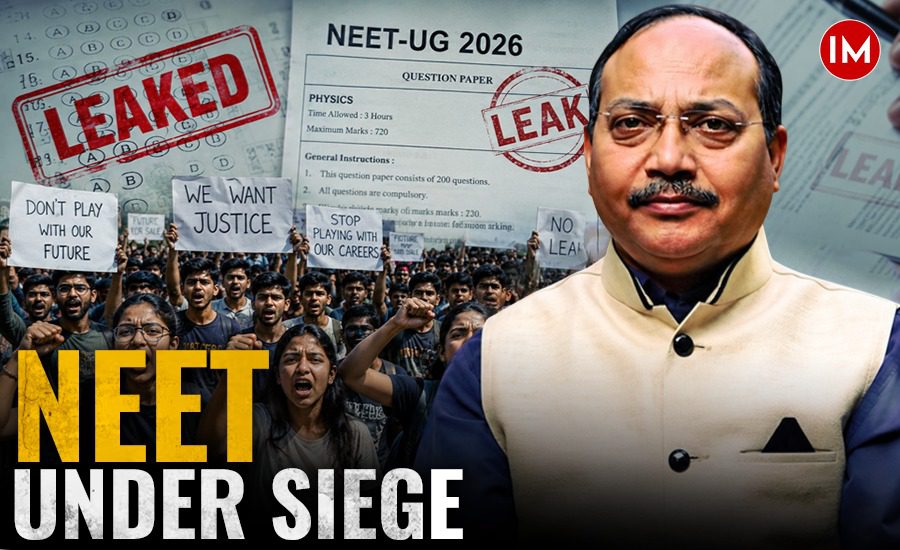
When millions of students sit for the National Eligibility cum Entrance Test (NEET), they are not just writing an exam—they are staking years of effort, family savings, and future aspirations. That is precisely why the NEET paper leak controversies of 2024 and 2026 have shaken the country far beyond the education sector, raising uncomfortable questions about governance, accountability, and institutional design.
Drawing on insights from former School Education Secretary Anil Swarup, the contrast between the two episodes is as revealing as their similarities.
At one level, both incidents expose the same underlying vulnerability: a high-stakes exam system interacting with weak execution layers. But look closer, and the nature of the breach—and the state’s response—mark a clear shift.
A Crack in the System
The 2024 controversy began almost quietly, with scattered reports of irregularities. What initially appeared as isolated malpractice soon revealed a deeper network spanning Bihar, Jharkhand, and parts of Gujarat.
Investigators later pieced together a classic leak operation. Question papers were allegedly accessed from secure storage points, photographed, and circulated through solver networks. In parallel, certain centres—like the one in Godhra—were accused of facilitating in-exam manipulation.
But what truly ignited public anger was not just the leak—it was the aftermath.
Also Read – From Nirbhaya to Nirbhav: Why India Needs a Governance Revolution for Women’s Safety
The Aftermath
Unusual results, including an unprecedented number of perfect scorers and the controversial awarding of grace marks, created a perception that the playing field had been fundamentally distorted. Students took to the streets. Courts were approached. Trust eroded rapidly.
Yet, despite the outrage, the system stopped short of a full reset.
The Supreme Court declined to cancel the entire exam, citing lack of evidence of widespread contamination. The government acknowledged lapses, removed NTA’s Director General Subodh Kumar Singh, and initiated reforms. A high-level committee was constituted to recommend systemic fixes. In Mr. Anil Swarup’s reading, this was a moment of diagnosis—but not decisive cure.
As he points out in the conversation, the tendency often is to “catch the DG, not the chairman,” meaning accountability gets fixed at the operational level while deeper structural issues remain unaddressed. The focus, he suggests, should be less on individuals and more on processes. The NTA chairman at the time was Mr Pradeep Kumar Joshi and DG was Mr Subodh Kumar Singh. Though Singh was removed summarily, no action was taken against Joshi, who continues to rule the roost there.
Divergent Paths
Post leak, Singh remained in administrative cold storage for sometime before being posted as Chief Secretary of Chhatisgarh. The new DG is another very dynamic officer, Mr Abhishek Singh, was shifted from the position of Additional Secretary Ministry of Electronics and Information Technology (MeiTY) after successfully accomplishing International AI Summit.
If Subodh Kumar Singh was blamed for the leak last time, why was the yardstick different this time? I don’t wish to blame Abhishek Singh. He has spent hardly any time in NTA. But, there shouldn’t be different rules for different people. Was Subodh Singh made a scapegoat only to protect Pradeep Joshi? A large number of senior and veteran officers including Anil Swarup, think so.
The Process Problem
Swarup’s critique cuts to the heart of the issue: the architecture of exam delivery. “System is built by human beings,” he notes, underlining that even a well-designed system can fail if execution is compromised. One major vulnerability, according to him, lies in the outsourcing of examination centres.
Unlike the UPSC, which tightly controls its centres, NEET relies on a wide network of external institutions. This introduces variability—and susceptibility to pressure, manipulation, and, ultimately, corruption.
“If the centre selection process is weak,” Swarup argues, “leak will happen.” The second weak link is the question paper lifecycle: where it is created, how it is stored, when it is transported, and how it is accessed. Any gap in this chain can become an entry point for leaks.
He recalls how a previous CBSE leak was traced to a bank storage process—where a teacher accessing one day’s paper managed to copy the next day’s as well. The lesson, he insists, is simple: unless you understand exactly how a leak occurred, you cannot plug it.
A System Overwhelmed
If 2024 exposed cracks, 2026 suggested something far more serious—a possible systemic breach. Unlike the earlier episode, where authorities initially maintained that the leak was localised, the 2026 controversy was treated from the outset as widespread. Reports indicated a multi-state network, with “guess papers” matching a significant portion of actual questions.
This was no longer about a few compromised centres. It hinted at deeper penetration—either at the paper-setting stage or along the distribution chain. And this time, the response was immediate and drastic: the exam was cancelled altogether.
That single decision reflects a profound shift. After the backlash of 2024, the government could no longer afford to defend a tainted exam. Institutional credibility had already been dented; another perceived cover-up could have been catastrophic. But the cancellation came at a cost—over 20 lakh students thrown into uncertainty, their academic timelines disrupted, mental stress amplified.
The Same Fault Lines
Despite the differences in scale and response, both incidents share core similarities. First, both underline the rise of organised cheating networks—highly coordinated, well-funded, and technologically savvy. These are no longer isolated acts of malpractice but structured operations resembling criminal enterprises.
Second, both expose the vulnerability of decentralised execution. The more actors involved—printing presses, transport chains, local administrators—the higher the risk of compromise. Third, both demonstrate delayed systemic learning. As Swarup hints, solutions exist, but implementation lags.
He proposes a simple but powerful idea: move towards digital, last-minute paper generation and printing at centres – exactly the process adopted by the CBSE after the 2018 leak and there has been no irregularity during past eight years, he says.
Another safeguard is multiple encrypted question sets which could be stored securely, with one randomly selected and printed just hours before the exam. “In today’s technology era,” he argues, “how can a paper leak if it doesn’t exist physically until the last moment?”
Scale, Perception, and Response
Where 2024 and 2026 diverge sharply is in three areas. The first is scale. The 2024 leak, though serious, was ultimately treated as localised. The 2026 breach, by contrast, appeared widespread enough to question the integrity of the entire exam.
The second is perception. In 2024, there was still room for doubt—was the system broken, or just misused in pockets? By 2026, that doubt had eroded. Public sentiment tilted towards assuming systemic failure. The third is response. In 2024, the system absorbed the shock and moved on, albeit with reforms promised. In 2026, it chose disruption over defence—cancelling the exam to preserve credibility.
The Human Cost
Lost in the institutional debate is the human impact. For students, each leak is not just a headline—it is a personal crisis. Months, often years, of preparation suddenly feel futile. Trust in meritocracy weakens. Anxiety deepens. Parents, too, bear the burden—financially and emotionally. Coaching investments, relocation expenses, and opportunity costs all come into question.
At a national level, the damage is subtler but significant. Competitive exams are a cornerstone of India’s social mobility. If their credibility erodes, so does faith in the fairness of the system.
The Larger Question
Swarup’s most pointed observation is not about technology or logistics—it is about institutional culture. “You cannot run a sensitive organisation with incompetent people or those chosen for the wrong reasons,” he says bluntly.
The implication is clear: reforms cannot be cosmetic. They must address both systems and the people who run them. Because in the end, the NEET crisis is not just about leaked papers. It is about whether India can build institutions that are robust enough to withstand pressure, temptation, and scale. The difference between 2024 and 2026 shows that the stakes are rising. The question now is whether the response will rise with them.
Also Read – The IPS Officer Who Fought Drug Cartels, Domestic Violence & Disaster in Himachal Pradesh