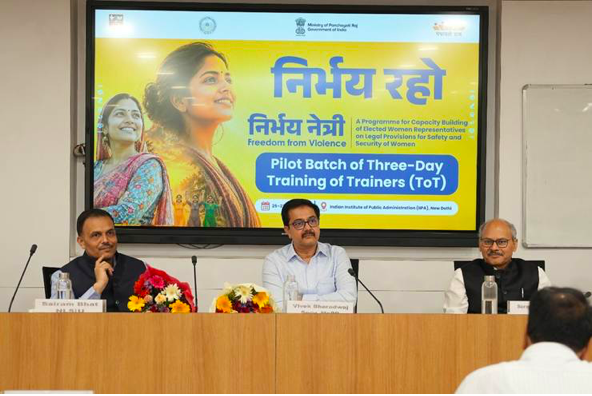
In a major push towards strengthening women’s safety and gender-sensitive governance in rural India, the Ministry of Panchayati Raj organised a three-day Training of Trainers (ToT) programme in New Delhi under its ‘Nirbhay Raho’ initiative.
Held from May 25 to 27, the programme focused on “Freedom from Violence: Capacity Building of Elected Women Representatives on Legal Provisions for the Safety and Security of Women.” The initiative is being implemented through the Nirbhaya Fund in collaboration with the Ministry of Women and Child Development and the National Law School of India University (NLSIU), Bengaluru.
Around 50 participants from State Institutes of Rural Development and Panchayati Raj (SIRD&PRs), NIRD&PR’s School of Excellence in Panchayati Raj, Piramal Foundation, and Transform Rural India Foundation attended the programme.
Three-Pronged Initiative for Safer Panchayats
Addressing the inaugural session, Secretary, Ministry of Panchayati Raj, Vivek Bharadwaj highlighted the critical role Panchayati Raj Institutions can play in improving legal awareness, access to justice, and community support systems for women.
He said the ‘Nirbhay Raho’ initiative consists of three key interventions — Nirbhay Netri for capacity-building of elected women representatives, Nirbhay Chetna for sensitising male representatives on gender issues, and Nirbhay Drishti for installation of CCTV cameras in strategic rural locations.
Also Read – Mission Vande Mataram: How Four BSF Women Climbed Everest And Sang India’s Soul From The Top Of The World
The initiative aims to reach nearly 14.5 lakh elected women representatives and around 17.5 lakh male elected representatives across the country through training and awareness programmes.
The sessions covered gender-based violence, domestic violence, cyber safety, survivor support systems, child marriage, legal remedies, and first responder mechanisms at the Panchayat level through case studies, simulations, and practical exercises.
Officials said the programme would now be expanded across states and Union Territories through a cascading training model to strengthen women-friendly governance at the grassroots level.