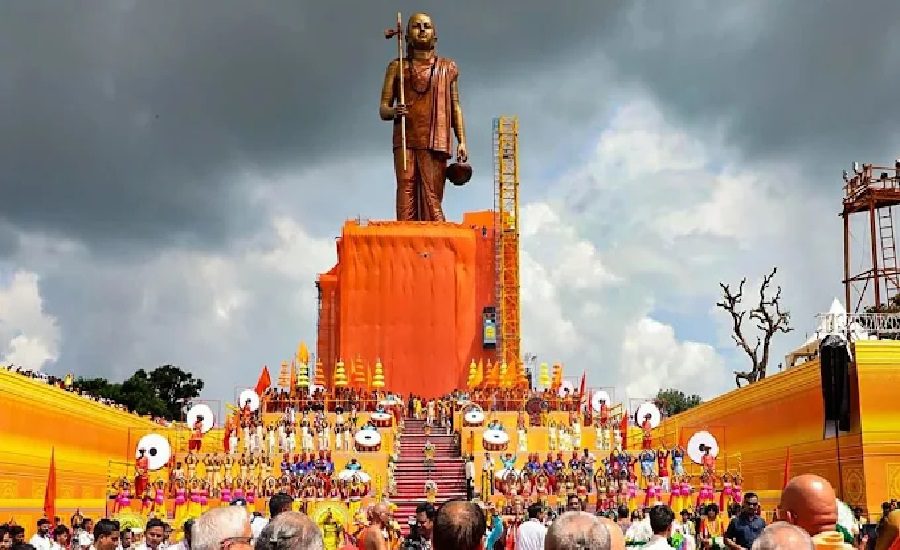
Bhopal: The 108-feet-tall Statue of Oneness (Ekatmata Ki Murti) installed at Ekta Dham in Omkareshwar, Madhya Pradesh, has been declared completely safe, structurally strong, and compliant with international engineering standards.
The grand statue of Adi Guru Shankaracharya, established in 2023 by the Acharya Shankar Cultural Unity Trust under the Culture Department, has undergone extensive technical evaluations by leading national and international experts to ensure long-term safety and durability.
Officials said the statue represents a remarkable achievement in modern engineering and has been designed to remain stable for centuries.
World-Class Engineering Behind Statue of Oneness
The construction of the Statue of Oneness was carried out by Larsen & Toubro (L&T), the company known for building India’s iconic Statue of Unity.
The project involved several globally recognised organisations, including:
- L&T – Construction of the statue
- JTQ – Costing of the project, also associated with Statue of Unity works
- Meinhardt Singapore – Project management consultant
- C.P. Kukreja Associates – Design consultant, known for major national projects including Bharat Mandapam and Yashobhoomi
The involvement of these organisations ensured that the project followed global standards for large-scale structural development.
Read also: MP CM Mohan Yadav Inaugurates ₹30.86 Crore Projects in Kalapipal, Reaffirms UCC Implementation Plan
Designed to Withstand High Wind Speeds
The safety of the statue was assessed through advanced wind engineering analysis conducted by Germany-based global firm Werner Sobek AG.
The wind tunnel analysis confirmed that the statue can withstand wind speeds of up to 169 kmph, which is significantly higher than the standard wind pressure requirement of 140 kmph for the Omkareshwar region.
This ensures that the structure remains stable even under extreme weather conditions.
Advanced Seismic Analysis Ensures Structural Stability
The structural design of the Statue of Oneness was developed considering strict earthquake safety standards.
Although Omkareshwar falls under Seismic Zone III, the structural calculations were carried out according to the more stringent requirements of Seismic Zone IV.
Technical evaluations were conducted by:
- IIT Madras (IIT Chennai)
- IIT Delhi
IIT Madras carried out:
- Mixed design analysis
- Advanced seismic analysis
The assessments confirmed that the statue meets high safety standards for earthquake resistance.
IIT Delhi Certifies 500+ Years Design Life
IIT Delhi’s technical assessment certified that the Statue of Oneness has a design life of more than 500 years.
This evaluation highlights the long-term durability of the structure and confirms its ability to remain a landmark for future generations.
ETABS Analysis Confirms Strong Structural Performance
The statue’s structural strength was also verified through the globally recognised ETABS structural analysis software.
The analysis found that:
- Permitted stress ratio limit: 0.85
- Actual stress ratio recorded: 0.4
The results showed that the structure operates well within safe limits, proving its strong engineering foundation.
Pedestal and Main Structure Remain Fully Stable
According to project officials, the pedestal and main structural framework of the Statue of Oneness are firmly stable and aligned with the approved design parameters.
The technical evaluations confirm that the statue is:
- Structurally secure
- Built according to international safety standards
- Capable of enduring extreme environmental conditions
A Symbol of Spiritual Heritage and Modern Engineering
The Statue of Oneness at Omkareshwar combines spiritual significance with advanced engineering excellence.
Officials said the monument will continue to serve as a centre of faith, inspiration, and tourism for devotees and visitors from India and around the world for centuries to come.
Read also: Madhya Pradesh Wins National E-Governance Silver Award 2026 for Cyber Security Excellence