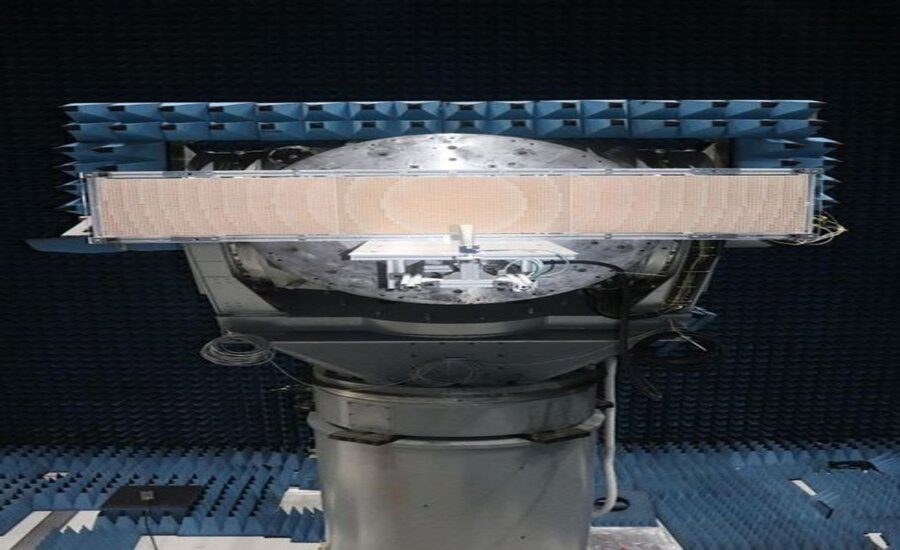
New Delhi: India’s private space sector has achieved an important milestone with the successful testing of the Varuna 2.0 antenna developed by Ahmedabad-based spacetech startup PierSight. The Varuna 2.0 antenna recently completed key performance tests at the Indian Space Research Organisation Compact Antenna Test Range Facility (CATF) in Ahmedabad.
The achievement marks a major step toward deploying advanced satellite systems designed for maritime surveillance and defence monitoring. Once operational, the satellite will help monitor ship movements, piracy threats, and strategic activity in the Indian Ocean Region. The milestone also highlights the growing collaboration between private startups and national space institutions to strengthen India’s space and defence technology ecosystem.
Varuna 2.0 Antenna Tested At ISRO Facility
PierSight successfully tested the reflect-array antenna of its upcoming Varuna 2.0 satellite at ISRO’s Compact Antenna Test Range Facility in Ahmedabad. The testing facility allows engineers to simulate space-like conditions on Earth and measure antenna performance accurately.
Read also: Explained: Why India Closes 2,500-km Airspace Over Bay of Bengal
During the tests, engineers evaluated several critical parameters including:
- Signal gain
- Beam width
- Radiation patterns
- Side-lobe suppression
The results showed that the antenna performed beyond expectations, achieving over 50% aperture efficiency, which exceeded its initial design targets. This confirms that the antenna can transmit and receive signals efficiently in space conditions.
How Varuna 2.0 Satellite Will Work
The Varuna 2.0 satellite is designed primarily for maritime surveillance using advanced Synthetic Aperture Radar (SAR) technology. SAR satellites can capture high-resolution images of the Earth even in challenging conditions.
Unlike traditional optical satellites, SAR technology can:
- See through clouds
- Work during heavy rain or bad weather
- Capture images at night
This allows authorities to monitor ship movements and ocean activity continuously.
Lightweight Reflectarray Antenna Design
One of the key innovations in Varuna 2.0 is its flat-panel reflectarray antenna design.
Unlike bulky parabolic dish antennas used in many satellites, this design:
- Reduces satellite weight
- Improves signal control through beam steering
- Lowers launch costs
The lightweight structure also makes the satellite easier to deploy in large constellations in the future.
Importance of Varuna 2.0 Antenna
The Varuna satellite system is expected to play an important role in India’s maritime security strategy.
It will help monitor:
- Exclusive Economic Zones (EEZ)
- Illegal fishing activities
- Piracy threats
- Suspicious naval movements
Because SAR satellites operate in all weather conditions, they provide persistent surveillance across the Indian Ocean Region, which is strategically important for India’s defence and economic security.
Private Space Startups Powering India’s Space Ecosystem
PierSight was founded in 2020 and focuses on Earth-observation satellites for maritime and defence applications. The company previously demonstrated India’s first privately developed SAR payload in orbit through the Varuna mission.
The company plans to deploy a constellation of SAR satellites that will provide continuous coverage of global oceans with frequent revisit times. Such systems can help track ships, detect oil spills, and monitor critical infrastructure like undersea cables and pipelines.
This development aligns with India’s Atmanirbhar Bharat initiative, which aims to promote indigenous manufacturing and reduce dependence on foreign space technologies.
Varuna 2.0 Antenna Launch Timeline And Next Steps
Following the successful antenna testing, PierSight will now move forward with:
- Satellite payload integration
- Environmental and vibration testing
- Final system optimization
The Varuna 2.0 satellite is expected to launch by late 2026, possibly aboard ISRO’s SSLV or GSLV rocket.
Once deployed in orbit, the satellite will significantly enhance India’s ability to monitor maritime activity in real time.