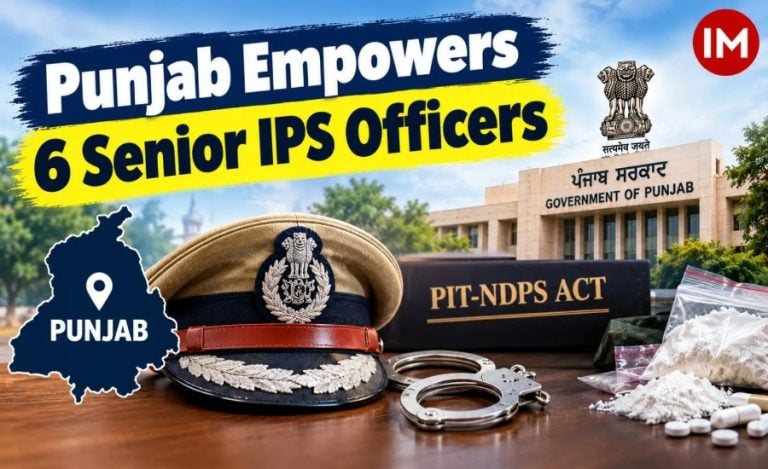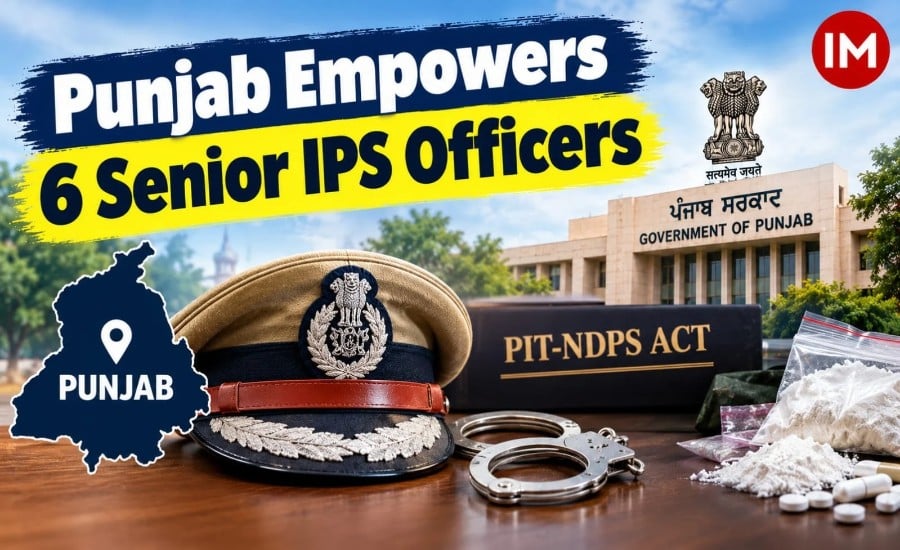
Chandigarh: The Punjab government has authorised six senior Indian Police Service (IPS) officers to exercise specified powers under the Prevention of Illicit Traffic in Narcotic Drugs and Psychotropic Substances Act, 1988, in a move aimed at strengthening action against drug trafficking.
The Home Department issued a notification on October 21, 2026, following approval by the Governor. The measure delegates preventive-detention powers under Section 3(1) of the Act to designated police officers and units, expanding the authority available for action against suspected illicit drug trafficking.
The six officers named in the announcement are A.S. Rai, Gautam Cheema, Naunihal Singh, Shive Kumar Verma, Kaustubh Sharma and S. Bhupathi.
According to reports, the notification is intended to reduce delays associated with obtaining prior approval from the state Home Secretary for preventive-detention proceedings. The authorisation is subject to the provisions of the law and the terms of the notification.
Six Senior IPS Officers Granted Special Powers
The six officers identified in the announcement are:
- A.S. Rai (IPS: 1994: PB): Amardeep Singh Rai is a senior Punjab-cadre IPS officer serving as Special Director General of Police, Traffic, Punjab. He has played a key role in traffic governance and road safety initiatives across Punjab, including the development of AI-driven road crash investigation units and programmes aimed at improving road safety. In recognition of his service, he received the Police Medal for Meritorious Service in 2010 and the President’s Police Medal for Distinguished Service in 2022.
- Gautam Cheema (IPS: 1995: PB): A senior IPS officer who has held senior operational and supervisory positions in the Punjab Police. Mr. Cheema holds an M.A. and an M.Phil. from Chandigarh.
- Naunihal Singh (IPS: 1997: PB): A Punjab-cadre IPS officer who has served in senior police leadership roles in the state. Mr. Singh holds a degree in M.A. and an M.A. in Public Administration (PM). He received the Police Medal for Meritorious Service in 2013 in recognition of his service.
- Shive Kumar Verma (IPS: 1998: PB): A Punjab-cadre IPS officer serving as Additional Director General of Police, Internal Security. He holds an M.Tech degree and received the Police Medal for Meritorious Service in 2014.
- Kaustubh Sharma (IPS: 2001: PB): An IPS officer who has held senior positions, including in the Security wing of the Punjab Police. He holds MBBS, MD (Medicine) and M.A. degrees. Mr. Sharma received the Police Medal for Meritorious Service in 2017.
- S. Bhupathi (IPS: 2007: PB): An IPS officer serving as Inspector General of Police, Provisioning, Punjab. He holds an MBBS degree. S. Bhupathi has served in several key field and administrative roles in the Punjab Police, including Senior Superintendent of Police (SSP) in Moga, Patiala and Khanna; Deputy Commissioner of Police (DCP) in Ludhiana; SP, Counter Intelligence, Amritsar; Assistant Inspector General (AIG), Vigilance Bureau; and Deputy Inspector General (DIG) for Personnel and Chief Minister’s Security.
What Powers Does the PIT-NDPS Act Provide?
The Prevention of Illicit Traffic in Narcotic Drugs and Psychotropic Substances Act, 1988, provides a framework for preventive detention intended to stop people from engaging in illicit drug trafficking.
Section 3(1) permits the Central or State Government, or officers specially empowered under the provision, to issue detention orders when the statutory conditions are satisfied.
The provision is distinct from ordinary criminal arrest and prosecution under the Narcotic Drugs and Psychotropic Substances Act, 1985. Preventive detention is intended to prevent future illicit trafficking, and its exercise remains subject to applicable legal safeguards.
Notification Seeks to Reduce Administrative Delays
According to reports, the notification extends the exercise of preventive-detention powers to designated police commissioners, range-level officers and other specified senior officers, including in units where an Inspector General of Police-rank officer is not available.
The earlier approval process involving the Home Secretary could delay preventive-detention proceedings. The revised arrangement is intended to enable authorised officers to take decisions within their designated jurisdictions.
The notification was issued by the Punjab government’s Department of Home Affairs and signed by Additional Chief Secretary Alok Shekhar (IPS: 1994: PB).
Punjab Steps Up Action Against Drug Trafficking
Drug trafficking and substance abuse remain major law-enforcement and public-policy concerns in Punjab. The state has faced sustained pressure to strengthen action against supply networks and those involved in illicit drug distribution.
The authorisation places greater responsibility on designated senior police officers to ensure that preventive-detention powers are exercised lawfully, on the basis of relevant material and in accordance with the safeguards prescribed by law.
Read Also: Who Is Gaurav Yadav, Appointed Regular DGP of Punjab? UPSC Panel, 2-Year Tenure and Career Profile