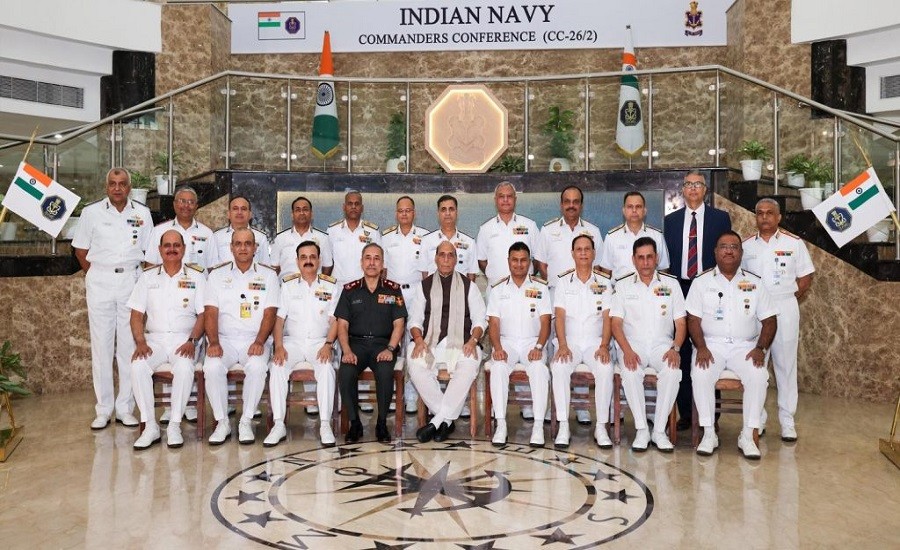
New Delhi: India has emerged as a First Responder and Preferred Security Partner in the Indian Ocean Region, with its growing maritime presence reflecting both its strategic position and responsibility in the region, Raksha Mantri Rajnath Singh said on September 29, 2026.
Addressing the second edition of the Indian Navy’s biannual Commanders’ Conference 2026 at Nausena Bhawan in New Delhi, Singh stressed the need to strengthen India’s maritime surveillance and response mechanisms amid growing congestion, deception and grey-zone activities at sea.
Rajnath Singh Highlights India’s Growing Maritime Role
Rajnath Singh said the entire world is witnessing the expansion of India’s strategic position and responsibility in the Indian Ocean Region.
He noted that the maritime domain has become increasingly complex due to factors including:
- Congestion in maritime routes
- Deception and evolving security challenges
- Grey-zone activities
- Increasing maritime traffic
- The need for faster monitoring and response
The Raksha Mantri called for India to take its maritime monitoring and response architecture to a higher level to effectively address emerging challenges.
Read also: Coast Guard Prevents Tanker Capsize Near Paradip After Engine Failure, Flooding
Indian Warships Demonstrate Blue-Water Capability
Singh highlighted the growing operational reach of the Indian Navy, stating that Indian warships are present in the South China Sea, Mediterranean and Atlantic Ocean.
According to the Raksha Mantri, this presence demonstrates the Indian Navy’s blue-water force capability and its role in providing strategic depth and regional power projection.
He emphasised that the Navy’s role extends beyond protecting India’s maritime boundaries to supporting regional stability and safeguarding the country’s wider strategic interests.
Navy Central to Viksit Bharat 2047 Vision
Rajnath Singh underlined the Government’s focus on modernising the Indian Navy as part of the broader vision of Viksit Bharat 2047.
He said the Navy acts as a strategic anchor for this vision and contributes to:
- Maritime security
- Economic protection
- Regional stability
- Strategic power projection
- Defence preparedness
The Raksha Mantri urged the Navy to maintain its momentum and continue transforming into a future-ready, combat-ready and globally respected force.
Operation Urja Suraksha and Strait of Hormuz
Singh praised the Indian Navy’s role during the crisis in West Asia, particularly its efforts to ensure the safe movement of Indian-flagged merchant vessels through the Strait of Hormuz under Operation Urja Suraksha.
He highlighted the importance of secure maritime routes for India’s economy and energy security.
India imports around 85–90% of its crude oil and approximately 50% of its natural gas through maritime routes, making the security of sea lanes directly linked to:
- Energy supplies
- Economic security
- Maritime trade
- Defence preparedness
The Raksha Mantri described the safe transit of merchant vessels, particularly LPG tankers, as an important achievement of the Navy.
Indian Navy Warships Cross 75% Indigenous Content
Rajnath Singh also highlighted the progress made by India in indigenous defence production and naval shipbuilding.
He said recently commissioned Indian warships contain more than 75% indigenous content, reflecting the development of the country’s domestic naval manufacturing ecosystem.
He stressed that India should move beyond meeting its own naval requirements and work towards exporting warships to friendly foreign countries.
The Raksha Mantri said the Indian Navy’s warship production ecosystem is now meeting global benchmarks, while emphasising the need for continued capability enhancement.
18 Warships Planned for Induction in 2026
Singh described 2026 as a historic year for the Indian Navy, with plans for the induction or commissioning of 18 warships.
This would represent the Navy’s largest single-year force accretion in its history.
The development highlights the growing capacity of India’s domestic naval shipbuilding ecosystem and the Government’s focus on strengthening maritime capabilities.
Maritime Surveillance Architecture to be Upgraded
The Raksha Mantri called for a significant upgrade to India’s maritime surveillance architecture.
While acknowledging the importance of existing surveillance systems, he pointed to the increasing volume and complexity of maritime traffic.
He stressed the need for stronger analytical capabilities so that the Navy can effectively monitor developments at sea and respond to emerging security challenges.
Women Officers Take on Frontline Naval Roles
Rajnath Singh commended the Indian Navy’s efforts towards women’s empowerment, recruitment and innovation under its “All Ranks, All Roles” approach.
He highlighted the deployment of women officers on:
- Frontline warships
- Naval aircraft
- Maritime expeditions
He also praised the participation of women officers in naval navigational expeditions, including the Navika Sagar Parikrama voyage.
India Takes Command of CTF-154
The Raksha Mantri congratulated the Indian Navy for assuming command of Combined Task Force-154 (CTF-154) under the Combined Maritime Forces.
He described the development as an important contribution to cooperative maritime security in the region.
He also highlighted Operation Southern Readiness, conducted in Kochi during India’s command tenure of CTF-154.
The exercise involved:
- 276 personnel
- 27 countries
- 76 facilitators and subject-matter experts
- Four international organisations
The operation demonstrated India’s role in strengthening international cooperation in maritime security.
INS Sudarshini Strengthens Maritime Diplomacy
Singh also commended the deployment of INS Sudarshini for Lokayan-26.
The deployment strengthened India’s maritime diplomacy and engagement with the Indian diaspora across the United States, Atlantic and Mediterranean regions.
It also provided an opportunity to showcase India’s rich maritime heritage and strengthen international engagement through naval outreach.
Indian Navy Commanders’ Conference 2026
The three-day apex-level Indian Navy Commanders’ Conference 2026 is being held from September 29 to October 1, 2026, in New Delhi.
The conference brings together the top leadership of the Indian Navy to review key areas, including:
- Operational preparedness
- Maritime security
- Future capability development
- Emerging maritime challenges
- Naval modernisation
During the conference, Rajnath Singh also interacted with the Chief of Defence Staff (CDS) and the Chief of the Army Staff.
Rajnath Singh: Secure Seas Essential for India’s Security
Concluding his address, the Raksha Mantri commended the Indian Navy for maintaining a high level of combat readiness and fulfilling its commitments across the region despite evolving maritime challenges.
He said India’s maritime power is not merely about displaying the national flag at sea. Wherever the Tricolour is seen, it should convey security, trust and confidence.
Reaffirming the Government’s support for the Indian Navy, Rajnath Singh said that secure seas are essential for India’s overall security and for strengthening the country’s resolve towards Viksit Bharat.