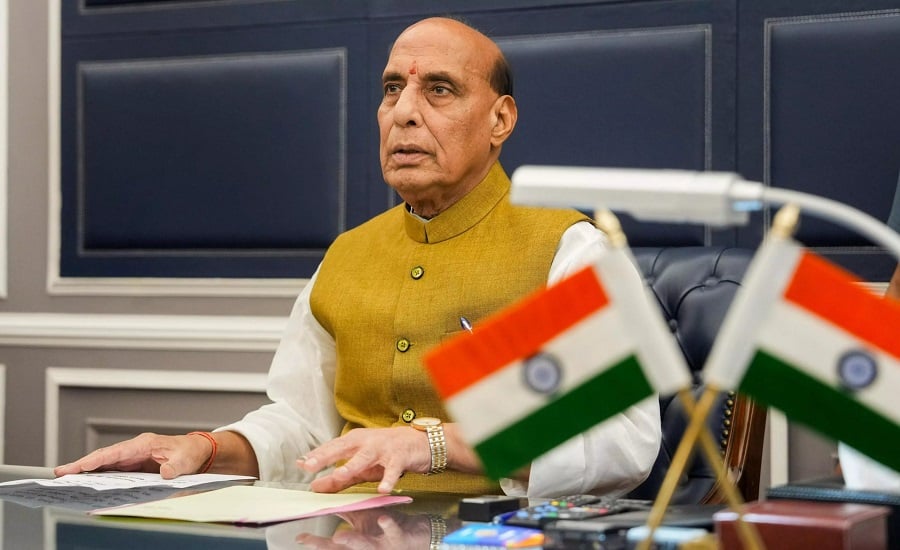
New Delhi: National security can no longer be viewed only through the lens of protecting geographical borders, Defence Minister Rajnath Singh said on September 24, outlining the government’s approach to emerging security challenges and military preparedness.
Addressing a defence conclave in New Delhi, Singh said modern threats now include drones and unmanned aerial vehicles, cyberattacks, lone-wolf attacks and disinformation campaigns, besides conventional military threats. He also linked national security with economic and energy security, saying disruptions to critical economic and energy systems could also affect the country’s security.
The Defence Minister said the government has adopted what he described as a “holistic approach” to deal with these evolving challenges.
National Security Goes Beyond Physical Borders
Singh described viewing national security only as the protection of geographical boundaries as a “perimeter fallacy”.
According to him, the changing nature of warfare and security threats requires India to prepare across multiple domains. Along with the Army, Navy and Air Force, areas such as cyber security, artificial intelligence, electronic warfare and space are becoming increasingly important.
He also stressed the relationship between national development and security. A strong economy provides greater resources for defence preparedness, while a secure environment supports economic and development activity.
Read also: Coal India Signs Exploration Licence Deed for 209 Sq Km Rare Earth Block in Andhra Pradesh
Diplomacy and Military Preparedness to Work Together
Singh said India’s security approach needs to maintain a balance between diplomacy and military capability.
He argued that military preparedness without diplomacy could increase the possibility of confrontation, while diplomacy without adequate defence capability could be perceived as weakness. He presented the two as complementary elements of national security policy.
The Defence Minister also referred to India’s participation in platforms such as the QUAD, I2U2, BIMSTEC, BRICS and SCO as part of its broader diplomatic and strategic engagement.
Rajnath Singh Outlines Evolving Counter-Terrorism Policy
A significant part of Singh’s address focused on India’s counter-terrorism approach.
He said the government’s approach has moved beyond what he described as “strategic containment” and “deterrence by denial” towards “deterrence by punishment”. He cited Surgical Strikes, the Balakot air strike and Operation Sindoor while discussing India’s response capabilities.
Singh also stated that India’s policy is that terrorism and dialogue cannot go together and said that no border should prevent India from acting against terrorist infrastructure.
He further said that any terror attack originating from Pakistani soil would be treated as an “Act of War” against India and met with a response.
These statements reflect the Defence Minister’s stated security policy position at the conclave.
Defence Budget Rises to ₹7.85 Lakh Crore
Singh highlighted the expansion of defence spending as part of India’s military modernisation.
According to the Ministry of Defence, the allocation for defence in FY 2026-27 stands at ₹7.85 lakh crore, compared with about ₹2.53 lakh crore in FY 2013-14. The 2026-27 allocation is 15.19% higher than the previous year’s Budget Estimates.
The Defence Minister also said defence production has reached around ₹1.80 lakh crore, while the armed forces are undergoing continued modernisation.
The government has also increased capital expenditure for defence. The 2026-27 allocation includes more than ₹2.19 lakh crore under the capital head for the Defence Forces.
Technology Becomes Central to Future Warfare
Singh identified “Terrain, Technology and Thinking” as three important factors in modern warfare.
He said India is developing capabilities in areas including:
- Drones and unmanned systems
- Artificial intelligence
- Cyber security
- Electronic warfare
- Space technology
- Quantum technology
He cited indigenous systems such as Rustom, Ghatak and Nagastra while highlighting the expansion of India’s domestic defence technology capabilities.
The Defence Minister also referred to BrahMos and the development of the proposed “Sudarshan Chakra” system as examples of the country’s focus on advanced defence capabilities.
Push for ‘Design in India’ and ‘Manufacture in India’
Self-reliance remained another major theme of Singh’s address.
He said the government is working with a vision of “Design in India, Develop in India and Manufacture in India” to reduce dependence on imported defence equipment and strengthen domestic capabilities.
Singh said defence research and development allocation has increased by more than 112% over the past 12 years, from around ₹13,700 crore in FY 2014-15 to more than ₹29,000 crore currently.
He also highlighted the opening of 25% of the defence R&D budget to industry, start-ups and academia to encourage wider participation in defence innovation.
The government has simplified licensing rules and promoted indigenous systems through the Defence Acquisition Procedure. Singh said more than 5,500 items have been included in over 10 Positive Indigenisation Lists.
Defence Corridors and MSMEs Get Greater Role
The government is also seeking to expand the domestic defence manufacturing ecosystem beyond large companies.
Singh highlighted Defence Industrial Corridors and the integration of start-ups and MSMEs into defence innovation and production.
The Srijan Defence Equipment Empowerment Platform, he said, has brought manufacturers, MSMEs and vendors onto a common platform. More than 41,000 vendors and over 2.7 lakh products have been listed on it, according to his address.
The government has also established 15 Industry-Academia Centres of Excellence to support research and technology development.
Defence Preparedness Linked With Economic Strength
Singh said a country’s physical power depends on both a strong economy and a capable military.
He referred to India’s economy growing at 7.8% and said economic strength creates greater resources for national security and defence preparedness. He described national security and national development as mutually supportive.
This approach places defence modernisation alongside economic growth, domestic manufacturing, research and technological development rather than treating military preparedness as a standalone activity.
Focus on Veterans and Soldiers’ Welfare
The Defence Minister also highlighted measures aimed at serving personnel, veterans and their families.
He referred to the expansion of ECHS facilities, the SPARSH pension platform and implementation of One Rank One Pension.
He also mentioned the government’s recent decision to provide lifetime free train travel to soldiers awarded the Sena Medal and selected members of their families.
According to Singh, military preparedness must therefore be accompanied by measures addressing the welfare and long-term needs of personnel and veterans.
Building a Broader Security Framework
Rajnath Singh’s address placed India’s defence preparedness within a wider national security framework covering military capability, diplomacy, technology, economic strength, energy security and domestic manufacturing.
The emphasis on indigenous defence production and research also reflects the government’s broader Aatmanirbhar Bharat approach in the defence sector. With rising defence allocations, increased domestic production and greater participation from industry and academia, the government is seeking to build capabilities for emerging forms of warfare while reducing dependence on external sources.
The approach outlined by the Defence Minister indicates that India’s security planning is increasingly being framed around both conventional military preparedness and newer domains such as cyber, drones, artificial intelligence, space and information-related threats.
Read also: India Moves To Strengthen Anti-Tank Warfare Capability With India US Javelin Missile Deal