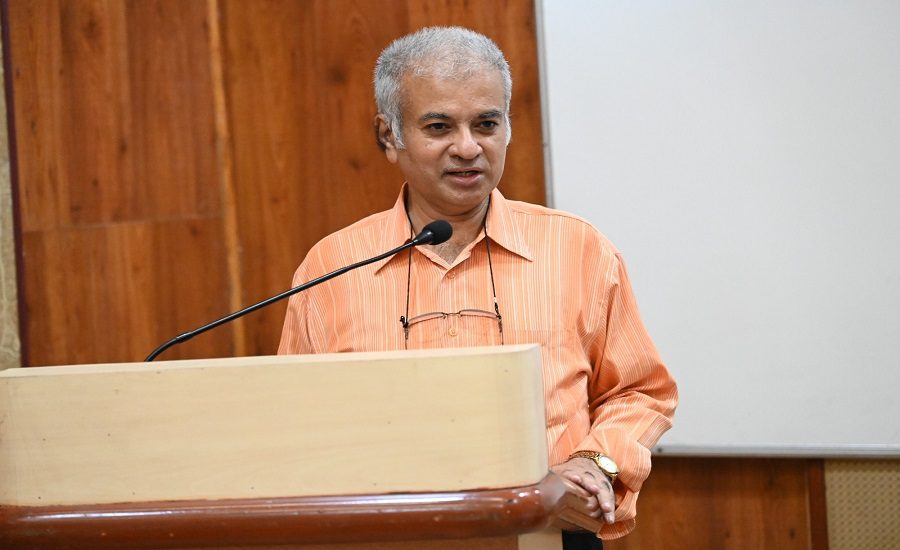
In a compelling address at Bodhi 2026, Dr. Raju Narayana Swamy, a highly decorated 1991-batch IAS officer of the Kerala cadre, emphasised that cybersecurity can no longer remain a reactive exercise and must evolve into a proactive, forward-looking framework.
Dr. Swamy, who currently serves as Principal Secretary to the Government of Kerala and is widely known as Kerala’s anti-corruption crusader and a firebrand administrator, was speaking at Rajagiri College, Kochi, on the theme “Cyber Security in the Age of AI.”
Call for Proactive and AI-Driven Cyber Defense
Highlighting the rapidly evolving cyber threat landscape, Dr. Swamy stressed that enterprises must go beyond traditional cyber defense mechanisms and adopt cutting-edge technologies such as Artificial Intelligence (AI) and Machine Learning (ML).
He underscored the transformative potential of AI-based self-learning applications, describing them as game changers in strengthening cybersecurity systems. According to him, these technologies are already driving the development of next-generation firewall solutions that are far more contextually intelligent.
“These advanced systems can understand the context of every piece of inbound and outbound communication within an enterprise, ensuring protection against unlawful intrusions while allowing legitimate interactions,” he explained.
Three-Pronged Strategy for Future Cybersecurity
Dr. Swamy outlined a three-pronged approach to strengthen cybersecurity frameworks:
- Integration of Layered Security: Enhancing traditional Layer 3 (network-level) security with Layer 7 (application-level) security solutions
- Forward-Thinking Network Strategy: Adopting a proactive and anticipatory approach to network protection
- Investment in Future-Proof Technologies: Preparing for emerging challenges by investing in solutions aligned with both current and future needs
Insights into Quantum Computing and Future Technologies
Expanding beyond cybersecurity, Dr. Swamy introduced the audience to the fundamentals of quantum computing, describing it as a powerful fusion of quantum physics and computer science.
He recalled physicist Richard Feynman’s prediction that by 2050, computers may become so advanced that they could be virtually invisible. Drawing parallels with the evolution of classical computing—from room-sized machines in the 1960s to today’s smartphones—he noted that governments and industries worldwide are investing billions into making quantum computing a reality.
However, he also highlighted key technological challenges, particularly the issue of “noise”—where random photons entering a quantum system can cause unintended disruptions in computations.
“Quantum computing shifts the focus from how humans compute to how the universe computes,” Dr. Swamy remarked.
Philosophical Note on Reality and Emerging Technologies
The session concluded on a reflective note, as Dr. Swamy referenced Morpheus while discussing Augmented Reality (AR) and Virtual Reality (VR):
“How do you define real? If you are talking about what you can feel, smell, taste, and see, then real is just electrical signals interpreted by your brain.”
Event Presided Over by Prof. Fr. Saju
The session was presided over by Prof. Fr. Saju, adding academic depth to the discussion, which brought together students, faculty, and technology enthusiasts for an insightful exploration of cybersecurity and emerging technologies.
Urgent Need For a Paradigm Shift
Dr. Raju Narayana Swamy’s address at Bodhi 2026 highlighted the urgent need for a paradigm shift in cybersecurity—from reactive defense to proactive, intelligence-driven systems. By integrating AI, preparing for quantum advancements, and adopting forward-thinking strategies, organizations can better safeguard their digital ecosystems in an increasingly complex technological era.