New Delhi: The Ancient Buddhist Site of Sarnath in Uttar Pradesh has been inscribed on the UNESCO World Heritage List, adding another landmark to India’s internationally recognised cultural heritage.
The inscription was made during the 48th Session of the World Heritage Committee in Busan, South Korea, taking India’s total number of UNESCO World Heritage properties to 45. The recognition places India sixth globally and second in the Asia-Pacific region by the number of World Heritage properties.
Why Sarnath Matters to Buddhist Heritage
Located in Varanasi, Sarnath is one of the four principal Buddhist pilgrimage sites associated with the life of Gautama Buddha.
Read Also: Yogi Govt’s Big Move: IITs to Conduct Quality Audit of UP’s ₹100 Crore+ Infrastructure Projects
It is traditionally identified as the place where Buddha delivered his first sermon, known as Dharmachakra Pravartana, after attaining enlightenment at Bodh Gaya.
The UNESCO inscription covers two connected components:
- Chaukhandi Stupa
- Archaeological Remains of Sarnath
The archaeological complex includes the Dhamek Stupa, Dharmarajika Stupa, Mulagandhakuti Vihara and Ashokan Pillar, along with other remains.
Sarnath Recognised Under Two UNESCO Criteria
The site was nominated under criteria (iii) and (vi) of the World Heritage Convention.
- Criterion (iii): Recognises Sarnath’s enduring spiritual importance as one of the four principal destinations of Buddhist pilgrimage.
- Criterion (vi): Recognises the site’s direct association with events in Buddha’s life that hold outstanding significance for the Buddhist community, particularly his first sermon and meeting with his first disciples.
According to the government, the monuments at Sarnath reflect nearly 16 centuries of development, with remains ranging from the pre-Mauryan period to the 12th century CE.
From 1998 Tentative List to World Heritage Status
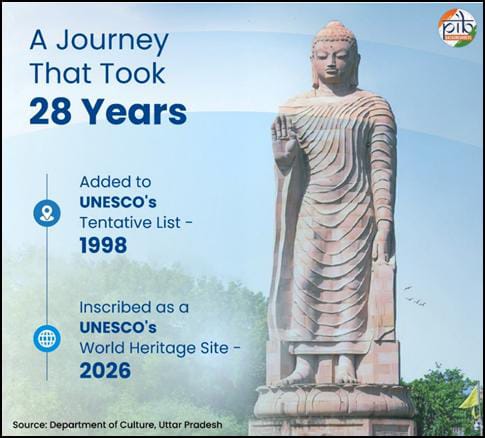
Sarnath was first included in India’s Tentative List of World Heritage Sites in 1998.
India submitted the nomination for consideration by the World Heritage Committee in January 2025. The nomination subsequently underwent technical consultations with UNESCO’s advisory bodies and an evaluation mission by the International Council on Monuments and Sites (ICOMOS).
The process culminated in its inscription at the World Heritage Committee’s 48th session in Busan.
India Now Has 45 UNESCO World Heritage Properties
With Sarnath’s inscription, India’s World Heritage portfolio has reached 45 properties.
These comprise:
- 37 cultural properties
- 7 natural properties
- 1 mixed property
India is now ranked sixth globally, behind Italy, China, France, Germany and Spain, and second in the Asia-Pacific region.
India’s previous World Heritage inscription was the Maratha Military Landscapes of India, added to the list in 2025.
India’s Tentative List currently contains 69 properties, which forms the preliminary stage for future World Heritage nominations.
Sarnath Strengthens India’s Buddhist Heritage Links
Sarnath is among the world’s major Buddhist pilgrimage destinations and attracts visitors from countries including Japan, Thailand, Sri Lanka, Myanmar, Vietnam, South Korea, Cambodia and Mongolia.
With its inscription, three of the four principal Buddhist pilgrimage sites associated with Buddha’s life are now UNESCO World Heritage Sites:
- Lumbini, Nepal – Buddha’s birthplace
- Mahabodhi Temple Complex at Bodh Gaya, Bihar – associated with Buddha’s enlightenment
- Ancient Buddhist Site of Sarnath, Uttar Pradesh – site of Buddha’s first sermon
The fourth principal pilgrimage site, Kushinagar in Uttar Pradesh, is associated with Buddha’s Mahaparinirvana.
ASI and Ministry of Culture Behind Heritage Conservation
The Ministry of Culture coordinates India’s engagement with UNESCO on cultural heritage matters, including World Heritage nominations.
The Archaeological Survey of India (ASI) serves as India’s nodal agency for World Heritage-related matters and is responsible for the conservation and maintenance of centrally protected monuments.
The government said sustainable tourism and controlled development within Sarnath’s buffer zone will be important for protecting the site’s authenticity and integrity.
India Expands Heritage Conservation Efforts
The Sarnath inscription comes alongside several initiatives aimed at documenting, conserving and promoting India’s cultural heritage.
Key Initiatives
- Adopt a Heritage 2.0: A framework for collaboration with private companies, PSUs, NGOs, trusts and societies to improve visitor amenities at protected monuments.
- Gyan Bharatam Mission: Focuses on preserving, digitising and making India’s manuscript heritage accessible.
- National Manuscript Survey: Launched in March 2026 to identify and document manuscripts across the country.
- National Mission on Monuments and Antiquities: Works towards documenting India’s monuments and antiquities to support conservation planning.
- Antiquities Repatriation: India has brought back 669 antiquities, including 656 since 2014.
The inscription of Sarnath adds another major Buddhist and cultural landmark to India’s World Heritage portfolio while highlighting the country’s continuing efforts to conserve sites of outstanding universal value.
Read Also: UP, Japan Deepen Green Hydrogen Partnership at Lucknow Investment Meet 2026