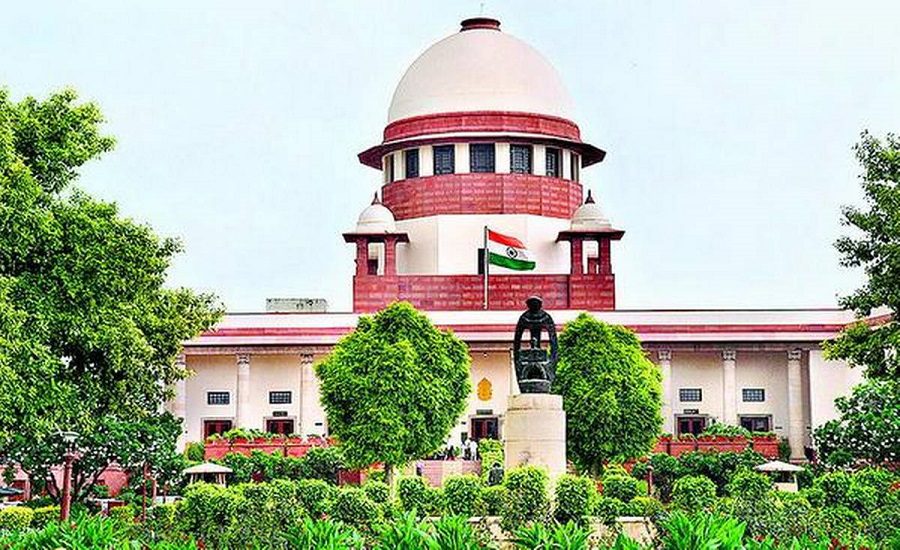
New Delhi: The Supreme Court has delivered a split verdict on the Union government’s request to refer petitions challenging the 2023 law governing the appointment of the Chief Election Commissioner (CEC) and Election Commissioners (ECs) to a five-judge Constitution Bench.
A two-judge Bench comprising Justices Dipankar Datta and Satish Chandra Sharma differed on whether the challenge raises a substantial question of constitutional law requiring adjudication by a larger bench.
Justice Datta rejected the Centre’s request for a reference, holding that the issues could be examined by the existing two-judge Bench. Justice Sharma, however, favoured reference to a Constitution Bench, saying the constitutional validity of the 2023 Act raises an important question that has not previously been authoritatively decided by the Supreme Court.
In view of the disagreement, the matter has been directed to be placed before the Chief Justice of India for consideration of whether a Constitution Bench should be constituted.
What Is the Dispute About?
At the centre of the case is the Chief Election Commissioner and Other Election Commissioners (Appointment, Conditions of Service and Term of Office) Act, 2023.
The law changed the composition of the committee responsible for selecting the CEC and other Election Commissioners.
Under the 2023 law, the three-member Selection Committee comprises:
- The Prime Minister — Chairperson
- The Leader of Opposition in the Lok Sabha — Member
- A Union Cabinet Minister nominated by the Prime Minister — Member
The law therefore replaced the Chief Justice of India, who was part of the interim selection arrangement laid down by the Supreme Court in 2023, with a Union Cabinet Minister nominated by the Prime Minister.
Petitions challenging the 2023 legislation argue that excluding the CJI and giving the executive two members on the three-member committee undermines the constitutionally required independence of the Election Commission.
The challenge has been brought by petitioners including civil society groups such as the Association for Democratic Reforms and Lok Prahari.
Read also: Why Is The Supreme Court Reviewing The Election Commissioner Appointment Process Again
What Did the Supreme Court Say in Anoop Baranwal?
The present dispute has its origins in the Supreme Court’s Constitution Bench judgment in Anoop Baranwal v. Union of India, delivered in March 2023.
At the time, the Supreme Court noted that Parliament had not enacted a law governing appointments to the Election Commission, despite Article 324 contemplating legislation on the subject.
Until Parliament enacted such a law, the Constitution Bench directed that appointments to the Election Commission would be made on the recommendation of a committee comprising the Prime Minister, the Leader of the Opposition in the Lok Sabha and the Chief Justice of India.
The judgment was therefore an interim arrangement pending legislation by Parliament.
Parliament subsequently enacted the 2023 law, but the new legislation replaced the CJI with a Cabinet Minister nominated by the Prime Minister.
That change is at the heart of the current constitutional challenge.
Justice Datta: No Need for a Larger Bench
Justice Dipankar Datta took the view that the petitions did not raise a fresh substantial question of constitutional law requiring a Constitution Bench.
According to his reasoning, the Supreme Court had already laid down the relevant constitutional principles in Anoop Baranwal. The question now was whether the 2023 legislation complied with those principles.
Justice Datta therefore considered the issue primarily one of applying already settled constitutional principles to the legislation rather than one requiring a fresh constitutional interpretation.
He consequently rejected the government’s request to refer the matter to a larger bench.
Justice Datta Questions the Independence of the Selection Panel
While rejecting the reference, Justice Datta made significant observations about the structure of the Selection Committee under the 2023 Act.
He said that independence of the Election Commission must not only exist in substance but must also be perceived.
Justice Datta questioned whether a Cabinet Minister nominated by the Prime Minister could be expected to act as an independent counterweight to the Prime Minister, who heads the Selection Committee.
He also observed that the presence of the Leader of Opposition could become “largely ornamental” because the government has two members on the three-member panel.
Justice Datta said the petitioners’ contention that the 2023 Act gives the executive overwhelming influence in the selection process and thereby affects the appearance of independence “prima facie” appeared to have substance. He made clear, however, that these were observations at the stage of considering the reference and not a final determination on the constitutional validity of the law.
Justice Sharma: Constitution Bench Is Necessary
Justice Satish Chandra Sharma took the opposite position.
He held that the challenge to the 2023 Act should be considered by a Constitution Bench of at least five judges.
Justice Sharma noted that the Supreme Court had not previously authoritatively ruled on the constitutional validity of the 2023 Act itself.
He identified the question of whether Parliament was constitutionally justified in excluding a neutral selector such as the CJI from the appointment committee as an important issue arising for the first time before the Court.
For Justice Sharma, this amounted to a substantial question of law concerning Parliament’s power under Article 324(2), and therefore the matter could not finally be decided by the existing two-judge Bench.
What Does Article 145(3) Say?
The question of a Constitution Bench is linked to Article 145(3) of the Constitution.
The provision requires a minimum of five judges when the Supreme Court is deciding a case involving a substantial question of law as to the interpretation of the Constitution.
Justice Sharma relied on this constitutional requirement in concluding that the challenge should be heard by a larger bench.
The disagreement between the two judges therefore was not about whether the case concerns the Election Commission alone, but about whether the constitutional questions raised by the 2023 Act require a larger bench to determine them.
Centre’s Argument: Parliament’s Law Should Prevail
The Centre defended the 2023 legislation and sought reference of the matter to a Constitution Bench.
Solicitor General Tushar Mehta argued that the Supreme Court’s 2023 judgment in Anoop Baranwal had operated only because Parliament had not enacted a law on the subject.
According to the Centre’s position, the Court had filled a legislative vacuum through an interim arrangement. Once Parliament enacted legislation, the statutory framework enacted by Parliament should be given effect.
The government’s position was that the judicial arrangement in Anoop Baranwal could not prevent Parliament from exercising its legislative power under the Constitution.
The 2:1 Composition of the Selection Panel
A central concern raised during the proceedings relates to the composition of the three-member Selection Committee.
The panel consists of the Prime Minister, the Leader of Opposition and a Cabinet Minister nominated by the Prime Minister.
This means two members are from the government side, while the Leader of Opposition is the third member.
Justice Datta questioned whether such a structure provides an effective independent counterweight in the appointment process. He observed that a minister who is part of the Council of Ministers and subject to collective responsibility cannot realistically be expected to oppose the Prime Minister who nominated the minister to the committee.
The Centre, however, defended the arrangement and argued that the Prime Minister’s constitutional position carries a high degree of trust and that it should not be presumed that the Prime Minister and the nominated minister would act contrary to democratic interests merely because the government has a numerical majority on the panel.
The Collegium Comparison
Another issue discussed during the proceedings was the government’s comparison between the Election Commission appointment process and the judicial collegium system.
Justice Datta rejected the comparison, questioning the argument that the Court should not insist on participation by a neutral outsider in appointments to the Election Commission when the collegium system itself has been criticised as involving judges appointing judges.
He said the two systems operate within different constitutional contexts and questioned the relevance of the comparison to the issue before the Court.
Why the Matter Now Goes to the CJI
Because Justices Datta and Sharma reached different conclusions on the reference question, the matter cannot proceed on the basis of a unanimous order of the two-judge Bench.
Both judges agreed that the matter should be placed before the Chief Justice of India for consideration of the appropriate course.
The CJI will therefore consider whether the constitutional questions identified in the case warrant constitution of a larger bench, potentially a five-judge Constitution Bench.
The split verdict does not itself mean that the 2023 appointment law has been struck down or upheld. The question of its constitutional validity remains to be decided.
What Happens Next?
The immediate issue is whether the CJI constitutes a Constitution Bench to hear the petitions challenging the 2023 Act.
If a larger bench is constituted, it would examine the constitutional questions surrounding Parliament’s 2023 legislation and the structure of the Selection Committee.
If the matter is not referred to a Constitution Bench, the existing proceedings would have to continue in accordance with the course determined by the Court.
The larger constitutional question concerns how the requirement of an independent Election Commission under Article 324 is to be reconciled with Parliament’s power to legislate on the appointment process.
For now, the split verdict has left that question open, with the next procedural decision resting with the Chief Justice of India.