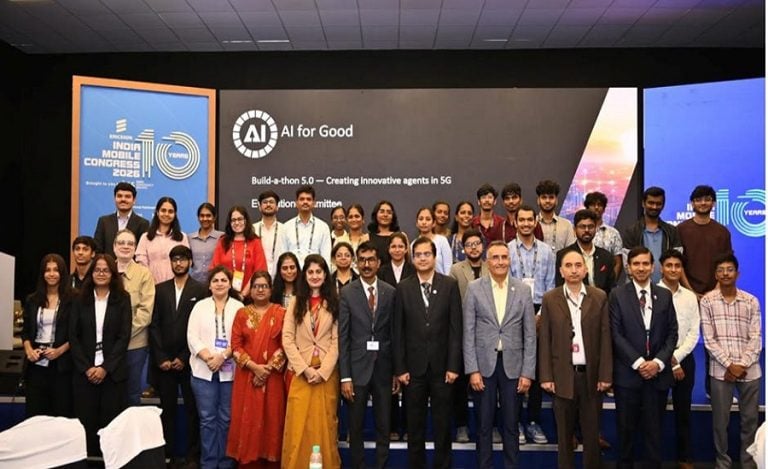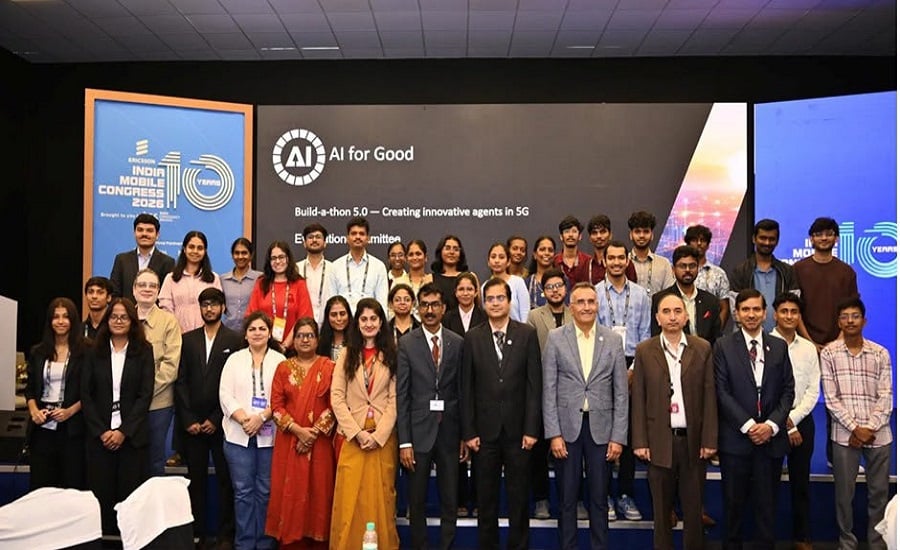
New Delhi: The Department of Telecommunications (DoT), Ministry of Communications, Government of India, in collaboration with the International Telecommunication Union (ITU), organised the AI for Good Build-a-thon 5.0 at India Mobile Congress (IMC) 2026 at Yashobhoomi, New Delhi. Held on the final day of the event, the hands-on capacity-building programme brought together teams from across India to develop Agentic Artificial Intelligence (AI) solutions for the telecommunications sector, with a focus on compliance with Indian policies, regulations and international standards.
The event was themed “Creating Innovative Agents in 5G” and aimed to encourage the development of AI-powered solutions that address real-world telecommunications challenges while integrating policy and regulatory considerations into their design.
Dr. Bilel Jamoussi Inaugurates AI for Good Build-a-thon 5.0
Dr. Bilel Jamoussi, Deputy Director and Chief of the Study Groups and Policy Department at the Telecommunication Standardization Bureau of ITU, inaugurated Build-a-thon 5.0 in the presence of senior DoT officials and distinguished representatives from academia, industry, international organisations and the technology ecosystem.
Addressing the gathering, Dr. Jamoussi highlighted the importance of developing Agentic AI solutions that are tailored to the country’s specific requirements, comply with international standards and operate within local policy frameworks.
He emphasised that the benefits of integrating AI into workflows can be fully realised by identifying policy gaps through the implementation of real AI solutions and subsequently addressing those gaps through appropriate regulations.
The event received leadership and support from Prabhat Dikshit, Deputy Director General (Satellite), and Bishnu Dubey, Director (AS-II), DoT, along with contributions from the Centre for Development of Telematics (C-DoT) and the organising teams.
The panel of judges included Amit Shrivastava, Deputy Director General (MT), Telecommunication Engineering Centre (TEC); Dr. Brajesh Mishra, Executive Director, C-DoT; and Prachish Khanna, Deputy Director General (Media), DoT.
Read also: India Post Partners with Blue Dart to Expand Parcel Deliveries Across Rural and Remote Areas
From Kick-off to AI Prototypes: More Than 25 Teams Participate
Build-a-thon 5.0 began in early July with more than 25 registered teams, each comprising an average of four members. During the preparation phase, ITU and DoT experts conducted five online mentoring sessions to help participants understand the technical, regulatory and policy requirements of the challenge.
The mentoring sessions covered:
- Build-a-thon problem statements and their application to the telecommunications sector.
- The ITU-T Y.3172 standardised machine learning pipeline.
- The ITU AI Readiness 2.0 report, a global benchmark for AI-ready use cases.
- Open-source data sources that could support the development of AI solutions.
The programme included more than 10 hours of mentoring, resulting in 16 AI prototype submissions. The prototypes demonstrated different approaches to agent-based AI, including knowledge-base agents for domain-specific problem-solving, policy and legal adviser agents that perform institutional roles, and coordinator agents capable of orchestrating multiple AI agents.
Key AI Innovations Developed for 5G and Telecommunications
Several submissions stood out for their approaches to network analysis, traffic management, security and regulatory compliance.
1. Multi-Agent Network Analysis With Policy Mapping
One solution combined a country-specific 5G and telecommunications knowledge base with multi-agent AI analysis. It was designed to assess progressive network-error scenarios, map relevant policies and standards, identify gaps, incorporate human supervision and provide auditable evidence to support its findings.
The approach demonstrated how AI agents could help analyse network issues while accounting for the applicable policy and standards framework.
2. Unified Traffic and Security Controller
Another prototype proposed an AI agent-based controller capable of managing network traffic priorities and security requirements together.
The system relied on three key inputs: service intent, available network resources and data sensitivity. By considering these factors together, the solution aimed to support more coordinated decisions on network resource allocation and security.
3. Integrating Law Into the Network Control Loop
A third solution embedded regulatory requirements directly into network operations. It featured three optimisation agents focused on spectrum, energy and network slicing, with a dedicated Regulator agent empowered to veto proposed actions that failed compliance checks.
The Regulator agent evaluated proposed actions against 10 rules based on Indian telecommunications law and cited the relevant official legal text.
The solution also included a Policy and Legal Adviser capable of answering questions based on 16 official documents, alongside a gap analyser designed to identify areas where Indian law does not provide clear guidance.
Together, these features demonstrated how AI-based network management could incorporate legal checks, policy interpretation and regulatory gap identification into operational decision-making.
Judges Appreciate Practical Demonstrations and Policy Compliance
The judges appreciated the energy and dedication displayed by participating teams. The interaction session featured detailed discussions between the judges and participants about the proposed solutions, their practical applications and their alignment with policy requirements.
Teams clearly explained their respective problem statements and demonstrated how their use cases mapped against policies, technical standards and global benchmarks.
The presentations were supported by live demonstrations that provided tangible evidence of each solution’s capabilities, including network-error scenarios and the identification of policy gaps.
The programme concluded with a prize distribution ceremony attended by ITU and DoT dignitaries, recognising outstanding innovations developed during the Build-a-thon.
AI for Good Build-a-thon 5.0: Winners and Award-Winning Projects
The competition recognised teams for their contributions to agentic AI, 5G network management, troubleshooting and regulatory compliance.
First Prize: Team Netaxis, RVCE Bangalore
Team Netaxis from RVCE Bangalore won the first prize for its project, “Context Aware Agentic Orchestration of QoS and Adaptive Security in Resource Constrained 5G.”
The project focused on coordinating Quality of Service (QoS) and adaptive security in 5G networks with constrained resources.
Second Prize: Team SNR
Team SNR secured the second prize for its project, “Knowledge-Grounded Retrieval, Deterministic Constraint Validation and Multi-Agent Arbitration.”
The project highlighted an approach combining knowledge-grounded information retrieval, rule-based constraint validation and coordination among multiple AI agents.
Third Prize: Team Agentnet
Team Agentnet received the third prize for “TeleAgent: Collaborative Multi Agent Framework Using a Fine Tuned Small Language Model for Automated Private 5G Network Troubleshooting.”
The project proposed a collaborative multi-agent framework using a fine-tuned small language model to support automated troubleshooting in private 5G networks.
Special Women’s Prize: Team Orbitflow and Team Handshake Protocol
The Special Women’s Prize recognised two projects:
- Team Orbitflow (SNU Chennai): “Predictive Traffic-aware Beam Hopping for LEO Non-Terrestrial Networks.”
- Team Handshake Protocol: “Law-aware AI agents for 5G emergency response.”
The projects addressed predictive traffic management for low-Earth-orbit (LEO) non-terrestrial networks and the use of law-aware AI agents in 5G emergency-response scenarios.
Judges’ Prize: Team Nethealers
Team Nethealers received the Judges’ Prize for “Autonomous Self-Healing 5G Radio Access Network Agent with Foundation-Model Diagnosis and Digital-Twin Pre-Validation.”
The project focused on autonomous recovery in 5G radio access networks, combining foundation-model-based diagnosis with digital-twin pre-validation to assess proposed solutions.
Build-a-thon 5.0 Highlights India’s Potential in AI-Driven Telecommunications
The AI for Good Build-a-thon 5.0 highlighted India’s potential to develop advanced AI solutions for telecommunications while ensuring that innovation remains aligned with national policies, regulatory requirements and international standards.
By bringing together teams, technical experts, policymakers and industry representatives, the initiative provided a platform to test practical AI applications and examine how policy considerations can be integrated into technology development.
The programme also demonstrated the potential of agentic AI to support 5G network troubleshooting, resource optimisation, adaptive security, traffic management and regulatory compliance. Its emphasis on real-world prototypes and evidence-based demonstrations reinforced the importance of developing AI systems that are both technically effective and suitable for deployment within India’s telecommunications framework.