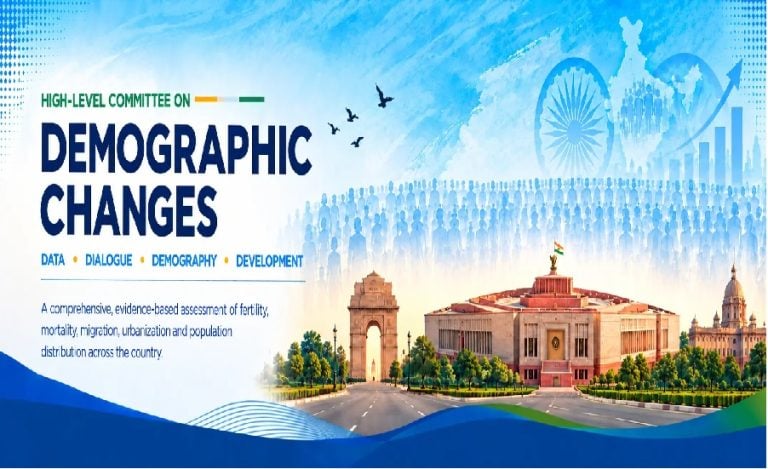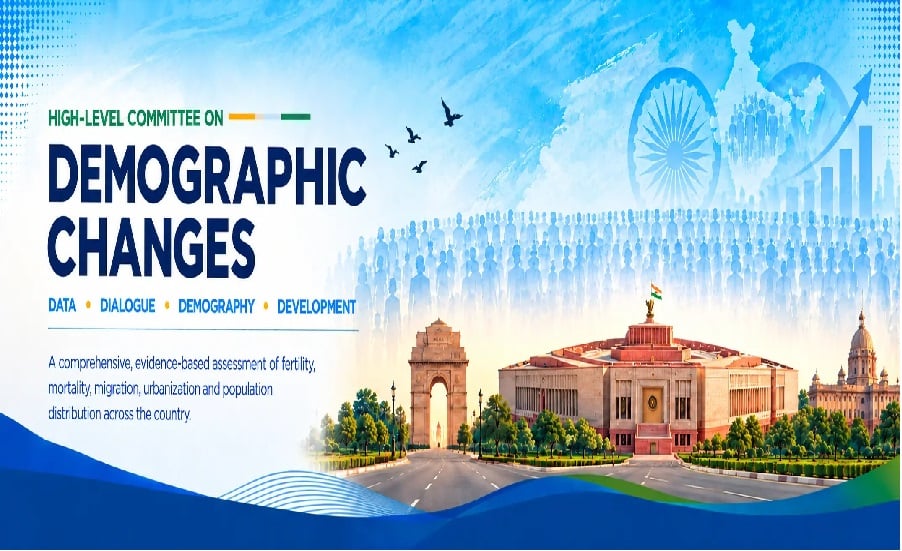
New Delhi: Justice Prakash Prabhakar Naolekar (Retd.), Chairman of the High-Level Committee on Demographic Changes (HLCDC), has launched the committee’s official web portal to facilitate public participation, stakeholder submissions and scientific data collection on demographic changes in India.
The portal is available at https://demography.mha.gov.in and is open for public access. It will enable Central Government ministries and departments, State and Union Territory governments, non-governmental organisations (NGOs), institutions and individuals to submit information about unusual demographic changes, their possible causes and underlying factors, including abnormal settlement patterns.
According to the Ministry of Home Affairs (MHA), the information collected through the portal will help the committee analyse demographic trends and identify the factors contributing to such changes. The committee will use these inputs to formulate recommendations on policy measures, institutional coordination and systems for addressing challenges associated with illegal immigration.
HLCDC Launches Digital Portal for Public Participation
The newly launched portal is designed to provide a centralised platform for gathering information and inputs from government bodies, institutions and members of the public.
Key features and objectives of the portal include:
- Public participation: Individuals can submit relevant information and inputs to the committee.
- Government coordination: Central ministries, departments and State and UT governments can contribute data and information.
- Institutional submissions: NGOs and other institutions can share relevant findings and inputs.
- Demographic analysis: Information will help the committee examine unusual demographic changes and their possible causes.
- Policy recommendations: The collected information will support recommendations on administrative systems, border management and intergovernmental coordination.
The initiative aims to broaden the committee’s information base and support a structured assessment of demographic changes and related challenges.
Read also: NHRC at 33: CJI Surya Kant Calls for Stronger Human Rights Protection at the Grassroots
High-Level Committee on Demographic Changes Constituted in May 2026
The Ministry of Home Affairs formally constituted the High-Level Committee on Demographic Changes on May 26, 2026.
The committee has been tasked with examining demographic changes in India, including those potentially linked to illegal immigration, and studying the social, economic and environmental factors associated with changing population patterns.
Its mandate includes analysing population trends, identifying the underlying causes of demographic changes and recommending institutional and policy measures to address the challenges identified during its assessment.
The newly launched portal will provide an additional channel for the committee to receive information from a wide range of stakeholders.
HLCDC Terms of Reference: Key Responsibilities
The committee has been assigned eight broad responsibilities covering demographic research, illegal immigration, population patterns, border management and policy coordination.
1. Examine Challenges Arising from Demographic Changes
The committee will undertake an extensive assessment of challenges associated with demographic changes, including those arising from illegal immigration.
2. Study the Causes of Demographic Changes
It will examine possible causes of population changes, including:
- Variations in fertility rates
- Cross-border movement, including illegal immigration
- Economic opportunities
- Social and environmental factors
The objective is to understand the different factors that may influence demographic patterns.
3. Identify Underlying Factors and Settlement Patterns
The committee will investigate the factors behind demographic changes, including illegal immigration, abnormal settlement patterns and planned migration.
Information submitted through the portal may help support this assessment.
4. Analyse Structural Population Changes
The committee will study structural population changes at the level of religious and social communities, particularly patterns that diverge from broader population trends.
This assessment forms part of its wider mandate to examine demographic changes and their possible causes.
5. Recommend a System for Addressing Illegal Immigration
One of the committee’s key responsibilities is to recommend a well-organised and permanent operational system for the legal, fair and time-bound identification, detention and deportation of illegal immigrants residing in India.
The proposed recommendations are intended to establish a structured approach in accordance with applicable legal requirements.
6. Strengthen Border Management and Identification Systems
The committee will recommend an appropriate institutional mechanism to strengthen border management, population stabilisation and identification systems.
These measures are intended to support the sustained monitoring of demographic trends.
7. Improve Coordination Between Central and State Governments
The committee will propose a comprehensive policy framework to enhance coordination between the Central and State Governments on matters related to illegal immigration and resulting demographic imbalances.
This responsibility includes examining mechanisms for cooperation between different levels of government.
8. Recommend Additional Measures
The committee may recommend any other measures it considers appropriate to address challenges arising from demographic changes, including those associated with illegal immigration.
This provision allows the committee to consider additional policy or administrative measures based on its findings.
Portal to Support Data Collection and Policy Formulation
The launch of the HLCDC portal establishes a dedicated digital channel through which government bodies, NGOs, institutions and individuals can provide information for the committee’s work.
The submissions will contribute to the committee’s examination of demographic trends, their potential causes and related administrative challenges. The findings are expected to inform recommendations on institutional mechanisms, border management, identification systems and coordination between Central and State Governments.
The portal is accessible at demography.mha.gov.in, where stakeholders can access the platform and submit relevant inputs for the committee’s consideration.
Read also: Guinness World Record Holder P Balasubramanian Menon Gets Senior Advocate Status At 100