Lucknow: From Cabinet Secretary T.V. Somanathan to Uttar Pradesh Chief Minister Yogi Adityanath and the state’s top police leadership, officials have repeatedly stressed the need for senior officers to remain accessible to the common people and maintain direct communication with them. Yet, a recent reality check presents a worrying picture: many senior officials in Uttar Pradesh appear to have little time to answer calls made to their official numbers.
Despite repeated directions from the government leadership—including calls for officers to remain accessible to citizens—many District Magistrates (DMs) and police chiefs appear to have delegated their official mobile phones to Public Relations Officers (PROs), personal assistants or other subordinate staff.
A Dainik Bhaskar investigation, conducted by calling the official mobile numbers of DMs and police chiefs across Uttar Pradesh, found that citizens often struggled to speak directly to the officers responsible for resolving their grievances.
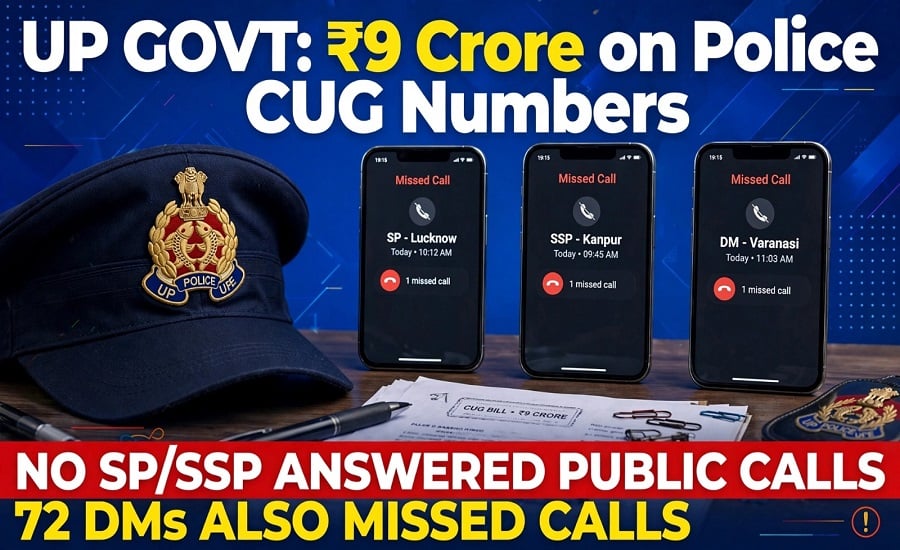
The findings are particularly striking in the police department, where the state spends around ₹9 crore annually on official CUG mobile connections and data recharges, yet the investigation could not connect with a single district police chief personally.
72 of 75 DMs Did Not Personally Answer
To test the accessibility of senior district officials, Bhaskar reporters called the official numbers of all 75 District Magistrates in Uttar Pradesh.
The calls were made three times a day—at 11 AM, 3 PM and 6 PM, with the exercise conducted over a period of seven days.
The reason for choosing multiple time slots was to account for the possibility that officers could genuinely be occupied with meetings, inspections or other official responsibilities.
Yet the results showed a significant gap in public accessibility.
Out of 75 DMs, 72 did not personally answer the official phone calls.
In most cases, the call was answered by a PRO or another staff member, while in several districts the phone either continued ringing or was found switched off or unreachable.
Only three districts recorded a direct response from the DM’s side, with officials either personally hearing the grievance or providing a route for assistance.
Read also: UP Govt Posts 23 Trainee IPS Officers; Dinesh Godara Appointed Assistant SP, Ayodhya
‘Sir Is in a Meeting or Video Conference’
In 25 districts, the standard response from the person answering the DM’s official number was that the officer was busy in a meeting or video conference.
These districts included Firozabad, Mainpuri, Mathura, Kanpur Nagar, Kanpur Dehat, Ayodhya, Sultanpur, Gorakhpur, Maharajganj, Lalitpur, Banda, Bahraich, Balrampur, Shravasti, Saharanpur, Raebareli, Meerut, Gautam Buddha Nagar, Baghpat, Bulandshahr, Hapur, Shahjahanpur, Basti, Hathras and Pratapgarh.
The response was broadly similar: the DM was unavailable because of a meeting or video conference.
The investigation raises the question of whether official numbers meant for public communication can effectively serve their purpose if citizens are unable to reach the officer or receive a callback.
In 14 Districts, Staff Gave Their Own Instructions
In another 14 districts, the caller was not connected to the DM and instead received instructions directly from the PRO or stenographer.
These included Agra, Jhansi, Jalaun, Kannauj, Kaushambi, Mirzapur, Gonda, Bareilly, Lucknow, Chandauli, Azamgarh, Varanasi and Sonbhadra.
The response in these cases was generally to approach the Tehsil or SDM office or visit the DM’s office the next day and submit a written complaint.
While such channels may be legitimate routes for grievance redressal, the investigation highlights the disconnect between the official phone accessibility requirement and what citizens experience when they call the number.
Some DMs Were Unavailable for Other Reasons
The investigation also found several unusual explanations for why the DM could not come on the phone.
In Kushinagar, the PRO reportedly said that guests had arrived and the DM was busy.
In Farrukhabad, Chitrakoot and Pilibhit, callers were told that the DM was currently busy and should be approached at the office the following day.
In Shamli, the PRO suggested a digital alternative, asking the caller to send the grievance through WhatsApp to a specified number.
In Prayagraj, the PRO reportedly said the CUG number was meant only for emergencies and that the DM had gone to the High Court.
The investigation also found that the official numbers of the DMs of Ambedkar Nagar, Ghaziabad and Kasganj were switched off.
In Deoria, Etah, Amethi and Siddharthnagar, the numbers reportedly showed that they were either outside network coverage or not reachable.
In 21 Districts, Phones Kept Ringing
There was another category in which the official phone remained active but nobody answered.
In Unnao, Amroha, Mahoba, Hardoi, Sitapur, Barabanki, Moradabad, Ghazipur, Ballia, Mau, Bhadohi, Jaunpur, Fatehpur, Badaun, Bijnor, Muzaffarnagar, Rampur, Sant Kabir Nagar, Sambhal, Hamirpur and Aligarh, the official numbers continued ringing without being answered by the DM or a responsible staff member.
This meant that callers in these districts could not even establish contact with the district administration through the official number.
Three Districts Where Help Was Offered
The investigation did, however, identify three districts where the response was more accessible.
In Etawah, DM Shubhrant Kumar Shukla personally answered the official number. He listened to the entire issue and advised the caller to first approach the Tehsil office. He also said that if the issue remained unresolved, he would personally look into it.
In Auraiya, the Additional District Magistrate answered the CUG number and explained that DM Brijesh Kumarwas away on official work. The ADM nevertheless agreed to listen to the issue and provide assistance.
In Lakhimpur Kheri, DM Anjani Kumar Singh personally answered the call and asked that the complaint be written down and sent directly through WhatsApp, providing a clear channel for registering the grievance.
These cases demonstrate that direct or alternative grievance-handling mechanisms are possible even when the DM is unavailable.
Police Accessibility Test Even More Concerning
The situation was reportedly even more striking when Bhaskar tested the official numbers of the state’s police chiefs.
Calls were made to the official numbers of SPs/SSPs in 68 districts and Police Commissioners in seven districts, covering all 75 districts of Uttar Pradesh.
The result: not a single police chief personally spoke to the caller.
In other words, the investigation found no district police chief who directly answered the official number and spoke with the caller during the test.
Three SP Numbers Were Switched Off
The official numbers of the police chiefs in Hapur, Mirzapur and Sant Kabir Nagar were found to be switched off or inactive.
This meant callers could not establish contact through the official numbers at all.
16 Police Chiefs Did Not Answer
In 16 districts, calls were not answered by the police chief or connected to the officer.
The officers named in the investigation include:
- Lucknow: Tarun Gaba
- Ghaziabad: J. Ravinder Goud
- Baghpat: Suraj Kumar Rai
- Ballia: Omveer Singh
- Barabanki: Arpit Vijayvargiya
- Bijnor: Abhishek
- Ghazipur: Iraj Raja
- Gonda: Vineet Jaiswal
- Gorakhpur: Kaustubh
- Jhansi: BBGTS Murthy
- Kannauj: Vinod Kumar
- Kanpur Dehat: Shraddha Narendra Pandey
- Mahoba: Om Prakash Singh II
- Mau: Elamaran G
- Saharanpur: Abhinandan
- Shravasti: Rahul Bhati
The calls in these districts did not result in direct communication with the respective police chiefs.
Only Two Offices Called Back—But PROs Spoke
There was limited evidence of follow-up from police offices.
Calls were returned from the SP offices in Maharajganj and Sonbhadra, but even in these cases, the caller did not get to speak directly to the officer.
The PROs reportedly said that the officer was busy and that a conversation could be arranged later.
Thus, even where the office followed up, the accessibility test did not result in a direct conversation with the police chief.
Assistants Answered in 54 Districts
In 54 districts, assistants answered the official numbers.
The callers were generally told that the officer was busy in a meeting and that a conversation might be possible later.
The investigation reportedly involved subsequent calls as well, but the callers were still not connected directly to the police chief.
This raises a fundamental question about the purpose of official CUG numbers if the citizen’s call stops at the level of an assistant or PRO.
‘Does the Officer Speak to Everyone?’—A Bizarre Response in Moradabad
Some responses recorded during the investigation were particularly striking.
In Kushinagar, SP Keshav Kumar’s PRO, Mahendra Prajapati, reportedly said that the officer does not speak over the phone.
Instead, the caller was advised to attend the Jan Sunwai between 10 AM and 2 PM or explain the issue to the PRO.
An even more unusual response reportedly came from Moradabad.
The PRO of SSP Satpal reportedly asked whether the caller was an official and whether someone had used a ‘source’ or connection to arrange a conversation with the officer.
The reported exchange raises questions about whether ordinary citizens should need an intermediary or personal connection to speak to a district police chief on an official government number.
What Do the Rules Say About Official Phones?
The findings are significant because Uttar Pradesh already has specific instructions regarding the handling of official mobile numbers of senior district officials.
In November 2020, Chief Minister Yogi Adityanath issued directions requiring District Magistrates, SPs and SSPs to keep their official mobile phones with themselves and personally answer calls from the public.
The instructions reportedly prohibited officers from handing over their official phones to PAs, PROs, security personnel or subordinate staff.
The purpose was to ensure that citizens could directly communicate with senior district officials regarding grievances and urgent administrative matters.
CMO Conducts Random Checks
The Chief Minister’s Office has also been conducting random checks by calling the official numbers of district-level officers.
The purpose of these checks is to establish whether the officer is actually answering the official phone.
Failure to answer or return a missed call has been treated as a matter of concern and, under the directions, can invite departmental action for indiscipline and neglect of public grievances.
The latest findings therefore raise questions about compliance with these instructions.
DGP Had Also Issued Instructions to Police Chiefs
The police department too has had explicit directions on the matter.
On March 15, 2021, the then Uttar Pradesh DGP Hitesh Chandra Awasthi issued a circular directing police captains, Police Commissioners, DIGs and IGs to keep their official numbers with them.
The objective was to ensure that citizens could communicate directly with senior police officers when required.
The latest investigation suggests a significant gap between these instructions and the experience of citizens trying to reach police chiefs through their official numbers.
₹9 Crore Spent Annually on Police CUG Numbers
The financial aspect makes the findings even more significant.
The Uttar Pradesh Police has approximately 25,000 CUG SIM cards, most of them issued through BSNL.
For the 2026-27 financial year, approximately ₹9 crore has been provided for keeping these official numbers operational and for data recharges.
The department has reportedly not disclosed the expenditure on CUG connections issued to District Magistrates.
The stated purpose of maintaining these official numbers is to facilitate communication and ensure that officers remain accessible.
However, if citizens are routinely unable to speak to the officers whose numbers they are calling, questions naturally arise over the effectiveness of the system and the utilisation of public funds.
From CM and Cabinet Secretary to District Officers: The Communication Gap
The issue also comes against the backdrop of repeated emphasis by senior government leadership on responsive and citizen-centric administration.
From Cabinet Secretary T. V. Somanathan at the central level to the Uttar Pradesh government leadership, the importance of communication, coordination and responsiveness among officials has repeatedly been emphasised.
At the state level, the Chief Minister and DGP have also issued directions aimed at making senior officers accessible to the public.
Yet the Bhaskar investigation presents a contrasting picture at the district level.
The findings suggest that meetings, video conferences, PROs and other intermediaries frequently stand between citizens and the officers who are officially expected to remain accessible.
Why This Matters
A DM or police chief cannot realistically answer every call personally at every moment. District administration involves meetings, field visits, law-and-order situations, inspections and emergencies.
However, the issue highlighted by the investigation is different: whether official numbers are being used in accordance with the state’s explicit instructions and whether citizens have a reliable mechanism to reach senior officials or receive a callback when officers are unavailable.
The three DMs who responded demonstrate that direct communication—or at least a clear alternative grievance mechanism—is possible.
The larger question for the administration is whether the official-phone system is functioning as a genuine citizen grievance redressal channel or merely as another number managed by an intermediary.
With around ₹9 crore allocated annually for police CUG services alone, ensuring that these numbers serve their intended purpose could be as important as maintaining the connections themselves.