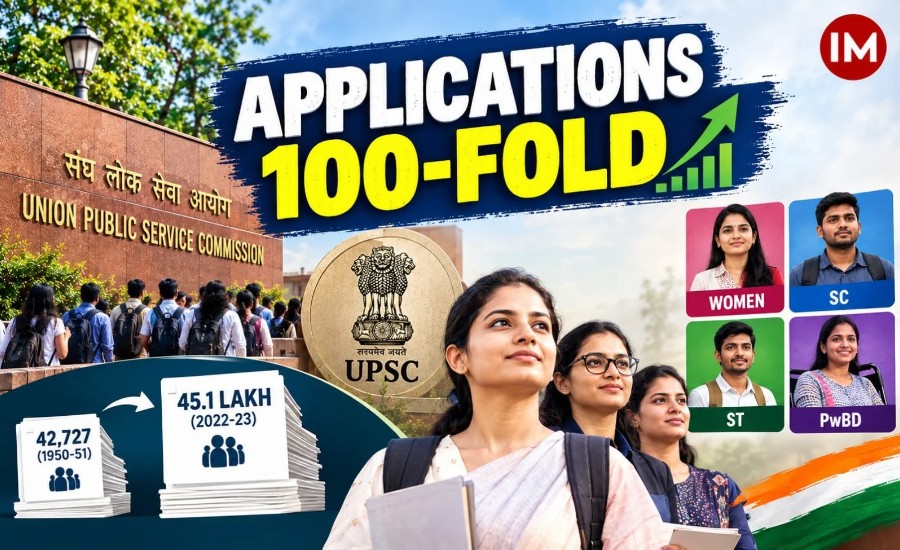
New Delhi: The Union Public Service Commission (UPSC), which completed 100 years on October 1, has expanded considerably in scale and reach since its early years, with applications across its examinations and recruitment-by-selection processes increasing from 42,727 in 1950-51 to 45,10,044 in 2022-23, according to official government data.
The figures are part of a PIB account of the Commission’s century-long institutional journey, which also records changes in examination centres, women’s representation and participation of candidates from different social groups.
UPSC’s Examination Workload Expands
In 2022-23, the Commission conducted 15 examinations, which together received 33,51,916 applications. It also received 233 requisitions for 4,411 posts through recruitment by selection, attracting another 11,58,128 applications.
Read Also: UPSC Exam Reforms: Chairman Ajay Kumar Stresses Reasoning, Decision-Making Over Rote Learning
The number of examination centres has also increased from eight in 1950 to 86 in 2026, reflecting the expansion of the Commission’s examination network over the decades.
Women’s Representation Rises in Civil Services
Official records also show a change in the representation of women among candidates recommended through the Civil Services Examination.
In 1952, only three women out of 83 recommended candidates were women, accounting for about 3.6%. In the CSE 2025, women accounted for 299 of the 958 candidates recommended, or about 31.2%. Women also secured 11 of the top 25 ranks in the 2025 examination.
The government’s centenary record notes that between 1949 and 1951, only one woman was selected for the Indian Foreign Service and two for the IAS.
The latest CSE result confirms that 299 women were among the 958 candidates recommended for appointment to various services in 2025.
Representation of SC, ST and PwBD Candidates Also Changes
The official centenary data records changes in representation beyond gender.
The number of SC candidates recommended through the Civil Services Examination increased from nine in 1955 to 158 in 2025, while ST recommendations rose from two in 1956-57 to 73 in 2025.
For persons with benchmark disabilities, recommendations increased from three in 2002 to 42 in 2025. The data also shows a substantial rise in applications from SC and ST candidates across UPSC examinations.
UPSC’s Century-Long Institutional Evolution
The first Public Service Commission in India was established on October 1, 1926. It was subsequently known as the Federal Public Service Commission from 1937 and became the Union Public Service Commission after the Constitution came into force in 1950.
Over the years, the Commission’s role expanded from its initial advisory framework to its present responsibilities as an independent constitutional authority involved in recruitment to various public services.
The UPSC’s centenary celebrations, held through a year-long programme from October 2025 to October 2026, have focused on its institutional values, recruitment processes, technology and the future of public service.
Read Also: PM Modi Calls for ‘Time Certainty’ in UPSC Exams, Says Delays Burden Aspirants