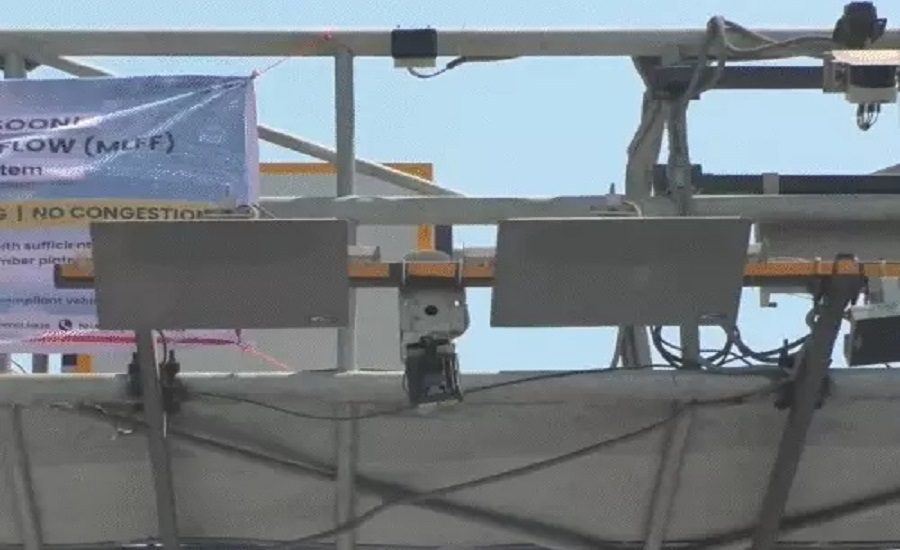
Surat (Gujarat): In a major step towards modernising India’s highway infrastructure, Union Minister for Road Transport and Highways Nitin Gadkari on Friday launched the country’s first Multi-Lane Free Flow (MLFF) barrier-less tolling system. The system has been inaugurated at the Choryasi Toll Plaza on NH-48 along the Surat–Bharuch stretch in Gujarat.
This cutting-edge initiative allows vehicles to pass through toll points without stopping, marking a significant shift from traditional toll collection systems.
What is MLFF Barrier-Less Tolling System?
The Multi-Lane Free Flow (MLFF) technology eliminates the need for physical toll barriers. Vehicles can move seamlessly through toll plazas—even at speeds of up to 120 km/h—without halting.
Instead of manual toll booths, the system uses overhead gantries equipped with advanced sensors and cameras that automatically detect vehicles and deduct toll charges in real time.
AI Cameras and FASTag Integration for Real-Time Toll Deduction
A key highlight of the system is its integration of FASTag with Automatic Number Plate Recognition (ANPR)technology.
- High-performance AI cameras can accurately read vehicle number plates even at speeds of up to 120 km/h
- RFID readers simultaneously scan FASTag stickers
- Toll charges are automatically deducted from the user’s linked account
In cases where a vehicle does not have a FASTag or the FASTag is non-functional, the system identifies the vehicle through its license plate and issues an e-notice to the registered owner.
Pilot Implementation at Choryasi Toll Plaza on NH-48
The system has been deployed at the Choryasi Toll Plaza on the busy Surat–Bharuch section of NH-48, a critical highway corridor with high traffic density. This pilot is expected to serve as a model for nationwide expansion in the future.
Reduced Travel Time, Less Congestion and Fuel Savings
According to the Ministry of Road Transport and Highways, the MLFF system is expected to bring multiple benefits:
- Significant reduction in travel time due to non-stop vehicle movement
- Lower traffic congestion at toll plazas
- Fuel savings by eliminating idling at toll points
- Reduced vehicular pollution
- Minimal human intervention in toll operations
Officials say the initiative represents a major step toward digitising India’s toll collection system and aligning it with global best practices.
‘System Will Simplify Lives of Citizens’: Gadkari
In a post on the social media platform X, Nitin Gadkari described the system as a state-of-the-art solution enabling seamless and non-stop toll payments.
He emphasised that the barrier-less tolling mechanism would simplify the lives of common people, while also boosting ease of doing business by improving the efficiency of goods movement and logistics across highways.
A Step Towards Smart Highways in India
The launch of MLFF tolling marks a transformative shift in India’s road infrastructure ecosystem. By combining AI-powered surveillance, FASTag integration, and automated enforcement, the system aims to create a faster, cleaner, and more efficient highway experience.
If implemented nationwide, this technology could redefine how millions of vehicles travel across India’s expanding network of national highways.