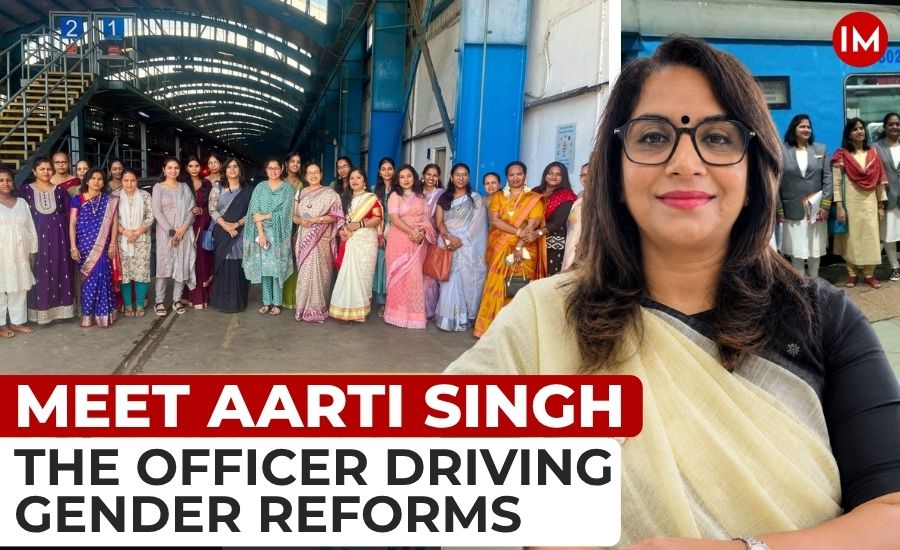
Indian Railways is often described as one of the world’s largest employers, connecting millions of people every day through an extensive network of stations, trains, and operational systems. Yet, for decades, many of its field-based roles remained overwhelmingly male-dominated.
Challenging that reality and creating space for greater participation of women has become a mission for IRTS officer Aarti Singh, whose initiatives are gradually changing both systems and mindsets across the organisation.
“When I joined Indian Railway Traffic Service in 2006, I found in my field postings that there were very few women officers and women employees. I felt that some proactive steps must be taken in order to increase women’s participation in Indian Railways,” IRTS officer Aarti Singh shared in an exclusive interview with Indian Masterminds.
Her observations were not limited to workforce numbers. Through years of field inspections and administrative responsibilities, she began identifying structural and cultural gaps that affected women’s experiences as both employees and passengers.
Creating Gender-Inclusive Railway Stations and Workplaces
One of Aarti Singh’s most significant contributions has been the development of the booklet “Guidelines for Gender Inclusive Systems at Railway Stations and Workplaces.“
The idea emerged during her tenure as additional divisional railway manager, where she oversaw passenger amenities and employee welfare. Regular inspections revealed that many facilities were designed with a gender-neutral approach that often overlooked the practical needs of women.
“The train services and stations are used by men and women. However, some small changes in design can make any amenity women-friendly,” she explains.
The guidelines provide practical recommendations for both women passengers and women employees. For passengers, the document highlights measures such as improved CCTV coverage, well-lit and separate washrooms, and enhanced security deployment. For employees, it recommends separate restrooms, prominent display of POSH Act information, emergency contact details, and safety mechanisms at workplaces and running rooms.
What makes the initiative notable is its focus on everyday infrastructure. Rather than relying solely on policy declarations, it seeks to make physical spaces safer, more accessible, and more comfortable for women.
Changing Mindsets, Not Just Infrastructure
According to Aarti Singh, the biggest challenge in implementing gender-inclusive reforms has not been resources or administrative approval but mindset.
“The issue is not insensitivity. It is more of a gender-blind approach. Gender-neutral is often taken as gender-blind, resulting in systems that are not designed to address women’s needs,” she says.
She believes that many gaps exist simply because decision-makers are unaware of them. Once these gaps are highlighted, people are generally willing to support corrective measures.
This understanding has shaped her broader approach to reform: creating awareness alongside infrastructure improvements.
Why Language Matters
A seemingly small but meaningful change introduced by Aarti Singh was renaming the long-standing “Man of the Month” awards to “Person of the Month.”
The awards were originally instituted in 2009 to recognise railway employees for exceptional service and contributions to operational safety. While women employees had received the award in the past, they were still being honoured under a title that implicitly excluded them.
By changing the name, Ms Singh sought to align recognition systems with the reality of a diverse workforce.
The response from employees has been positive, reinforcing the idea that inclusive language can play an important role in shaping workplace culture and perceptions.
Building Support Networks Through EASE
During interactions with women employees posted across remote railway locations, Aarti Singh noticed another challenge: the absence of mentorship and support systems.
Many women working in isolated stations and operational units faced difficulties but lacked channels to communicate their concerns effectively.
To address this, she launched the Empowerment Advocates and Support Enhancement (EASE) Team.
The initiative is designed to connect women employees with mentors, provide guidance on professional growth, and create a support structure that can identify and address workplace concerns.
“I felt that women employees were often lacking a mentor who could guide them in their professional journey. The EASE team was created to provide support, mentorship, and a platform where their voices can be heard,” she says.
Although the initiative is still in its early stages, it reflects an important shift toward institutional support mechanisms for women employees.
Bringing Gender Sensitivity Training to Thousands
Recognising that long-term change requires awareness and education, Aarti Singh also developed a Gender Sensitivity and Women Empowerment course on the iGOT platform.
The training programme focuses on gender sensitivity, workplace behaviour, professional boundaries, and awareness of the POSH Act. It also introduces participants to key concepts in gender studies and inclusion.
“Gender sensitivity training is necessary because people need to understand professional boundaries and behaviours that should be followed while working together,” she explains.
The response has been remarkable. Within just two working days of launch, the course attracted more than 5,000 learners and earned a 4.5-star rating from thousands of users.
Such participation demonstrates a growing willingness among public servants to engage with conversations around inclusion and workplace culture.
The All-Women Matunga Road Station Experiment
One of Aarti Singh’s most widely recognised achievements dates back to 2018, when she helped establish the all-women-staffed Matunga Road railway station in Mumbai.
“The objective extended beyond operational efficiency. It was intended to challenge stereotypes and showcase women’s capabilities across railway functions traditionally associated with men,” she says.
The initiative also sought to inspire young girls to consider careers in Indian railways.
Its success led to similar models being adopted elsewhere and contributed to a broader shift in perceptions. Today, the number of women station masters in Indian Railways has increased significantly compared to a decade ago.
Expanding Opportunities Beyond Traditional Roles
Aarti Singh also played a role in introducing women ticket-checking staff on long-distance services such as the Shatabdi Express.
Historically, women ticket-checking staff were often assigned station-based duties rather than lengthy train journeys. This was largely due to assumptions about their ability to manage demanding travel schedules.
Ms Singh challenged those assumptions.
To make the transition smoother, she introduced support measures including additional rest periods, security personnel, and transportation arrangements after duty hours.
The initiative not only expanded opportunities for women employees but also addressed a long-standing barrier to career progression in the department.
A Vision for the Future
For Aarti Singh, women’s empowerment is closely linked to better governance and stronger public institutions.
“Women are half the population of our country. If we can tap their potential, our economic growth will be doubled. More women in public service means a more holistic perspective on public issues and better service delivery systems,” she says.
Looking ahead, she envisions an Indian Railways where women are represented across all departments and levels—from loco pilots, guards, technicians, and station managers to senior leadership and policymaking positions.
She also believes that greater participation of women in designing workplaces, stations, and systems will naturally eliminate many of the blind spots that currently exist.
Her message is simple but significant: organisations function best when they fully utilise the talents of both men and women. As Indian Railways continues to evolve, initiatives like those led by Aarti Singh demonstrate how thoughtful reforms, inclusive policies, and cultural change can work together to create a more equitable future.